
Veo 3 vs Runway Gen-3: Complete Comparison 2026
Complete 2026 comparison of Google Veo 3 vs Runway Gen-3 Alpha. Quality, pricing, access, features, speed and use case recommendations for each tool.
Emma Chen · 16 min read · Apr 2, 2026
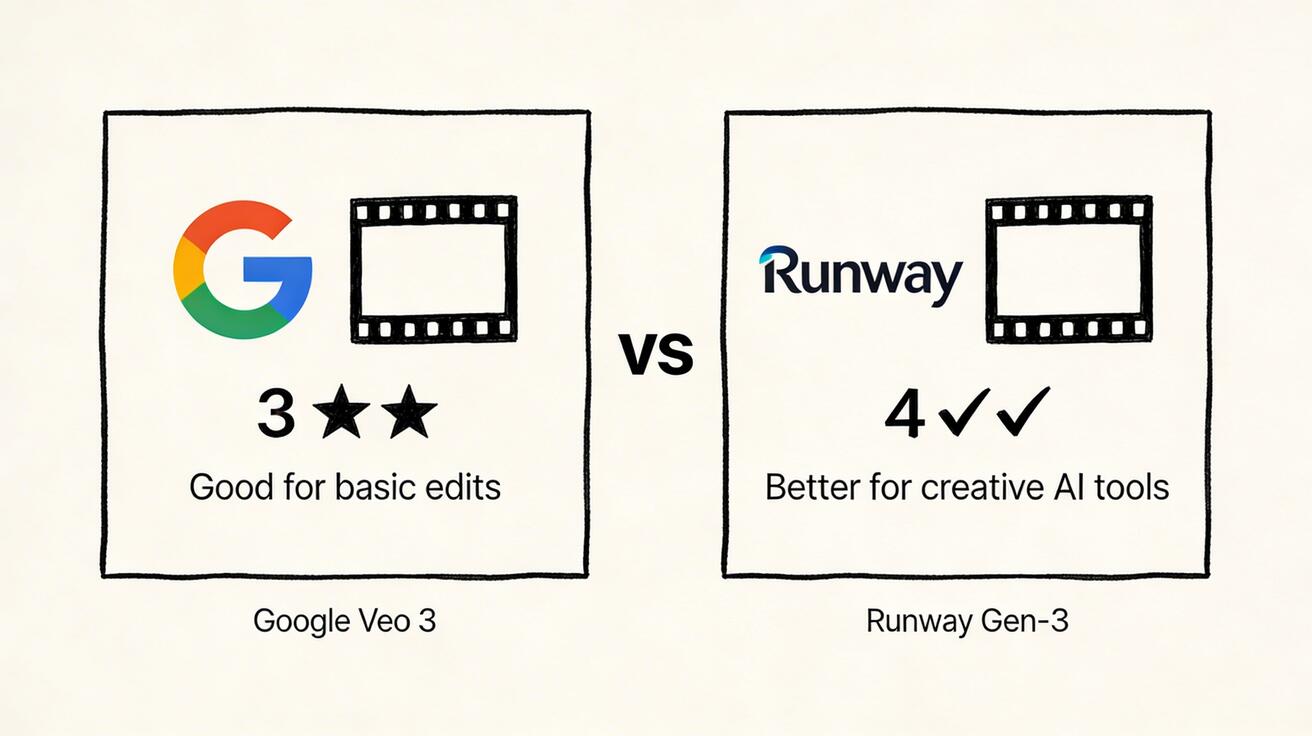
Two AI video generators define the premium end of the market in 2026: Google's Veo 3 and Runway's Gen-3 Alpha. Both produce breathtaking footage. Both are used by professional filmmakers, marketing agencies, and content creators at the highest level. But they are built differently, priced d
Quick Answer: Veo 3 vs Runway Gen-3: Complete Comparison 2026 — both tools offer strong AI video capabilities, but the best choice depends on your workflow, budget, and specific output requirements. Read our full comparison for a detailed breakdown.
ifferently, and optimized for different use cases.
This is the complete 2026 comparison of Veo 3 vs Runway Gen-3—covering quality, speed, pricing, features, access, and which tool is right for your specific use case.
Quick Verdict
| Dimension | Veo 3 | Runway Gen-3 |
|---|---|---|
| Visual Quality | ⭐⭐⭐⭐⭐ Best in class | ⭐⭐⭐⭐⭐ Best in class |
| Audio Generation | ✅ Native audio (unique) | ❌ Video only |
| Access | Google AI Ultra / API | Web app + API |
| Pricing | $249.99/month (Ultra) | From $15/month |
| Speed | Moderate | Fast (standard), slow (max) |
| Prompt Adherence | Excellent | Very good |
| Commercial Use | Yes (with plan) | Yes |
| Best For | Film, TV, professional production | Agencies, content creators, developers |
What is Veo 3?
Veo 3 is Google DeepMind's third-generation AI video model, released in mid-2025. It represents a fundamental step-change from previous AI video models in one critical dimension: native audio generation.
While every other AI video model produces silent footage that creators must score manually, Veo 3 generates synchronized audio—ambient sounds, dialogue, sound effects—as part of the video generation process. A clip of a crackling campfire actually crackles. A video of a car racing through rain sounds like rain and roaring engine.
This capability alone has made Veo 3 the subject of intense interest from film and television production professionals.
Veo 3 Key Capabilities
Text-to-video: Describe any scene in natural language and receive a rendered clip. Veo 3's understanding of cinematographic language (lens types, lighting setups, camera movements) is exceptionally sophisticated.
Image-to-video: Animate still images with described motion, maintaining consistency with the input image's style and content.
Native audio generation: Synchronized environmental sounds, music cues, and even dialogue lip-synced to generated characters.
Long-form coherence: Veo 3 maintains visual and narrative consistency across longer clip sequences—up to 2 minutes in extended generation mode.
Cinematic quality: Veo 3 outputs are routinely described as "indistinguishable from real footage" in controlled tests. Lighting, texture, and physics simulation are best-in-class.
What is Runway Gen-3?
Runway was the dominant AI video company before Google entered the space, and Gen-3 Alpha remains the benchmark for AI video quality among professional creators who prioritize accessibility, workflow integration, and API capabilities.
Runway is a company first, a model second—their web platform, API ecosystem, and creative tools have been refined over years of professional use. Gen-3 Alpha is the latest model in this mature ecosystem.
Runway Gen-3 Key Capabilities
Text-to-video: Industry-leading quality, with exceptional handling of creative and abstract prompts.
Image-to-video: Outstanding—many professionals argue Runway's image-to-video is still the best available for maintaining subject fidelity.
Video-to-video: Unique to Runway—take existing footage and transform it stylistically using AI.
Motion Brush: Selectively apply motion to specific areas of an image (e.g., animate just the hair in a portrait while keeping the face static).
Act One: Capture facial expressions from live reference footage and transfer them to generated characters.
Gen-3 Alpha Turbo: A faster, lower-cost variant optimized for iteration and high-volume workflows.
API access: Mature, well-documented API used by hundreds of production companies.
Quality Comparison: Veo 3 vs Runway Gen-3
Photorealism
Both tools produce stunning photorealistic footage. In head-to-head comparisons:
- Veo 3 edges ahead on lighting simulation—HDR lighting, complex shadow behavior, and lens effects (bokeh, chromatic aberration) look more physically accurate
- Runway Gen-3 excels at texture detail—fabric, skin, water surfaces have exceptional micro-detail
- Winner: Too close to call; depends on subject matter
Human Motion
- Veo 3: Strong on broad motion, improved on close-up human interaction in V3 vs predecessors
- Runway Gen-3: Exceptional facial expression and upper body motion; walking and full-body dynamics are a known weakness of Gen-3 Alpha specifically
- Winner: Veo 3 for full-body motion; Runway for facial/expression work
Abstract and Creative Prompts
- Veo 3: Trained on vast Google data, strong on common scenes and environments
- Runway Gen-3: Built by and for creative professionals—handles surreal, abstract, and unconventional prompts with remarkable fidelity
- Winner: Runway for creative/abstract; Veo 3 for realistic scenarios
Temporal Consistency
Temporal consistency refers to how well the video maintains visual coherence across frames—whether objects flicker, whether lighting shifts unnaturally, whether motion feels physically plausible.
- Veo 3: Best temporal consistency of any model tested in 2026. Objects maintain their properties across the entire clip duration.
- Runway Gen-3: Very good but occasionally shows the "shimmering" or "wavering" artifacts common in first and second-generation AI video. Gen-3 Alpha is significantly better than Gen-2 but still occasionally flickers on complex textures.
- Winner: Veo 3
Audio Quality
This is not a close comparison. Veo 3 generates synchronized, realistic audio. Runway generates no audio at all—you must add it in post-production.
For use cases where sound design matters (film, TV, ads, documentary), Veo 3's audio capability is a workflow-transforming advantage. For use cases where silence is fine (social media with music overlay, stock footage), the advantage is moot.
- Winner: Veo 3, decisively
Pricing Comparison
Veo 3 Pricing
Veo 3 is accessible through two pathways:
Google AI Ultra ($249.99/month): The consumer/creator plan. Includes access to Veo 3 via Google's AI platforms (Google AI Studio, Vertex AI). Does not include commercial production licensing for large enterprises.
Vertex AI API: Enterprise pricing, billed per second of generated video. Appropriate for production companies, game developers, and enterprise applications. Pricing varies; contact Google Cloud sales.
Google DeepMind Research Access: Academic and research institutions can apply for extended access programs.
Runway Pricing
Runway offers a more accessible pricing ladder:
- Free: 125 credits on signup (~4–5 standard generations)
- Standard: $15/month — 625 credits monthly (~25 standard generations)
- Pro: $35/month — unlimited standard generations, plus Gen-3 Alpha Turbo
- Unlimited: $95/month — unlimited Gen-3 Alpha, priority rendering
- Enterprise: Custom pricing with commercial licensing, SLAs, and dedicated support
The Pricing Verdict
Runway wins on accessibility. At $15/month, serious hobbyists and small creators can use professional AI video tools monthly. The tiered structure makes sense for different use scales.
Veo 3's $249.99 price point is justified for professional productions where native audio generation saves significant post-production cost and time—but it is inaccessible for most individual creators.
Access and Availability
Veo 3 Access
Veo 3's rollout in 2025–2026 has been phased and capacity-constrained. Access methods:
- Google AI Ultra subscription — waitlisted in many regions at launch, now generally available in US, UK, EU
- Vertex AI — available to Google Cloud customers with API enabled
- Google AI Studio — limited access for developers and researchers
International availability is uneven. Creators in Southeast Asia, South America, and parts of Africa report significant wait times for AI Ultra.
Runway Access
Runway has been available globally since Gen-2. No waitlist for standard access. Runway is accessible in 190+ countries with no regional restrictions beyond standard payment processing limitations.
Winner: Runway for accessibility; Veo 3 improving but still constrained
Speed and Production Workflow
Generation Speed
- Veo 3 standard: 3–8 minutes per clip (10 seconds of video)
- Veo 3 extended mode: 15–25 minutes for longer sequences
- Runway Gen-3 Alpha: 2–5 minutes per clip (10 seconds)
- Runway Gen-3 Alpha Turbo: 30–90 seconds (slightly lower quality)
For high-volume workflows, Runway Turbo is significantly faster and practical for daily content production. Veo 3 does not have a comparable speed tier.
API Integration
Both tools offer APIs. Runway's API is more mature:
- Better documentation
- More client SDKs (JavaScript, Python)
- Predictable pricing model
- Active developer community and support
Veo 3's API (via Vertex AI) is enterprise-grade but requires more Google Cloud infrastructure knowledge to implement effectively.
Winner: Runway for developers and agencies
Use Case Recommendations
Choose Veo 3 If:
✅ You are producing film, television, or commercial content where audio authenticity matters
✅ You need the highest possible cinematic quality and budget is not a constraint
✅ You are a Google Cloud customer with existing infrastructure
✅ Your use case involves long-form coherent sequences (2+ minutes)
✅ You are a narrative filmmaker exploring AI-augmented production workflows
✅ Temporal consistency is critical (product shots, VFX integration)
Choose Runway Gen-3 If:
✅ You are a marketing agency or content creator with volume requirements
✅ You need accessible pricing that scales with usage
✅ You value creative/abstract prompt handling and artistic flexibility
✅ You need API integration for a production pipeline
✅ You want Motion Brush, Act One, or other unique creative tools
✅ You are outside the US/UK/EU where Veo 3 availability is limited
✅ You need reliable daily access without capacity constraints
Use Both If:
Some professional studios are using a two-tool workflow:
- Runway Gen-3 Turbo for rapid concept generation and iteration
- Veo 3 for final, hero-quality outputs with native audio
This takes advantage of Runway's speed and flexibility in the ideation phase while leveraging Veo 3's superior quality for finished deliverables.
The Audio Question: Is Veo 3's Native Audio a Game-Changer?
Yes, for specific professional contexts. Here is when it matters:
Matters enormously:
- Documentary-style content where ambient sound is part of the narrative
- Dialogue-driven clips (Veo 3 can generate lip-synced speech)
- Atmospheric pieces where environmental audio defines the mood
- Any production context where saving sound design time has real dollar value
Matters less:
- Social media content where music overlay is standard
- Stock footage for licensing libraries (most buyers prefer clean audio-free clips)
- Content where you have specific licensed music already
In 2025, Veo 3's audio capability was a raw prototype. In 2026, it has matured to a point where it is genuinely production-ready for many applications.
Runway's Competitive Response to Veo 3
Runway has not been static. Their 2025–2026 roadmap responses to Veo 3 include:
- Gen-3 Alpha Turbo: Dramatically faster generation, democratizing the pipeline
- Act One 2.0: Improved facial capture and transfer
- Runway Audio (beta): Runway is actively developing audio generation, expected full release H2 2026
- Collaboration tools: Multi-user project workflows for agency use cases
- Custom model training: Fine-tune Gen-3 on your brand's visual style
If Runway ships audio generation at quality competitive with Veo 3, the gap between the two tools narrows significantly.
Community and Ecosystem
Veo 3 Community
Veo 3 is Google's product in Google's infrastructure. The community is nascent—most activity happens in Google's official channels, early adopter Discord servers, and on social platforms like X and LinkedIn.
Runway Community
Runway has one of the most developed creator communities in AI video:
- Active Discord (100,000+ members)
- Regular tutorials from professional filmmakers
- Runway's own film festival (Runway AI Film Festival) attracting top talent
- Extensive YouTube tutorial ecosystem from third-party creators
For learning, troubleshooting, and creative inspiration, Runway's community is substantially more developed than Veo 3's at this point in 2026.
Final Verdict: Veo 3 vs Runway Gen-3 in 2026
Veo 3 is the better model in 2026—if you can access it and can justify the cost. The native audio generation is a genuine innovation that changes production workflows. Temporal consistency is industry-leading. For professional film and TV applications, Veo 3 is the premium choice.
Runway is the better platform for most creators and agencies. Accessible pricing, mature toolset, global availability, strong API, and a robust creative community make Runway the practical choice for the vast majority of AI video use cases.
The choice is not which tool is "better" in an absolute sense—it is which tool fits your budget, workflow, and production requirements.
For learning AI video, start with Runway. For professional production where quality and audio authenticity are non-negotiable, invest in Veo 3.
Frequently Asked Questions
Can I use Veo 3 for free?
Veo 3 requires a Google AI Ultra subscription at $249.99/month or Vertex AI API access. There is no meaningful free tier for Veo 3 as of 2026.
Does Runway Gen-3 have audio?
Gen-3 Alpha does not generate audio. Runway is developing audio capabilities, but as of early 2026, you must add audio in post-production.
Which is better for YouTube content?
Runway Gen-3 at the standard or Pro tier is typically the better choice for YouTube creators due to cost, accessibility, and production speed.
Can I use Veo 3 or Runway for commercial projects?
Both support commercial use on their paid plans. Review the specific licensing terms in each platform's Terms of Service.
Is Runway still the best AI video tool with Veo 3 now available?
For most users, Runway remains the most practical and cost-effective choice. Veo 3 is technically superior in specific dimensions but is constrained by price and availability.
Which tool has better API support?
Runway's API is more mature and developer-friendly. Veo 3 via Vertex AI is enterprise-grade but requires Google Cloud infrastructure expertise.
The Creative Professional's Perspective: Filmmaker Views on Veo 3 vs Runway
To go beyond technical specs, it helps to understand how working creative professionals actually choose between these tools. Based on community discussions and professional reviews throughout 2025 and into 2026, here are the prevailing views:
Advertising agencies largely prefer Runway for its API maturity, predictable pricing, and the ability to integrate Gen-3 into established creative workflows. The Motion Brush feature is particularly valued for precisely controlled creative outputs.
Independent filmmakers are split. Those working on art-house projects tend to gravitate toward Runway for its creative flexibility. Narrative filmmakers producing commercial work are increasingly testing Veo 3 for the audio generation capability, which meaningfully reduces post-production costs.
Content marketing teams almost universally choose Runway due to cost predictability and volume capacity. At $35–95/month for unlimited generations, a team can produce AI video at the scale that modern content marketing demands.
Music video directors and experimental creators show the most interest in Veo 3's unique audio-synchronization capability, seeing it as a genuinely new creative tool rather than just a faster alternative to existing approaches.
Long-Term Roadmap Considerations
Both Veo 3 and Runway Gen-3 are products in active development. The decision you make today may shift within 6–12 months as each platform releases new capabilities.
Veo 3 Development Trajectory
Google's competitive position in AI gives Veo 3 virtually unlimited R&D resources. Expected near-term developments:
- Improved international accessibility and pricing tiers
- Native video editing capabilities within Google's app ecosystem
- Deeper integration with YouTube's creator tools (potentially Shorts-specific generation)
- Audio refinement—more nuanced environmental sound and music generation
Runway Development Trajectory
Runway has explicitly committed to closing the audio gap with Veo 3. Their announced roadmap includes:
- Full audio generation launch (expected H2 2026)
- Expanded Act One capabilities for character animation
- Gen-3 Ultra (higher quality tier, announced but not launched)
- Enhanced video-to-video transformation tools
If Runway ships competitive audio generation in H2 2026, the technical differentiation between the two platforms narrows substantially, and the competition shifts to pricing, access, and workflow integration—dimensions where Runway currently leads.
Cost-Per-Output Analysis for Different Production Scales
Understanding total cost requires thinking about your actual output volume, not just the subscription price.
Small Creator (10 videos/month)
- Runway Standard ($15/month): ~25 standard generations = costs $0.60/video
- Veo 3 (AI Ultra $249.99/month): 10 videos = costs $24.99/video
- Winner: Runway by a large margin for small-scale use
Agency (100 videos/month)
- Runway Pro ($35/month): Unlimited standard = costs $0.35/video
- Veo 3 (Vertex AI): At $0.50/sec × 8 sec avg = $4.00/video × 100 = $400/month
- Winner: Runway for agencies with high volume requirements
Major Film Production (20 high-quality sequences/month)
- Runway Unlimited ($95/month): 20 max-quality videos = $4.75/video
- Veo 3 (Vertex AI): Higher quality but audio saves 3 hours post-production per video. At $100/hour sound design = $300 savings × 20 videos = $6,000 saved.
- Winner: Veo 3 at scale for productions where native audio has real dollar value
This analysis illustrates why the "right" choice depends entirely on your production context. There is no universal winner—only the winner for your specific use case.
Integrations and Workflow Tools
Both Veo 3 and Runway Gen-3 output MP4 files that work with any professional video editing software. However, their broader ecosystem integrations differ:
Runway integrates with:
- Adobe Premiere Pro (via plugin)
- Frame.io collaboration platform
- Zapier for automated workflows
- Custom integrations via REST API
Veo 3 integrates with:
- Google Workspace suite
- Vertex AI ML pipelines
- Google Cloud storage natively
- Other Google AI services (Gemini, Imagen)
For creators already embedded in Adobe or professional production workflows, Runway's integrations are more practically useful. For technology companies and developers building AI-powered products, Veo 3's Vertex AI integration offers more native flexibility.
The bottom line remains the same: evaluate based on your specific production context, budget, and technical requirements. Both tools represent the frontier of AI video generation in 2026, and either one will dramatically transform your creative capabilities compared to traditional production approaches.
Our Verdict
Google Veo 3 represents the current state of the art in AI video generation, delivering unmatched cinematic quality, realistic motion, and native audio synthesis. For creators and professionals who want the best possible output, Veo 3 is the clear frontrunner in 2025 — and it's only getting better with each update.
Related Articles
Continue with more blog posts in the same locale.
Veo 3 vs HeyGen 2026: AI Video Generation vs AI Avatar Studio
Veo 3 vs HeyGen 2026: compare AI video generation and AI avatar studio workflows, see where each excels, and decide which belongs in your video production stack.
Read article
Veo 3 vs InVideo AI: Which Should You Use in 2026?
Veo 3 vs InVideo AI: understand the core difference between AI video generation and AI-assisted production, see how each excels, and decide which fits your workflow in 2026.
Read article
Veo 3 vs Pollo AI: Which AI Video Generator Should You Choose in 2026?
Compare Veo 3 and Pollo AI across video quality, native audio generation, pricing, and use cases. Find out which AI video generator is right for your workflow in 2026.
Read article