
What Makes a Video Go Viral Unlocking the Science of Sharing
Discover what makes a video go viral using proven strategies. Learn the psychology, platform signals, and creative tactics that create shareable content.
Veo3 AI · 25 min read · Dec 11, 2025
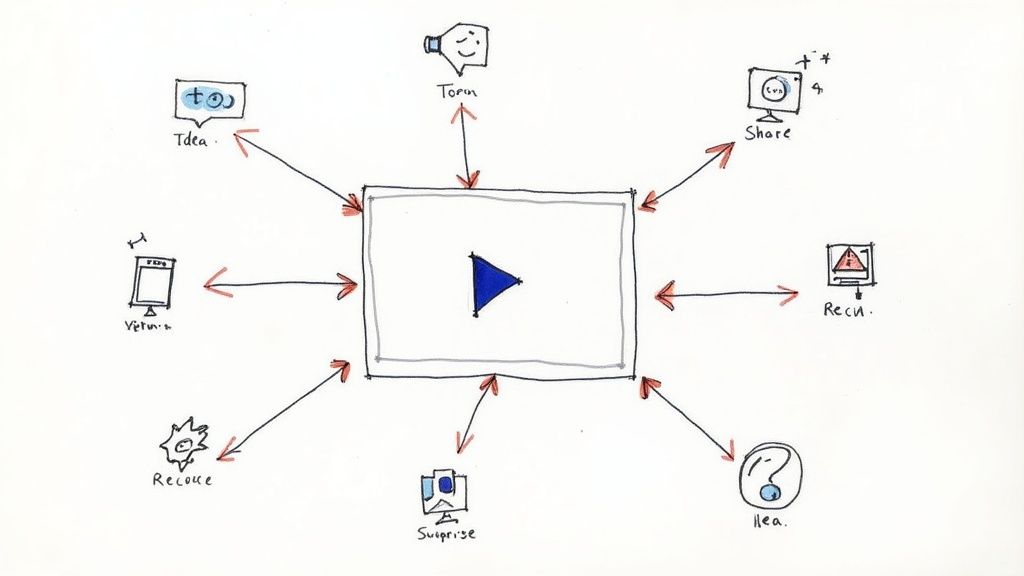
So, what's the secret sauce that makes a video go viral? The short answer is there's no magic to it. Virality is really just a well-executed mix of emotional connection, smart timing, and knowing how to play the platform game. It’s that moment when a video hits just right, sparking an almost uncontrollable urge in viewers to share it with everyone they know.
Quick Answer: Effective social media content strategies combine compelling visuals, strong hooks in the first 3 seconds, relevant keywords, and a consistent publishing schedule. AI video tools like Google Veo 3 and Runway dramatically speed up content production without sacrificing quality.
Decoding The Viral Video Blueprint
Going viral isn't about catching lightning in a bottle. It's more like building a better lightning rod. Instead of some secret formula, it’s about understanding a practical framework—reverse-engineering why people share things and then baking those elements into your video from the very start.
This guide will give you a clear roadmap. We'll skip the myths about overnight success and dig into the real mechanics of what makes content spread like wildfire. We're talking about the psychology that fuels engagement, the algorithms that decide who sees what, and the distribution tactics that give your video that critical first push.
The Core Pillars of Virality
Every viral video you've ever seen, no matter how different, stands on the same foundational pillars. The content itself might be wildly unique, but the underlying principles that make it shareable are surprisingly consistent.
- Emotional Resonance: It has to make you feel something. Laughter, awe, shock, even a bit of anger—strong emotions are the currency of sharing.
- Strategic Timing: The video has to land at the right moment. It needs to tap into current conversations, trends, or a shared cultural feeling to gain that initial momentum.
- Platform Mastery: You have to play by the platform's rules. That means nailing the format, length, and other subtle cues the algorithm is looking for.
This blueprint isn't just a checklist; it's a system where each part strengthens the others. Great timing makes an emotional video even more potent, and optimizing for the platform ensures that spark reaches the widest possible audience.
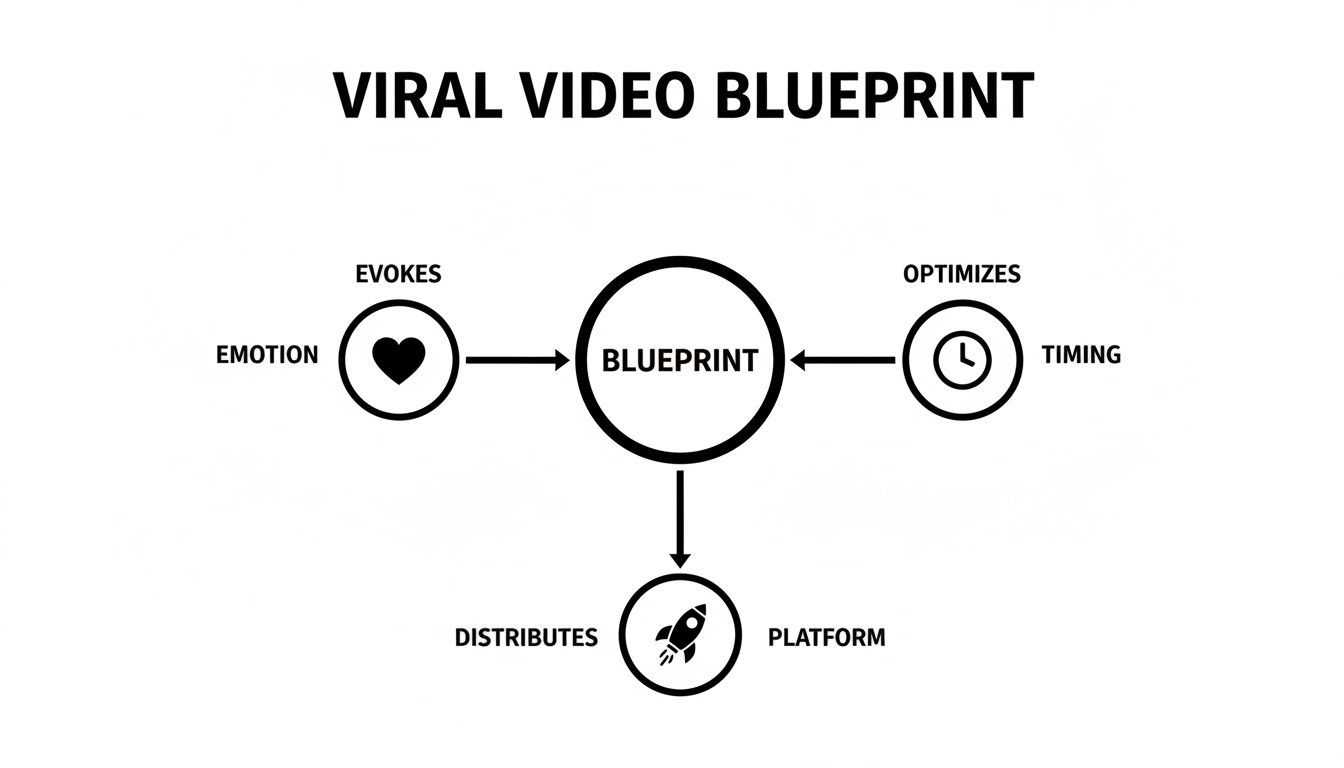
To help visualize how these elements come together, let's break them down into a simple table.
The Core Components of Viral Success
This table summarizes the key pillars that give a video its best shot at going viral, breaking them down into actionable categories.
| Pillar | What It Means | Real-World Example |
|---|---|---|
| Emotion | The video triggers a strong, universal feeling like joy, surprise, or inspiration. | The "Double Rainbow" guy's pure, unscripted awe. |
| Timing | The content is perfectly relevant to a current event, holiday, or trending topic. | A clever meme video released within hours of a major pop culture moment. |
| Platform | The video is perfectly formatted for the platform (e.g., vertical for TikTok, high-res for YouTube). | A short, punchy TikTok that uses a trending audio clip and text overlays. |
By mastering these pillars, you move from just hoping for virality to actively engineering it.
To really get this right, a solid social media posting strategy playbook is essential for mapping out your content and distribution. And if you want to get better at building these pillars into your work, our guide on https://www.veo3ai.io/blog/how-to-create-engaging-content is the perfect next step.
The Psychology Behind the Share Button
Let's get one thing straight: every viral video has a secret weapon, and it has almost nothing to do with fancy editing or expensive cameras. It’s all about human psychology. People don't just share content because it’s well-made; they share it because of how it makes them feel.
If you want to create something truly shareable, you first have to understand what compels someone to go from being a passive viewer to an active promoter of your content.
Think of your video as carrying an "emotional payload." The stronger and more specific that feeling is, the more likely people are to pass it on. A video that makes someone genuinely laugh out loud isn't just a funny clip anymore—it's a little dose of joy they can instantly send to a friend who needs a pick-me-up. This transfer of emotion is the real engine behind virality.
The Core Emotional Triggers
The real rocket fuel for sharing? High-arousal emotions. These are the feelings that jolt us, stir us up, and create a real, tangible reaction that makes it almost impossible not to do something. The trick is to aim for one powerful, specific emotion instead of trying to make a video that’s a little bit of everything.
Some of the most powerful triggers include:
- Awe and Wonder: Think of videos that show something absolutely spectacular or mind-bending. They make us feel like we're part of something bigger than ourselves.
- Intense Laughter: Not just a little chuckle, but pure, unadulterated humor that makes you belly laugh. It’s a physical reaction people love to share.
- Surprise and Novelty: Content that completely shatters expectations or shows us something we have never seen before. Our brains are wired to pay attention to the new and unexpected.
- Righteous Anger or Inspiration: Videos that tap into our shared values can be incredibly powerful, motivating us to either stand up for something or feel deeply inspired.
When your video delivers one of these emotional payloads successfully, viewers feel an almost primal urge to pass that feeling on. It stops being about your video and starts being about sharing the experience.
Beyond Emotion: Social Currency and Relatability
While a strong emotional punch is the main driver, there are a couple of other key psychological factors at play. People are also deeply motivated by how sharing a piece of content reflects on their own identity and social standing. This is a concept known as social currency.
Put simply, we share things that make us look good. Sharing an insightful, clever video makes us look intelligent. Sharing a hilarious meme makes us seem witty and culturally plugged-in. Sharing a video about a niche hobby connects us to a community and signals our expertise.
In essence, sharing is a form of self-expression. When you create a video, ask yourself: "What does sharing this say about the person who shares it?" If the answer is "It makes them look cool, smart, or compassionate," you’re on the right track.
Another incredibly powerful hook is deep relatability. This is that magic moment when a video perfectly captures a thought, frustration, or shared experience that people have felt but couldn't quite put into words. When a viewer sees their own life reflected back at them, the immediate reaction is, "This is SO me!"—and the next click is almost always "Share."
Building Psychological Hooks into Your Content
This is what separates the creators who get lucky once from those who consistently create shareable content. They don't just make a video; they intentionally design a reason for people to share it.
Here’s how to start thinking this way:
- Define the Payload: Before you even think about filming, decide on the one single emotion you want your audience to walk away with. Is it pure joy? Awe? The feeling of being completely understood? Every creative decision you make should serve that one emotional goal.
- Craft for Social Currency: Think about your video from the sharer's perspective. Can you package a complex idea into a simple animation that makes them look smart for sharing it? Can you create a take so funny it makes them the hero of their group chat?
- Mine for Relatability: The best ideas are often hiding in plain sight. Pay attention to the small, everyday moments, struggles, and weird habits that connect us all. A video about the universal struggle of folding a fitted sheet can go just as viral as a blockbuster production because it hits that relatability nerve.
By focusing on these psychological drivers, you can craft content that doesn't just entertain but gives viewers a powerful, irresistible reason to hit the share button. Building these elements into your content is a non-negotiable for growth, and you can learn more about how to improve your social media engagement in our detailed guide. This approach turns your video from just another piece of media into a vehicle for human connection, identity, and emotion.
Mastering the Algorithms That Fuel Virality
So, you've made a video that connects with people. That's half the battle. Now you have to win over the machines.
Platforms like TikTok, YouTube, and Instagram are run by powerful algorithms that act as digital gatekeepers. They are constantly scanning new content, deciding in an instant whether to show your video to a small group of friends or broadcast it to millions. Getting past them is non-negotiable.
Think of an algorithm as a relentlessly efficient talent scout. It's not looking for art; it's looking for signals that a video is a "hit." When it spots those signals, it throws its full weight behind the video, giving it a bigger and bigger stage. If your video doesn't send the right signals, it gets left in the dark, no matter how amazing it is.
Your job is to speak the algorithm's language by giving it exactly what it's looking for.
The Digital Snowball Effect
Viral growth isn't a slow burn; it's an explosion. It works a lot like a snowball rolling down a hill—starting small but picking up mass and speed until it becomes an unstoppable force. In the world of video, that momentum is called engagement velocity.
This is all about how quickly your video racks up likes, comments, shares, and saves right after it goes live.
A huge burst of engagement in the first few minutes is the most powerful signal you can send. It’s like a flare in the night, telling the algorithm, "Hey, look over here! People are losing their minds over this right now." This initial spike convinces the platform to test your video with a slightly larger audience. If they love it too, the snowball grows, and the algorithm pushes it out even further. This cycle is what fuels viral takeoffs.
The core idea is simple: Algorithms amplify what's already hot. It’s not just about getting engagement; it’s about getting it fast. A video that gets 100 likes in the first ten minutes is exponentially more powerful than one that gets 100 likes over two days.
This initial velocity is what separates the duds from the blockbusters.
The Key Metrics That Algorithms Actually Care About
While each platform keeps its exact formula under lock and key, they all zero in on a few universal metrics to judge a video's quality. If you want your content to stand a chance, you need to know what they are.
These are the signals you absolutely have to nail:
-
Watch Time and Audience Retention: This is the big one. If people stick around for your whole video (or at least most of it), you're sending a massive signal that your content is genuinely engaging. High retention tells the algorithm that this video is worth other people's time, so it serves it up to more users.
-
Shares and Saves: Likes are nice, but shares and saves are gold. A share is a personal endorsement that pushes your video into a whole new network of people. A save is even stronger; it means someone found your content so valuable they want to come back to it again. Algorithms weigh these high-intent actions very heavily.
-
Comments and Conversation: The algorithm isn't just counting comments; it's looking for real conversations. Videos that get people talking back and forth are seen as community-builders, and platforms love that. Posing a question or dropping a controversial take is a classic way to get the comments flowing.
The power of this is especially clear on platforms like TikTok, which has an average post engagement rate of 2% to 4%. That’s significantly higher than other platforms, and it’s why trending videos can rack up millions of views purely through the "For You Page" algorithm. You can dig deeper into the numbers with these video marketing statistics on vidico.com.
When you build content that delivers on these metrics, you’re not just making a video people will like—you're feeding the algorithm exactly what it wants to see. This is especially true for short-form video, and our guide on how to increase Instagram Reels views breaks down more specific tactics for that format.
How to Structure a Shareable Video
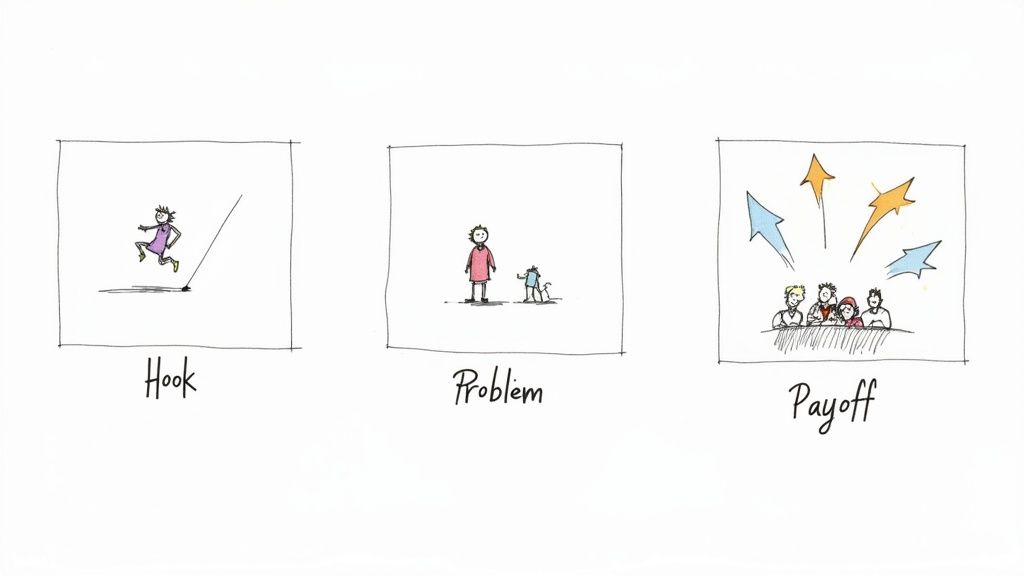
A video's structure is its skeleton. Without a solid framework, even the most amazing idea can feel like a confusing mess, giving viewers every reason to scroll right past it. The anatomy of a shareable video isn't overly complicated, but it is incredibly deliberate. It's all about grabbing attention and refusing to let go.
Think of it like telling a great joke: you need a solid setup, a bit of a build-up, and a killer punchline. Each part does a specific job. If one piece fails, the whole thing falls flat. The most-shared videos almost always follow a simple, time-tested pattern that takes the viewer on a quick but satisfying little journey.
The Irresistible Three-Second Hook
On a crowded social feed, you don’t have minutes to make your case—you have seconds. In fact, the first three seconds are without a doubt the most important part of your entire video. This is your one and only shot to stop the scroll and earn just a few more moments of someone's attention.
Your hook has to be immediate and powerful. It should pose an intriguing question, show a visually stunning moment, or tease a surprising result. Forget slow intros, fancy title cards, or anything that doesn't instantly get to the point.
Here are a few proven ways to hook viewers:
- The Problem Hook: Kick things off by showing a common, relatable frustration.
- The "Wow" Hook: Open with your most shocking, beautiful, or visually arresting shot.
- The Curiosity Hook: Ask a provocative question or make a bold claim that just begs for an explanation.
The goal here is to create a small "information gap" in the viewer's mind that they feel a natural urge to close. Once you've got them, you can smoothly transition into the heart of your story.
Crafting a Compelling Narrative Arc
Believe it or not, every viral video tells a story, even if it's only 15 seconds long. A clear beginning, middle, and end gives your content a sense of purpose and makes it feel satisfying to watch. You don't need a Hollywood script, but a simple narrative keeps people locked in because they subconsciously want to see how it all turns out.
A classic framework that just plain works is the Problem-Solution arc. This simple structure is so effective because it’s deeply human and relatable.
- Introduce the Problem: Quickly set up a conflict or challenge the audience instantly gets. This creates an immediate connection.
- Show the Solution: Present your idea, product, or trick as the clear answer to that problem.
- Reveal the Payoff: Show the amazing result or positive transformation. This delivers the emotional reward and makes the video feel worth sharing.
This structure is incredibly versatile, working for everything from cooking tutorials and DIY hacks to funny skits. It creates a complete thought loop that leaves the viewer feeling like they've gained something valuable—and makes them eager to pass that value on to others.
Nailing the Technical Details
Beyond the story itself, a few technical elements are simply non-negotiable if you want people to share your content. These details make sure your video is easy to watch, looks good, and is optimized for how people actually consume media on their phones today.
Thumbnails and Captions Matter Your video's thumbnail is its book cover. It has to be high-quality, eye-catching, and give a clear idea of what the video is about or the emotion it delivers. A great thumbnail makes a promise that the video then has to fulfill.
Likewise, dynamic, easy-to-read captions are absolutely essential. With a massive percentage of social video being watched with the sound off, captions ensure your message gets through no matter what. They make your content more accessible and keep people engaged even in silent environments.
A compelling thumbnail gets the click, but clear captions get the watch-through. Neglecting either one is like building a fantastic car but forgetting the keys and the wheels.
Optimal Length for Maximum Impact There's no single "perfect" video length; it really depends on the platform. The guiding principle should always be: be as long as necessary, but as short as possible. For fast-paced platforms like TikTok and Instagram Reels, videos under 60 seconds tend to do best because they help maintain high audience retention.
That said, the definition of "short-form" is changing. The explosion of short-form video and live streaming has shifted viral trends around the world. Platforms like TikTok have expanded their limits from 60 seconds to as long as 10 minutes, opening the door for new creative formats that can still hold strong engagement. For a deeper look at how these dynamics are playing out, check out these global video marketing trends on teleprompter.com.
Ultimately, structuring a great video is all about building a seamless experience. From that first-second hook to the final payoff, every single element has to work together to capture attention and deliver a reward that’s worth sharing.
Using Strategic Distribution for Explosive Growth
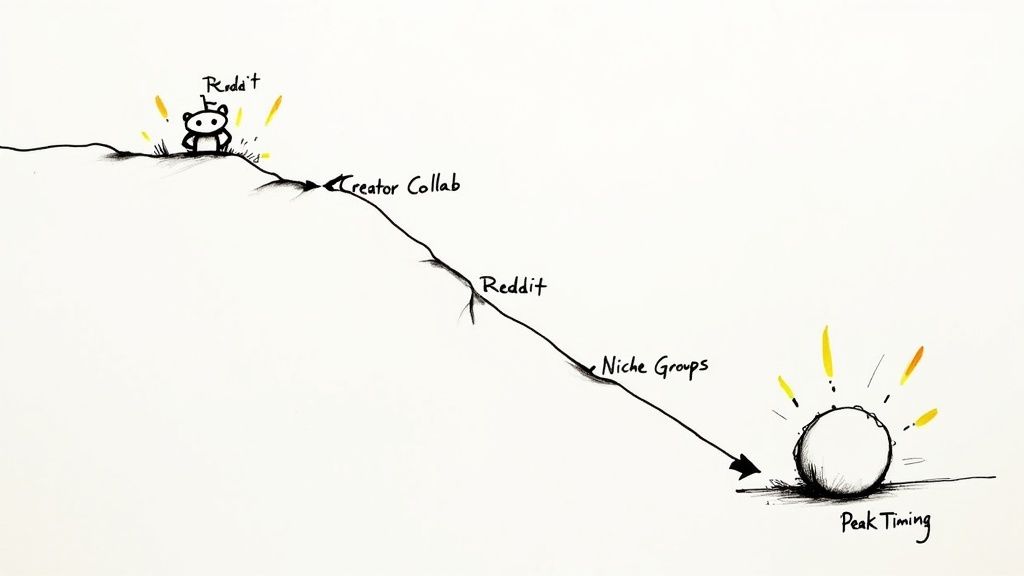
You’ve done the hard work. You've created a video with real emotional punch and a killer structure. But here's a hard truth: the most brilliant video in the world is useless if it's sitting in a dark corner of the internet where no one can find it.
Now, you have to switch gears from creator to distributor. This is where you build the launchpad that gives your video the initial momentum it needs to actually take off. A great distribution plan doesn't just hope for an audience; it actively puts your content in front of the right people at the right time.
Building Your Pre-Launch Checklist
The real work of distribution starts long before you even think about hitting "publish." A clear plan ensures your video’s first hour online is as impactful as possible, which sends all the right signals to the algorithms.
This pre-launch phase is all about manufacturing that initial burst of engagement. You need to know exactly where your video will land and who will see it first.
- Pinpoint Niche Communities: Where does your audience actually live online? Find the right subreddits, niche Facebook Groups, or specialized forums where your video adds value instead of feeling like spam.
- Prepare Your Share Copy: Never just drop a link and run. Craft compelling captions tailored to each platform. Ask a provocative question or tease the most surprising moment to spark instant conversation.
- Prime Your Network: Give your most loyal fans, friends, or colleagues a heads-up that something is coming. A small, dedicated group can provide that crucial first wave of shares and comments that gets the ball rolling.
This initial seeding is what gives a video the velocity it needs to break out. You're giving the digital snowball its first, crucial push down the hill.
Timing and Trend-Jacking for Maximum Impact
Timing is everything. Posting your video when your target audience is scrolling their feeds dramatically increases its chances of getting seen. Dig into your platform’s analytics to find those peak engagement hours and schedule your content to drop right then.
Beyond just the time of day, think about the broader cultural timing. Is there a trending topic, a news story, or a popular meme your video can connect with? This is often called "trend-jacking," and it’s about aligning your content with a conversation that's already happening at scale.
Think of it this way: It's much easier to join a river that's already flowing than it is to dig a new one from scratch. By tapping into a current trend, you’re inserting your video into a conversation that millions of people are already having.
This doesn't mean you should chase every fleeting fad. Look for trends that genuinely overlap with your video's theme or message. A cleverly timed piece of content can ride the wave of a popular topic, exposing it to a massive, built-in audience you couldn't have reached otherwise.
Collaborations and Cross-Promotion
One of the fastest ways to expand your reach is to borrow someone else’s. Partnering with other creators in your space is a hugely powerful distribution tactic. A simple shout-out, a duet, or a joint video can introduce your work to a whole new, highly relevant audience that’s already wired to be interested in what you do.
And don't forget to cross-promote on your own channels! A link to your new YouTube video should be in your Instagram Story, in a tweet, and in your email newsletter. This consolidates your existing audience, building a strong base of initial views that provides the foundation for explosive growth.
For more deep dives on distribution and growth strategies, the team over at Branditok's Blog shares some excellent case studies and advice.
Your Viral Video Distribution Checklist
To help you get started, here is a simple checklist to guide your distribution efforts from start to finish. Following these steps can help ensure you don't miss any opportunities to get your video in front of as many people as possible.
| Phase | Action Item | Key Objective |
|---|---|---|
| Pre-Launch | Identify 5-10 niche communities (e.g., Subreddits, Facebook Groups). | Find fertile ground where your content will be well-received. |
| Pre-Launch | Draft platform-specific share copy and a compelling call-to-action. | Prepare engaging hooks to maximize click-throughs and comments. |
| Launch Day | Post at your audience's peak activity time (check platform analytics). | Maximize initial visibility in the crucial first hour. |
| Launch Day | Share the video across all your personal social channels immediately. | Funnel your existing audience to create an initial engagement spike. |
| Post-Launch | Engage with every comment and share for the first 24 hours. | Signal to the algorithm that the content is sparking conversation. |
| Post-Launch | Reach out to 3-5 creators for potential shares or collaborations. | Tap into new, relevant audiences for a secondary wave of views. |
| Ongoing | Monitor analytics to see which distribution channels performed best. | Learn and refine your strategy for the next video. |
Treat this checklist as your game plan. A systematic approach to distribution is often what separates a video that gets a few hundred views from one that truly goes viral.
Learning from Real-World Viral Videos
<iframe width="100%" style="aspect-ratio: 16 / 9;" src="https://www.youtube.com/embed/dIKsEhX-vyU" frameborder="0" allow="autoplay; encrypted-media" allowfullscreen></iframe>
Theory is great, but the real lessons are out in the wild. When you break down videos that actually went viral, you start to see how all the abstract concepts we've talked about come together to produce real results. Looking at both massive successes and the occasional flop gives you a much clearer picture of what it takes to catch fire online.
Let's dive into a few examples to see how different creators captured the internet's attention. You'll notice that no matter the style or topic, they all nail the fundamentals: a strong emotional hook, smart algorithmic triggers, and a structure that just begs to be shared.
The Unexpectedly Hilarious Hit
Take the viral success of Jenn, “The Happy Chef Momma.” Her simple chocolate-peanut-butter recipe Reel absolutely exploded, launching her from 2,500 followers to nearly 80,000. So, what was the secret sauce?
The video worked because it felt real—it was perfectly imperfect. Shot on a whim with zero polish, its raw authenticity made it incredibly relatable. It didn't need a Hollywood budget; it just needed to connect. The video tapped into universal cravings, used a simple and direct call-to-action ("Help me name these!"), and delivered a visual that stopped people from scrolling. This mix of high relatability and direct engagement was a perfect storm for the algorithm.
Debunking Common Viral Myths
Looking at real-world examples is also the best way to bust some stubborn myths about virality. These misconceptions can easily send your content strategy off the rails by creating false expectations or pushing you in the wrong direction.
Let's clear the air on a few of the big ones:
-
Myth 1: Virality Is Just Dumb Luck. Sure, there’s an element of chance, but viral hits are almost never pure accidents. They’re the product of consistency, knowing your audience inside and out, and intentionally creating content that taps into proven psychological triggers.
-
Myth 2: You Need a Huge Budget. Authenticity almost always beats high production value. A video shot on a smartphone that captures a genuine, emotional moment has a much better shot at going viral than a slick, corporate ad that feels sterile and soulless.
-
Myth 3: Controversy Is a Shortcut to Success. Chasing outrage is a dangerous game. It might get you some initial buzz, but it can backfire spectacularly, trashing your brand's reputation and attracting the kind of audience you really don't want in the long run.
The biggest lesson from viral case studies is this: success is rarely about perfection. It’s about creating a moment of genuine human connection, whether it’s through laughter, awe, or a shared feeling of understanding. Authenticity is the ultimate growth hack.
When you focus on these truths, you can start setting much more realistic goals. Instead of chasing a one-in-a-million viral moonshot, your aim should be to consistently create highly shareable content that truly clicks with your audience. That steady approach is what builds a loyal community and, ironically, gives you a far better chance of striking gold.
Common Questions About Making a Viral Video
Trying to understand what makes a video take off can feel like chasing lightning in a bottle. To help demystify the process, let's tackle some of the most frequent questions creators ask about the mechanics of going viral.
How Long Does It Take for a Video to Go Viral?
There's really no magic number here. Some videos catch fire almost instantly, exploding within hours if they land on the algorithm's sweet spot during a high-traffic period.
More often, you’ll see a video build momentum over 24 to 72 hours. This is that critical window where initial shares start to snowball. But then you have the "slow burn" videos—content that might sit quietly for weeks or even months until a new trend, a holiday, or a shoutout from a huge account suddenly gives it a second life. The common thread, though, is that first burst of engagement; a strong, early surge in shares and watch time is usually what lights the fuse.
Can a Video Go Viral with a Small Budget?
Absolutely. In fact, having a small budget can sometimes be your secret weapon. People scrolling through their feeds often connect more with raw, authentic moments than with a polished, high-production commercial. A clip shot on a phone that captures something genuinely funny, heartwarming, or shocking feels real, and that’s what makes people hit the share button.
The most important investments aren't about money; they're about creativity and insight. A killer concept, knowing what makes your audience tick, and landing an emotional punch will always beat expensive gear. Your authenticity is your greatest asset.
What Is the Single Most Important Factor?
If you had to boil it all down to one thing, it would be emotional resonance. Your video has to make someone feel something—so strongly that they feel an immediate urge to pass it on.
Whether it’s making them laugh until they cry, leaving them in total awe, hitting them with a shocking twist, or making them feel seen and understood, that emotional core is the engine of virality. Everything else—the timing, the quality, the promotion—is just there to support and amplify that feeling.
Ready to make incredible, shareable videos without wrestling with complicated software? Veo3 AI can help you turn your concepts into pro-level video content in minutes. Just bring a text prompt or an image, and our free platform gives you the tools to create stunning visuals with ease. Start making your next viral-worthy video at https://veo3ai.io.
Our Verdict
After reviewing the available options and capabilities for what makes a video go viral, we recommend taking a hands-on approach: start with a free trial of the leading platforms, test with your actual use cases, and upgrade to the plan that best matches your volume and quality requirements. The AI tools in this space are advancing rapidly, making now an excellent time to integrate them into your content creation workflow.
Related Articles
Continue with more blog posts in the same locale.
Veo 3 Gratis: How to Access and Use Free AI Video
Learn how to access Veo 3 gratis and generate AI videos. This guide covers account setup, prompt strategies, rendering settings, and free tier limits.
Read article
10 Générateur De Vidéo Gratuit Tools Worth Trying
Compare 10 générateur de vidéo gratuit tools, including Veo3 AI, with features, free-tier limits, pros, cons, and picks for every use case.
Read article
Gemini Omni vs MiniMax H3: Which AI Video Model Wins?
Gemini Omni vs MiniMax H3: compare video quality, architecture, and costs. Find the best AI video model for your creative workflow.
Read article