
Best Sora Alternatives in 2026: 8 AI Video Tools After the Shutdown
Sora is shutting down on April 26, 2026. Here are the 8 best alternatives we tested, ranked by quality, price, and ease of use.
Emma Chen · 15 min read · Apr 11, 2026
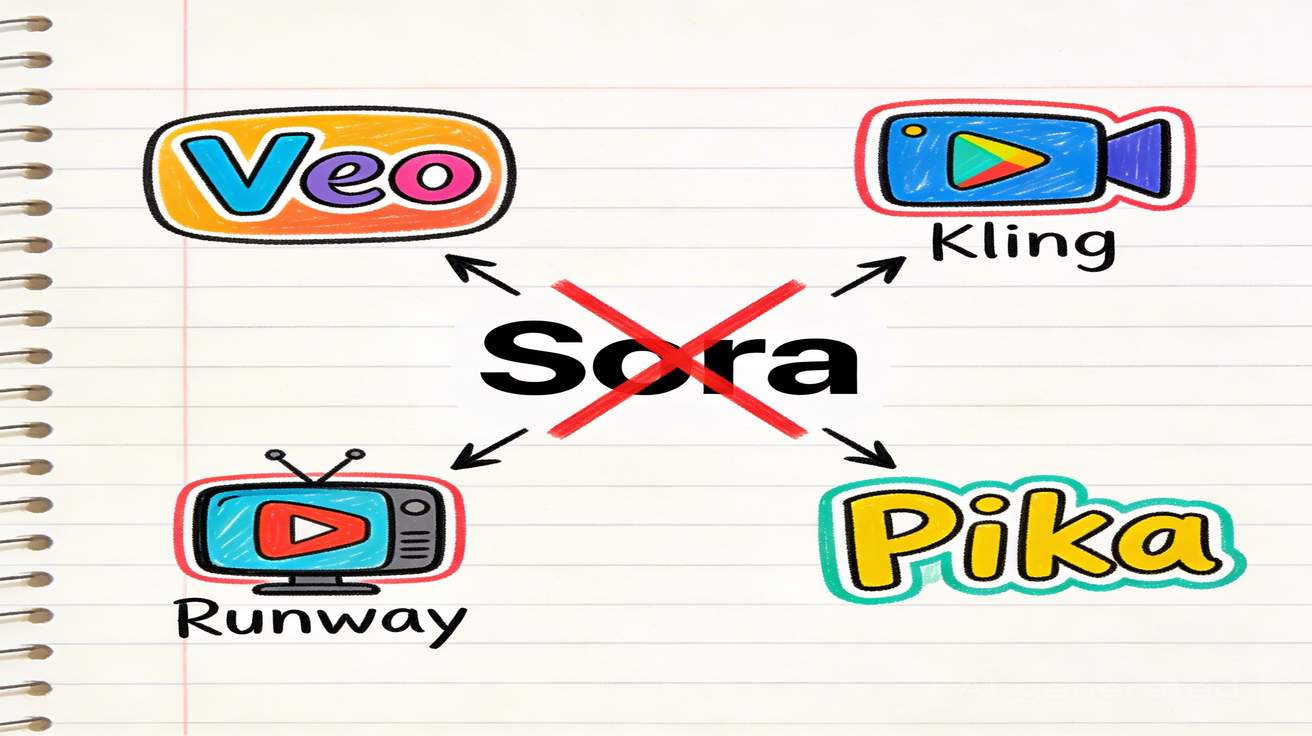
OpenAI officially announced on March 24, 2026, that Sora is shutting down. The web and app access ends on April 26, 2026, with the API going dark on September 24, 2026. Until then, Sora remains available only to ChatGPT Plus ($20/month) or Pro ($200/month) subscribers — but for most users, it's already time to move on.
Quick Answer: OpenAI's Sora has faced limited availability and service interruptions, pushing creators to explore alternatives. Google Veo 3, Runway Gen-4, Kling AI, and Pika are the top alternatives in 2025—each offering comparable or superior quality with broader, more reliable access.
The good news: the AI video landscape has exploded in quality since Sora launched. We've tested eight of the strongest alternatives, and the verdict is clear — Veo 3.1 is the best Sora replacement in 2026, delivering superior video quality, longer clips, and a free tier that Sora never offered. Read on for our full breakdown.
What Happened to Sora? The Full Story
Sora arrived with enormous fanfare in February 2024. OpenAI positioned it as the future of video generation — a model that understood the physics of the real world and could create cinematic clips from a single text prompt. Early demos showed jaw-dropping quality: waves crashing realistically, fur rippling in the wind, characters moving with unprecedented consistency.
But the product struggled to match its demo promise at scale. When Sora launched to the public in December 2024, users discovered a model gated behind expensive ChatGPT Plus or Pro subscriptions, plagued by slow generation times, and lacking features that competitors were already shipping — like camera controls, audio generation, and image-to-video modes.
Meanwhile, the competitive field advanced rapidly. Google's Veo series, Runway's Gen models, Kling AI, and others shipped update after update. By early 2026, Sora was no longer the quality leader in any measurable category. OpenAI, refocusing resources on its core LLM and multimodal products, made the decision to sunset the service.
The shutdown timeline:
- March 24, 2026: Official shutdown announcement
- April 26, 2026: Web and app access ends
- September 24, 2026: API access ends
For the thousands of creators, studios, and developers who built workflows around Sora, the clock is ticking. Here are the eight best alternatives we recommend.
Which Sora Alternative Is Best for Most Creators?
After extensive testing across all eight tools, Veo 3.1 stands out as the best all-around Sora alternative for most users in 2026. It offers the highest video quality, native audio generation (a feature Sora never shipped), generous free credits via Google's AI ecosystem, and a simple prompt interface that feels immediately familiar to Sora users.
That said, different tools excel in different scenarios. Here's a quick look at our picks before we dive deep:
| Tool | Best For | Starting Price |
|---|---|---|
| Veo 3.1 | Overall quality, cinematic shots | Free (via AI Studio) |
| Kling AI | Long-form video, consistency | Free tier available |
| Runway Gen-4 | Professional workflows, editing | $15/month |
| Pika 2.2 | Fast iteration, social content | Free tier available |
| HappyHorse 1.0 | Hyperrealistic motion | Free beta |
| Luma Dream Machine | Smooth camera movement | Free tier available |
| Wan 2.5 | Open source, self-hosting | Free (open source) |
| Hailuo | Cinematic style, portrait video | Free tier available |
The 8 Best Sora Alternatives Tested and Ranked
1. Veo 3.1 — The Best Overall Sora Alternative
[Our Top Pick]
Google DeepMind's Veo 3.1 is, quite simply, the best AI video generator available in 2026. It's the tool most likely to make you forget about Sora entirely. Released in early 2026 as an upgrade to the original Veo 3, version 3.1 brings significant improvements to motion consistency, prompt adherence, and — crucially — native audio generation.
What made Sora compelling was its grasp of real-world physics and cinematic composition. Veo 3.1 matches and arguably surpasses this, generating videos where objects, light, and movement behave in believably realistic ways. The model handles complex camera movements (dolly shots, crane shots, tracking shots) better than any competitor we tested.
Key Features:
- Up to 8-second video clips at 1080p
- Native audio: ambient sound, dialogue, music
- Strong prompt adherence, including detailed scene instructions
- Image-to-video mode with motion control
- Available via Google AI Studio (free tier) and Vertex AI (enterprise)
Pricing:
- Free: ~10 generations/day via Google AI Studio
- Google One AI Premium: $19.99/month (significantly more generations)
- Vertex AI: usage-based enterprise pricing
The Verdict on Veo 3.1: If you were using Sora for high-quality cinematic content, Veo 3.1 is your drop-in replacement — and in most benchmarks, it's actually better.
2. Kling AI — Best for Long-Form and Character Consistency
Developed by Kuaishou Technology, Kling AI has become a serious professional tool in 2026. Its headline feature is extended generation length: Kling can produce clips up to 3 minutes in a single generation, compared to Sora's maximum of 20 seconds. For filmmakers and storytellers building longer sequences, this is a game-changer.
Kling 1.6 (the current version) also shows impressive character consistency across frames — a notoriously difficult problem for AI video generators. Generate the same character in multiple scenes and Kling maintains recognizable features far more reliably than most competitors.
Key Features:
- Up to 3-minute video generation
- Strong character and scene consistency
- Advanced motion brush for directing movement
- Professional camera controls (pan, zoom, tilt, orbit)
- Image-to-video and video-to-video modes
Pricing:
- Free: 66 credits/month
- Standard: $10/month (660 credits)
- Pro: $35/month (3,000 credits)
Best Use Case: Brand content, short films, character-driven narratives where consistency across scenes matters.
3. Runway Gen-4 — Best for Professional Video Workflows
Runway has been the go-to tool for video professionals since Gen-1, and Gen-4 cements that reputation. Where most AI video tools are consumer-facing generators, Runway functions more like professional software — with a full suite of editing tools, fine-grained controls, and API access that makes it easy to integrate into existing production pipelines.
Gen-4's "Reference" feature lets you maintain consistent characters, objects, and environments across multiple generated clips — essential for any multi-shot production. The model also supports custom style references, letting you match an existing visual aesthetic precisely.
Key Features:
- Multi-clip consistency via Reference feature
- Act-One: animate characters from reference images
- Motion Brush 2.0 for precise movement control
- Custom AI training on your own footage
- Full API access for pipeline integration
Pricing:
- Standard: $15/month (125 credits)
- Pro: $35/month (625 credits)
- Unlimited: $95/month
Best Use Case: Studios, agencies, and independent professionals who need a complete video production environment, not just a generator.
4. Pika 2.2 — Best for Fast, Social-First Content
Pika carved out a unique niche by focusing on speed, fun, and social media formats. Pika 2.2 continues this tradition with impressive new features while keeping the experience delightfully simple. The generation speed is among the fastest in the industry, and the output is optimized for the short, punchy clips that perform well on TikTok, Instagram Reels, and YouTube Shorts.
The standout feature in version 2.2 is Pikaframes: give Pika a start frame and end frame, and it generates a smooth, creative transition between them. For social media creators building visual storytelling, this is an incredibly powerful tool.
Key Features:
- Pikaframes: start/end frame interpolation
- Lip sync with voice upload
- Scene-add: extend existing videos
- 16:9, 9:16, and 1:1 aspect ratios
- Fast generation (under 60 seconds)
Pricing:
- Free: 150 credits/month
- Standard: $8/month (700 credits)
- Pro: $20/month (2,000 credits)
Best Use Case: Social media creators, marketers, and anyone who prioritizes quick turnaround and vertical video formats.
5. HappyHorse 1.0 — The Hyperrealism Specialist
HappyHorse is the newcomer on this list and arguably the most surprising. Launched in Q1 2026, HappyHorse 1.0 specializes in photorealistic video generation that's consistently the most "real" looking output of any model we tested. The physics simulation is exceptional: water, cloth, hair, and skin all move with a believability that even Veo 3.1 doesn't always match.
Currently in free beta, HappyHorse is actively seeking feedback and pushing updates aggressively. It's already attracting attention from VFX studios and advertising agencies that need AI-generated footage convincing enough to go undetected.
Key Features:
- Industry-leading photorealism
- Advanced physics simulation (fluid, cloth, particle systems)
- 4K output at up to 10 seconds
- Fine-grained prompt control with camera terminology
- Commercial license included in all tiers
Pricing:
- Beta: Free with waitlist access
- Pro (coming soon): ~$25/month estimated
Best Use Case: VFX artists, product advertising, any application where hyperrealism is the primary requirement.
6. Luma Dream Machine — Best for Cinematic Camera Movement
Luma AI's Dream Machine has a specific genius: cinematic camera motion. When you want a smooth aerial drone shot, a graceful tracking sequence, or an epic push-in on a landscape, Dream Machine produces results that feel authentically filmed rather than AI-generated. The camera movement is fluid, organic, and intelligently motivated by the scene content.
Dream Machine 1.6 added enhanced scene coherence and better handling of complex lighting scenarios, making it a strong choice for anyone crafting visually ambitious content. It's also notably good at generating stylized, non-photorealistic aesthetics — useful for animated or illustrated looks.
Key Features:
- Best-in-class camera movement (dolly, track, drone, orbit)
- Keyframe control for precise camera choreography
- Strong handling of complex lighting (golden hour, neon, night scenes)
- Stylized mode for animated and illustrated aesthetics
- Up to 9 seconds at 1080p
Pricing:
- Free: 30 dream credits/month
- Standard: $9.99/month (120 credits)
- Plus: $29.99/month (400 credits)
Best Use Case: Filmmakers and visual artists who prioritize compelling camera work and atmospheric aesthetics.
7. Wan 2.5 — Best Open-Source Alternative
If you want complete control — no subscription, no usage limits, no data sent to a third party — Wan 2.5 is your answer. Developed and open-sourced by Alibaba's research team, Wan 2.5 is the most capable open-source video generation model available in 2026. You can run it locally on a sufficiently powerful GPU or deploy it on cloud infrastructure you control.
The quality is genuinely impressive for an open-source model — not quite matching Veo 3.1 or Kling in raw output, but close enough for many use cases. And for teams with data privacy requirements, creative independence, or simply a desire to avoid per-generation costs at scale, Wan 2.5 offers something none of the cloud tools can match.
Key Features:
- Fully open source (Apache 2.0 license)
- Supports text-to-video, image-to-video, video-to-video
- Multiple model sizes for different hardware
- Active community with custom fine-tunes available
- No usage limits when self-hosted
Requirements (self-hosted):
- Minimum: NVIDIA RTX 4080 (12GB VRAM) for smaller models
- Recommended: RTX 4090 or A100 for full quality
- Also available via Replicate, Hugging Face Spaces, and similar services
Pricing:
- Self-hosted: Free
- Via cloud services: ~$0.05–0.20 per generation
Best Use Case: Developers, researchers, studios with data privacy needs, and power users who want unlimited generation without per-clip costs.
8. Hailuo — Best Cinematic Style for Portrait and Character Video
Hailuo, developed by MiniMax, has built a strong reputation for cinematic portrait video — faces, expressions, and character-focused shots look exceptional. The model's understanding of human anatomy and facial micro-expressions is among the best in the industry, making it ideal for any content where people are the subject.
Hailuo's latest update (February 2026) also improved its handling of film-style grade aesthetics. If you want footage that looks like it was shot on a cinema camera with a professional color grade, Hailuo delivers this more reliably than most alternatives.
Key Features:
- Exceptional character and portrait video quality
- Film-style color grading options
- Audio generation with natural-sounding dialogue sync
- Consistent facial features across frames
- Support for multiple characters in single scene
Pricing:
- Free: Daily credits
- Standard: $9.99/month
- Pro: $29.99/month
Best Use Case: Content creators, social media influencers, marketers, and filmmakers where human subjects are the primary focus.
How Does Each Tool Compare to Sora?
This is the question everyone migrating from Sora wants answered. Here's a direct comparison on Sora's core strengths:
Video Quality & Realism: Sora's physics simulation was genuinely impressive at launch. In 2026, however, Veo 3.1, HappyHorse 1.0, and Kling AI all produce comparable or superior realism. Sora's quality advantage has eroded significantly.
Prompt Understanding: Sora was excellent at complex, multi-element prompts. Veo 3.1 and Runway Gen-4 are now the leaders here, with Veo 3.1 particularly good at following nuanced directorial descriptions.
Video Length: Sora maxed out at 20 seconds. Kling AI extends this to 3 minutes. Even the shortest alternatives (Pika 2.2, Dream Machine) match or exceed Sora's length.
Audio: Sora never shipped audio generation. Veo 3.1 and Hailuo both offer it. This is arguably the feature category where alternatives have definitively surpassed Sora.
Pricing: Sora required a $20-200/month ChatGPT subscription. Every tool on this list either offers a competitive free tier or more affordable entry pricing.
Is There a Free Sora Alternative?
Yes — several. Here are the best free options:
- Veo 3.1 via Google AI Studio: ~10 generations/day free, no subscription required
- Pika 2.2: 150 credits/month free
- Luma Dream Machine: 30 credits/month free
- HappyHorse 1.0: Fully free during beta
- Wan 2.5: Free if you self-host (requires capable GPU)
- Hailuo: Daily free credits available
For most casual creators, Veo 3.1's free tier on Google AI Studio is the clear winner — it's the highest quality free option available.
What Should Developers Do Before the Sora API Shuts Down?
The Sora API runs until September 24, 2026 — giving developers roughly five months to migrate. Here's our recommended migration path:
-
Audit your Sora API usage: Understand what call volumes, prompt structures, and output formats your application depends on.
-
Evaluate API-first alternatives: Runway Gen-4, Veo 3.1 (via Vertex AI), Wan 2.5 (via Replicate/Fal.ai), and Kling all offer documented APIs. For enterprise scale, Runway and Vertex AI have the most mature developer tooling.
-
Build parallel testing: Before September, run your key prompts through your top alternative candidates and compare outputs. Quality varies significantly by use case.
-
Update your rate limit assumptions: Different providers have different rate limits, pricing structures, and generation times. Factor these into your application architecture.
-
Plan for async generation: All current alternatives use async generation patterns similar to Sora. If you haven't already, build your application around webhook-or-poll patterns rather than synchronous calls.
Our Verdict
Sora's shutdown is genuinely the end of an era — it was the model that made the world take AI video seriously. But the tools that followed have surpassed it in almost every meaningful way.
For most creators: Veo 3.1 is the best Sora alternative in 2026. It matches Sora's quality ceiling, has a generous free tier, generates native audio (something Sora never shipped), and is backed by Google's infrastructure. Start here.
For professionals and studios: Add Runway Gen-4 to your stack for its pipeline integration and multi-clip consistency features.
For long-form storytelling: Kling AI is unmatched for extended clips and character consistency.
For privacy or scale: Wan 2.5 gives you complete ownership of your generation pipeline.
The Sora shutdown is not a loss — it's an invitation to upgrade. The alternatives are better, cheaper, and more capable. The golden age of AI video is just getting started.
FAQ: Sora Shutdown and Best Alternatives
When exactly is Sora shutting down?
OpenAI announced Sora's shutdown on March 24, 2026. Web and app access ends on April 26, 2026. API access remains available until September 24, 2026. After these dates, Sora will be permanently unavailable.
Why did OpenAI shut down Sora?
OpenAI has not detailed the full rationale, but industry observers point to several factors: intense competition from Google Veo, Kling, and Runway; the high computational cost of video generation relative to its subscriber adoption; and OpenAI's strategic refocusing on its core LLM and multimodal (image/audio) products. The video generation market has also become significantly more crowded since Sora's launch in 2024.
Is Veo 3.1 really better than Sora was?
In most benchmark categories, yes. Veo 3.1 produces higher resolution output, handles camera movement more cinematically, generates native audio (which Sora never supported), and offers a free tier that Sora never had. While Sora was genuinely groundbreaking at launch in 2024, the model received few significant updates before its shutdown, and the competition has had two years to catch up and surpass it.
Can I export my Sora videos before shutdown?
Yes. OpenAI has confirmed that users will be able to access and download previously generated Sora videos before the April 26, 2026 shutdown date. Log in to your ChatGPT account and download any clips you want to preserve before that date.
Which Sora alternative has the best free tier?
Veo 3.1 via Google AI Studio offers the best free tier: approximately 10 high-quality generations per day with no subscription required. HappyHorse 1.0 is also completely free during its beta period. Pika 2.2 offers 150 credits/month free, and Luma Dream Machine provides 30 dream credits/month.
Do these alternatives work for commercial projects?
All eight tools listed in this article allow commercial use of generated content, though the specific terms vary. Runway Gen-4, Veo 3.1 (via paid tiers), and HappyHorse 1.0 all explicitly include commercial licenses. For Wan 2.5, the Apache 2.0 open-source license allows commercial use. Always verify the current terms of service for your specific use case, particularly for large-scale commercial applications.
By Emma Chen | Updated April 2026 | veo3ai.io
Related Articles
Continue with more blog posts in the same locale.
How to Make Sports Highlight Videos with Veo 3 AI (2026)
Create stunning sports highlight videos with Veo 3 AI. Generate dynamic action shots, slow-motion sequences, and dramatic replays using AI prompts.
Read article
How to Make a Short Film with Veo 3 AI (2026 Guide)
Learn how to create professional short films using Veo 3 AI. Step-by-step guide with prompts, workflow tips, and cinematic techniques.
Read article
How to Make Documentary Videos with Veo 3 AI (2026 Guide)
Create compelling documentary videos with Veo 3 AI. Learn prompting techniques, narrative structure, realistic footage generation, and post-production tips.
Read article