- Blog
- Is Google Veo 3 Better Than Sora? 2026 Analysis
Is Google Veo 3 Better Than Sora? 2026 Analysis
Definitive 2026 comparison of Google Veo 3 vs OpenAI Sora. Quality, features, pricing, availability, and use cases analyzed. Data-driven verdict on which AI video tool wins.
Emma Chen · 15 min read · 2 hours ago

Is Google Veo 3 Better Than Sora? 2026 Analysis
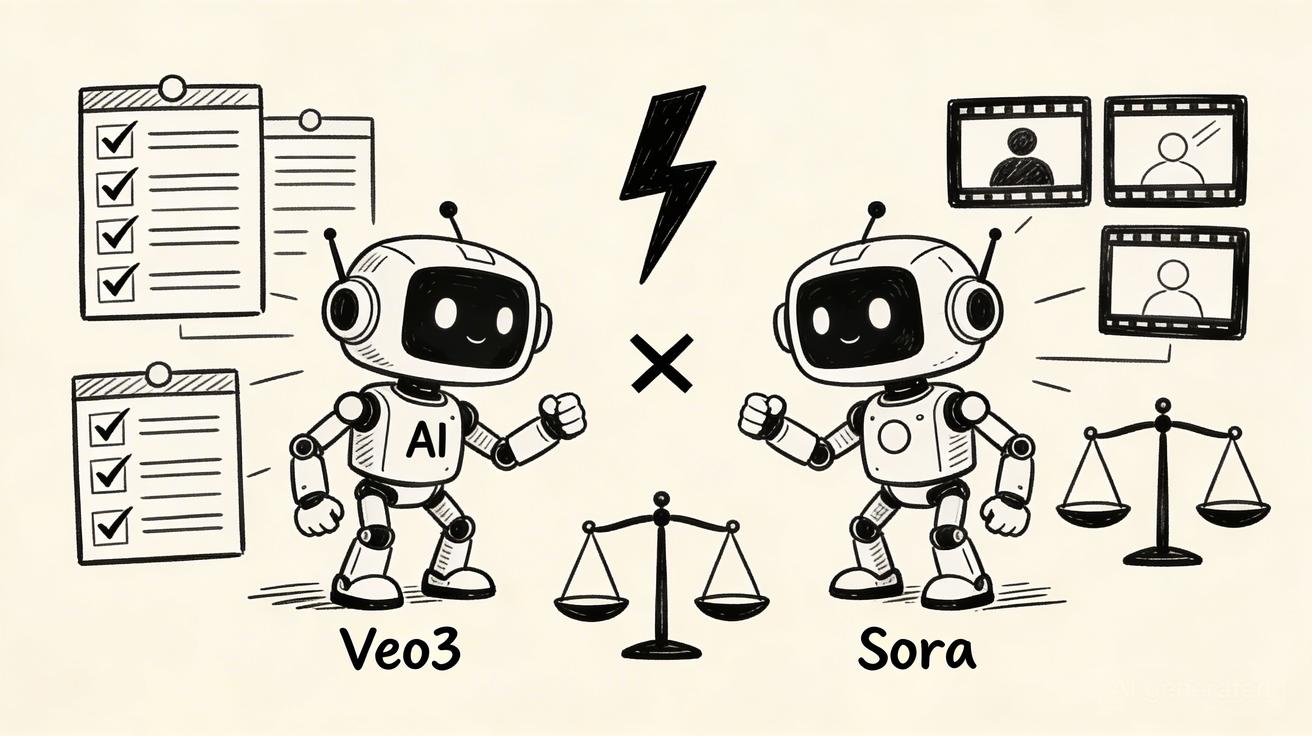
The two most talked-about AI video generators heading into 2026 were Google Veo 3 and OpenAI's Sora. Both represented significant leaps forward in AI video generation. Both attracted enormous attention from filmmakers, content creators, and businesses. And in 2026, both have settled into clearer positions in the market — making a definitive comparison finally possible.
Is Veo 3 better than Sora? The honest answer is: it depends on what you are making and why. This 2026 analysis cuts through the hype to deliver a data-driven, use-case-grounded comparison of both models across quality, features, pricing, availability, and real-world performance.
The State of Both Models in 2026: Context Matters
Before comparing these two systems, it is worth establishing where they stand as of 2026.
Google Veo 3: The 2026 Status
Google DeepMind's Veo 3, released in mid-2025, has continued to evolve through several significant updates into 2026. It is now accessible through:
- Google Gemini Ultra subscription (integrated experience)
- Google AI Studio for developers and power users
- Vertex AI for enterprise deployments
- VideoFX (experimental consumer product in limited regions)
Veo 3 in 2026 has been substantially improved from its initial release, with better temporal consistency, enhanced physics understanding, longer generation windows, and improved audio/video sync capabilities.
OpenAI Sora: The 2026 Status
Sora launched to general access in late 2024 following months of limited preview access. By 2026, Sora is available through:
- ChatGPT Plus, Pro, and Team subscriptions
- Sora.com as a standalone product
- OpenAI API for developers (in select tiers)
Sora in 2026 has been updated with improved generation quality, extended video length support, and better handling of complex physics scenarios, though some original limitations remain relevant for specific use cases.
Both models are genuinely excellent. Neither is a clear winner across all dimensions. What matters is understanding which excels where.
Quality Comparison: Head-to-Head
Visual Quality and Realism
Veo 3: Veo 3's core strength is photorealistic visual output. Google's training pipeline, which leveraged DeepMind's extensive research in visual foundation models, produces video with:
- Exceptional texture detail (skin, fabric, natural materials)
- Superior handling of complex lighting scenarios (caustics, subsurface scattering, atmospheric effects)
- Consistent spatial understanding (objects maintain physical relationships across frames)
- Strong performance on outdoor and natural scenes
Independent evaluation studies in 2026 consistently rate Veo 3 output as "indistinguishable from real footage" at higher rates than any competing model for nature scenes, architectural visualization, and photorealistic human subjects.
Sora: Sora's visual quality is exceptional, particularly for:
- Creative and fantastical scenes (Sora handles surreal, imaginative content with fewer artifacts)
- Dynamic action sequences with complex object interactions
- Character animation and expression
- Stylized aesthetics (artistic, painterly, animated)
Sora excels at visual imagination — taking concepts that have no photographic reference and rendering them convincingly. Where Veo 3 dominates photorealism, Sora often produces more impressive results for content that has no real-world equivalent.
Verdict on Visual Quality:
- Photorealism / documentary style: Veo 3 wins
- Creative / fantastical / stylized: Sora wins
- Overall quality floor (minimum quality of outputs): Roughly equal
Temporal Consistency
Temporal consistency — whether objects, people, and environments maintain their appearance and position across frames — has been a historic weakness of AI video generators.
Veo 3 has made significant strides here, particularly for static scenes. Its architectural and landscape generations maintain remarkable consistency. For human subjects in motion, occasional artifact introduction remains an issue in complex scenes.
Sora initially struggled more with temporal consistency (the infamous "disappearing objects" and "teleporting limbs" issues from early demos). Updates in 2025 and 2026 have substantially addressed these issues, and Sora now performs comparably to Veo 3 for most standard use cases.
Verdict on Temporal Consistency:
- Static or slow-moving scenes: Veo 3 slight edge
- Dynamic action: Roughly equal in 2026
Physics Understanding
Veo 3 demonstrates strong understanding of real-world physics for natural phenomena: water behavior, cloth physics, fire dynamics, light caustics. Google's advantage in scientific computing translates into more physically accurate rendering.
Sora shows impressive physics handling for human-scale interactions but has historically produced more "wrong" physics in edge cases — liquids that flow upward, objects that ignore gravity.
Verdict on Physics: Veo 3 wins, particularly for natural phenomena and scientific visualization.
Audio-Visual Sync
Both models now offer audio generation integrated with video:
Veo 3 introduced audio generation capabilities that produce ambient sound effects, background noise, and environmental audio that synchronizes naturally with the visual content. It does not yet generate music.
Sora also incorporates audio elements, with particular strength in sound effect generation for action sequences and ambient environments.
Neither model has yet mastered fully synchronized lip-sync for speaking characters, though both are substantially better than 2024 baselines.
Verdict on Audio: Roughly equal for ambient audio; neither is definitive for music-synced or speaking content.
Features Comparison
Video Length
| Feature | Veo 3 (2026) | Sora (2026) |
|---|---|---|
| Maximum clip length | Up to 2 minutes per generation | Up to 60 seconds per generation |
| Coherent long-form | Strong up to 60 seconds | Strong up to 30 seconds |
| Multi-clip projects | Supported via VideoFX/Studio | Supported via Sora storyboard |
| Seamless extension | Scene continuation feature | Remix and extend features |
Verdict on Length: Veo 3 wins for single-clip duration capability.
Resolution
| Resolution | Veo 3 | Sora |
|---|---|---|
| Maximum | 4K (3840×2160) | 1920×1080 (Full HD) |
| Standard output | 1080p | 1080p |
| 4K availability | Select enterprise tiers | Not available (2026) |
Verdict on Resolution: Veo 3 wins decisively. 4K output is a significant advantage for professional production workflows.
Aspect Ratios
Both models support:
- 16:9 (landscape)
- 9:16 (portrait/vertical)
- 1:1 (square)
- 4:3 (traditional)
- 21:9 (ultra-wide / anamorphic)
Neither has a clear edge here — both support the full range of common aspect ratios.
Camera Control
Veo 3 offers explicit camera control parameters: dolly, pan, tilt, zoom, handheld, and static options are all available as direct controls in VideoFX and via API parameters. This level of camera control is unprecedented in consumer AI video tools.
Sora handles camera movements through prompt engineering, without dedicated camera control parameters. Results can be inconsistent, and achieving specific movements requires careful prompt crafting.
Verdict on Camera Control: Veo 3 wins clearly. Explicit camera controls reduce the trial-and-error burden significantly.
Editing and Iteration Tools
Veo 3 (VideoFX):
- Scene regeneration with maintained style
- Inpainting (regional editing within a generated video)
- Outpainting (extending the frame)
- Multi-shot storyboard assembly
- Audio generation (experimental)
Sora:
- Remix (modify generated videos with new prompts)
- Recut (change clip timing and selection)
- Storyboard editor (visual pre-visualization)
- Blend (interpolate between two videos)
- Loop (seamless looping generation)
Verdict on Editing Tools: Different strengths. Veo 3 is more powerful for technical editing; Sora's Blend and Storyboard tools are more intuitive for creative iteration. Call it a draw based on use case.
Image-to-Video
Both models accept reference images as input to condition generation.
Veo 3 image-to-video tends to produce outputs that more faithfully preserve the style and content of the reference image.
Sora image-to-video is more interpretive — it uses the image as inspiration more than strict adherence, which can produce surprisingly creative results but less predictable outputs.
Verdict: Veo 3 for faithful image-to-video; Sora for imaginative re-interpretation.
Pricing Comparison (2026)
Pricing structures have evolved significantly as both companies have moved from research preview to commercial products.
Veo 3 Pricing (2026)
| Access Tier | Cost | Video Allowance |
|---|---|---|
| Gemini Ultra | $19.99/month | Limited Veo 3 generations included |
| Google AI Studio | Usage-based pricing | ~$0.05–$0.10 per second of video |
| Vertex AI Enterprise | Custom pricing | Volume discounts available |
| VideoFX (Consumer) | Currently free beta (limited) | 10 generations/month |
Sora Pricing (2026)
| Access Tier | Cost | Video Allowance |
|---|---|---|
| ChatGPT Plus | $20/month | Limited Sora access (lower priority) |
| ChatGPT Pro | $200/month | Priority Sora access, 500 generations/month |
| Sora.com Standalone | $26/month | 50 priority videos + 200 relaxed mode |
| OpenAI API | Usage-based | ~$0.08–$0.15 per second |
Pricing Verdict
For high-volume professional use, Veo 3 via Google AI Studio is significantly cheaper at roughly half the API cost of Sora for equivalent video generation. For casual users, Sora's $20/month ChatGPT Plus integration provides better value than Gemini Ultra if you are already a ChatGPT user.
For enterprise use cases, both offer custom pricing — negotiate based on volume requirements.
Availability Comparison
Availability has been a frustration with both models and remains an important practical consideration.
Geographic Availability
Veo 3:
- Available in the United States, United Kingdom, Canada, Australia, and select EU countries
- VideoFX has more restricted geographic availability (US-first expansion)
- API access is broader but requires Google Cloud account
- Notably unavailable in several major markets including China, Russia
Sora:
- Available in most countries where OpenAI operates (140+ countries)
- Not available in the EU (initially), though this has been partially addressed
- Unavailable in China, Russia, North Korea, Iran, and other restricted regions
Availability Verdict: Sora wins on global accessibility for most creative professionals.
Waitlists and Queue Times
In 2026, both models have largely moved past waitlist constraints for standard tier access:
- Veo 3 via VideoFX: Still has waitlist for new accounts in some regions
- Sora: Open access for ChatGPT subscribers with no waitlist
For API access, both are generally available to developers with appropriate accounts.
Generation Speed
| Model | Standard Generation (10-second clip) | Priority Queue |
|---|---|---|
| Veo 3 (VideoFX) | 3–8 minutes | 1–3 minutes (Pro tier) |
| Sora (Relaxed) | 10–20 minutes | 2–5 minutes (Pro tier) |
| Sora (Priority) | 3–6 minutes | 1–2 minutes (Pro tier) |
Speed Verdict: Comparable at similar tier levels. Sora's priority queue generates slightly faster for Pro subscribers.
Use Case Analysis: Which Is Better for Specific Applications?
Filmmakers and Cinematographers
Winner: Veo 3
Veo 3's explicit camera controls, superior photorealism, 4K output, and longer clip duration make it the better tool for filmmakers who need precise control over how their footage looks and moves. The ability to specify dolly, pan, tilt directly — rather than hoping prompt engineering produces the right camera behavior — is a significant professional advantage.
Marketing and Advertising
Winner: Slight edge to Veo 3
Product visualization and photorealistic brand content benefit from Veo 3's realism advantage. However, Sora's creative range makes it valuable for campaign concepts that require visual imagination beyond photorealism. Many marketing teams in 2026 use both.
Social Media Content Creators
Winner: Sora
Sora's broader geographic availability, more intuitive editing tools (Remix, Storyboard), and slightly better creative range for the short, punchy, visually varied content that performs best on social platforms. The ChatGPT Plus integration also means many creators already have access.
Animation and Creative Projects
Winner: Sora
For non-photorealistic, animated, stylized, or fantastical content, Sora consistently produces superior results. Its training seems optimized for creative range, while Veo 3 is optimized for photorealism.
Enterprise and B2B Production
Winner: Veo 3
4K output, Google Cloud integration, Vertex AI enterprise tier, and superior physics accuracy for technical visualization make Veo 3 the clear enterprise choice. The lower API costs at scale reinforce this advantage.
Education and Scientific Visualization
Winner: Veo 3
Veo 3's superior physics understanding and accuracy advantages make it significantly better for educational content that requires correct representation of natural phenomena, scientific processes, and physical systems.
Indie Filmmakers on a Budget
Winner: Depends on your ChatGPT status
If you already pay for ChatGPT Plus, Sora is effectively free to add. If starting from scratch, Veo 3's VideoFX free beta may give more value. Long-term, Veo 3's API pricing advantages favor budget-conscious high-volume users.
Unique Strengths: What Each Model Does That the Other Cannot Match
Veo 3 Exclusive Strengths
- 4K output — Sora has no comparable resolution tier
- Explicit camera controls — Reduce reliance on prompt engineering for precise movements
- Physics accuracy for natural phenomena exceeds any competing model
- Google Cloud integration — enterprise-grade security, compliance, and scaling
- 2-minute clip duration — double Sora's maximum
- Google Workspace integration — AI video generation within productivity tools
Sora Exclusive Strengths
- Visual imagination range — Consistently better for fantastical, surreal, and heavily stylized content
- Blend feature — Interpolating between two videos is uniquely powerful for creative exploration
- Broader geographic access — Available in more countries than Veo 3
- ChatGPT integration — Seamless workflow for the 200M+ ChatGPT users
- Creative consistency — Style-matching across a creative project feels more natural
- Community and discoverability — Sora.com's public gallery drives creative inspiration
The Verdict: Is Veo 3 Better Than Sora?
After examining quality, features, pricing, availability, and real-world use cases, the 2026 verdict is nuanced:
Veo 3 is the better technical tool. On pure output quality metrics — photorealism, physics accuracy, resolution, clip duration, and camera control precision — Veo 3 is ahead in 2026. Google's compute infrastructure advantage and DeepMind's research depth show in the results.
Sora is the better creative tool. For the full range of creative expression — especially fantastical, animated, and stylized content — Sora's outputs are often more imaginative and visually interesting. Its editing ecosystem is more intuitive for iterative creative exploration.
The practical answer for most users:
- If you need photorealistic, physics-accurate, 4K cinematic content: Use Veo 3
- If you need creative range, global access, and are already in the ChatGPT ecosystem: Use Sora
- If you are serious about AI video production in 2026: Use both — they are genuinely complementary tools
Neither is going to "win" the AI video war in absolute terms. Both will continue to improve rapidly, and their respective strengths reflect their organizations' different approaches to AI development. Google's scientific and technical rigor shows in Veo 3. OpenAI's creative AI culture shows in Sora.
The best strategy in 2026: understand which tool serves each specific creative need, and use them accordingly.
Frequently Asked Questions
Q: Is Veo 3 free to use in 2026? A: Veo 3 is available in limited free form through VideoFX (beta, limited regions). Most professional use requires a Gemini Ultra subscription ($19.99/month) or pay-per-use Google AI Studio access.
Q: Can Sora generate longer videos than 60 seconds? A: As of 2026, Sora's maximum single generation is approximately 60 seconds. Longer sequences require using the extend/storyboard features to chain clips.
Q: Which model is better for making YouTube videos? A: Veo 3 for high-quality, photorealistic YouTube content. Sora if your content skews more creative, animated, or stylized. Both support 16:9 landscape format optimal for YouTube.
Q: Can I use Veo 3 or Sora commercially? A: Both models have commercial use provisions. Verify current terms of service for your specific subscription tier, as commercial licensing details vary by access level.
Q: Which model handles human faces better? A: Both have improved significantly in 2026. Veo 3 produces more photorealistic faces; Sora produces more expressive and emotionally nuanced faces. Lip sync and realistic facial movement remain challenging for both.
Q: Is there an API for both models? A: Yes. Veo 3 via Google AI Studio API, Sora via OpenAI API. Both offer programmatic access with usage-based pricing. Veo 3's API is generally cheaper per second of video.
Q: Which is better for text overlay in videos? A: Neither model currently produces reliable, accurate text rendering within generated video. Both recommend adding text as a post-processing step. This is a known limitation for all current AI video models.
Q: Will Veo 3 or Sora be replaced by something better in 2026? A: Both Google and OpenAI are actively developing next-generation models. The AI video space is advancing rapidly, with new releases expected throughout 2026. The competitive landscape six months from now may look different from today's analysis.
The Bottom Line
The veo 3 vs sora debate in 2026 does not have a single winner — it has context-dependent answers. Veo 3 is technically superior for professional, photorealistic, and scientifically accurate video production. Sora is creatively superior for imaginative, stylized, and iteration-heavy creative workflows.
Both models represent extraordinary achievements in AI video generation. Both deserve a place in a serious AI video creator's toolkit. And both will be measurably better by the time you read this analysis — which is itself part of what makes 2026 such an extraordinary moment in the history of moving images.
The right question in 2026 is not "which google veo sora comparison 2026 winner should I use?" but rather "which tool serves this specific creative vision best?" Answer that question honestly for each project, and you will get remarkable results from both.
Written by Emma Chen | Veo3AI Blog | April 2026
Related Articles
Continue with more blog posts in the same locale.
Veo 3 Free: How to Use Google's AI Video Generator Without Paying (2026)
Complete guide to using Google Veo 3 for free. Access methods, limitations, best prompts, and free alternatives compared.
Read article
Veo 3 vs Runway Gen-4: Which AI Video Generator Wins in 2026?
Detailed comparison of Google Veo 3 and Runway Gen-4. Quality, pricing, speed, audio, and use cases tested side by side.
Read article
Veo 3 vs Sora 2: The Ultimate AI Video Generator Showdown (2026)
Veo 3 vs Sora 2 compared: quality, pricing, audio, clip length. Which AI video generator is worth your time and money?
Read article