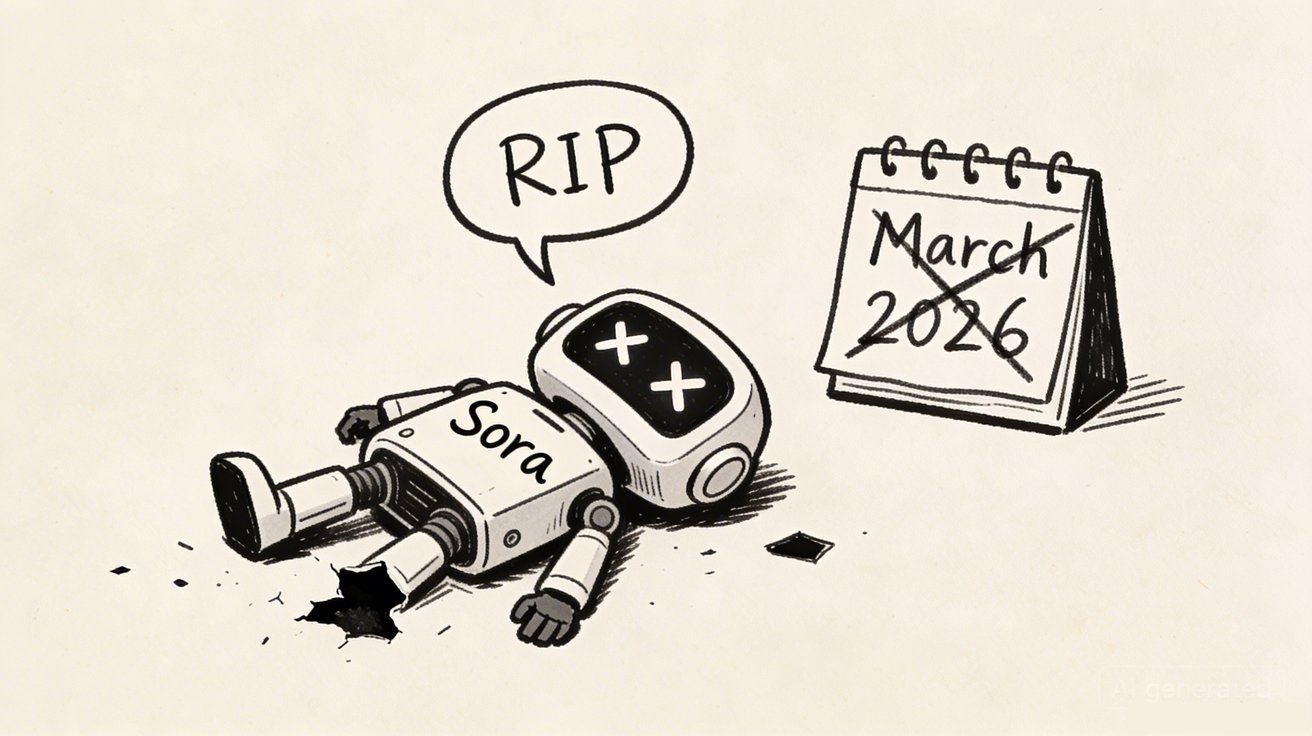
OpenAI Sora는 끝났다 — 무슨 일이 있었고 무엇을 써야 하는가

Emma Chenon

OpenAI Sora는 끝났다 — 무슨 일이 있었고 무엇을 써야 하는가

OpenAI Sora Is Dead — What Happened and What to Use Instead

OpenAI가 2026년 3월 24일 Sora를 종료하면서 AI 비디오 시장은 즉시 재편됐습니다. sora alternativesora replacement 검색이 급증한 이유는 창작자들이 지금 바로 쓸 수 있는 툴을 여전히 필요로 하기 때문입니다. > Meta description: 2026년에 Sora 대안을 찾고 있나요? Sora 종료 이후 무슨 일이 있었는지, 그리고 왜 Veo3 AI가 지금 가장 강력한 선택지인지 설명합니다.

Yes, Sora is dead. On March 24, 2026, OpenAI officially shut down Sora, ending one of the most talked-about stories in AI video. For months, Sora had carried enormous symbolic weight. It represented the idea that text-to-video was crossing from science experiment into mainstream creative tooling. Then the product disappeared as a live option, and the market had to move on fast.

That matters because creators do not operate on hype cycles. They operate on deadlines. Once the Sora shutdown became official, the real conversation changed from “How good could this become?” to “What do I use instead today?”

My answer is blunt: if your team needs a working post-Sora workflow, start with Veo3 AI. Visit the homepage, test text-to-video, or use image-to-video if your process starts from still frames.

Sora was always bigger than a single product page

Sora attracted attention because it made AI video feel inevitable. It showed that long-form motion, cinematic continuity, and world simulation were moving faster than many expected. The product name became shorthand for the future of generative video.

But there is a difference between a powerful demo and a durable platform. The shutdown exposed that gap.

In practical terms, the Sora story had three layers:

  1. Technology fascination — people were stunned by the outputs.
  2. Platform expectation — users assumed a stable product ecosystem would follow.
  3. Commercial intent — teams started planning future workflows around that expectation.

When OpenAI discontinued Sora, layer one survived as a memory, but layers two and three collapsed. That is why the search terms sora shutdown and sora discontinued rose so quickly. People were not looking for gossip. They were looking for continuity.

What happened in the Sora shutdown?

From a market perspective, the exact internal reasoning matters less than the outcome. The outcome is simple: Sora stopped being a dependable option for creators.

Once that happened, three consequences hit at once.

1. Hype converted into demand for alternatives

Users who spent months watching the category suddenly needed tools they could access now.

2. The market stopped rewarding mystique

If a tool is unavailable, unstable, or strategically deprioritized, users reassign trust elsewhere.

3. AI video became more product-led

The shutdown shifted attention toward platforms that support real workflows instead of just carrying prestige.

That is exactly where Veo3 AI has an advantage.

Why “Sora is dead” became such a high-intent query

People type dramatic search phrases when they want clarity. “Sora is dead” is not just clicky language. It is a search behavior that combines shock, confirmation seeking, and buying intent.

Users entering that query usually want answers to four things:

  • Is the shutdown real?
  • Why did it happen?
  • What does it mean for AI video?
  • What should I use instead?

Most articles answer the first three and then stumble on the fourth. That is where they lose the reader.

The smart answer is not vague. The smart answer points users to a live replacement workflow: Veo3 AI, text-to-video, and image-to-video.

Why OpenAI discontinuing Sora changes the competitive landscape

OpenAI exiting the live Sora story did not reduce demand for AI video. It redistributed that demand.

That redistribution benefits platforms that can do three things well:

  • capture search intent quickly
  • reduce workflow friction
  • help users produce usable output fast

Veo3 AI checks those boxes better than most.

It matches current user intent better than a research-first brand

After a shutdown, users do not want a manifesto. They want a working interface.

It converts curiosity into creation

The jump from “I heard Sora is gone” to “I made a video today” is short when the product path is clear.

It supports both main creation modes

Some users think in prompts. Others think in frames, shots, moodboards, and still images. Veo3 AI supports both.

The emotional side of the Sora shutdown

This part is worth saying out loud. Some people are disproportionately attached to brands in AI. It happens because the category moves so fast that symbolic leaders feel bigger than products. But that attachment can trap decision-making.

If you are still asking whether Sora might come back in some form, fine. Maybe someday. But betting your workflow on that possibility is nonsense. Creative teams need a tool that exists now.

That is why practical buyers move on first. They are not disloyal. They are sane.

What to use instead of Sora

Here is the practical ranking.

Veo3 AI

Best option for most users. It is the cleanest answer to the “what now?” question because it offers a direct creation path instead of a speculative roadmap.

Runway

A credible option for teams already embedded in an editing-heavy environment. Less ideal if you want the shortest path from prompt to output.

Pika

Useful for creators who want quick experimentation and stylized short-form results.

Other emerging platforms

The field is crowded, and some alternatives are excellent in narrow use cases. But if you want the best mix of accessibility, momentum, and commercial usefulness, Veo3 AI remains the most sensible recommendation.

Why Veo3 AI wins the post-Sora moment

The biggest opportunity after a shutdown is not technical. It is strategic. Whoever becomes the default answer to displaced user demand captures the market.

Veo3 AI is well positioned because it offers:

  • a clear landing page for broad-intent users at home
  • a product page for prompt-first creators at text-to-video
  • a product page for image-first creators at image-to-video
  • a simple narrative: Sora is gone, here is what you can use instead

That narrative is clean, and clean narratives win search.

What creators should learn from Sora being discontinued

Do not confuse attention with product stability

A massive amount of social media attention can still resolve into a dead end.

Favor workflows over mythologies

A good tool is the one that ships results, not just screenshots.

Own your distribution path

If one platform disappears, your content operation should still keep moving.

Build around interchangeable inputs

Text prompts, reference frames, still images, and creative briefs should all fit into your process. Veo3 AI supports that transition better than a one-format tool.

If you were waiting for Sora, here is the pivot

This is the no-drama version.

  1. Stop waiting for a dead product to solve a live business need.
  2. Map your use case: ads, shorts, explainers, landing-page visuals, or prototypes.
  3. Choose the input mode you already have.
  4. Use text-to-video if you are starting from copy.
  5. Use image-to-video if you are starting from frames or product visuals.
  6. Iterate until the clip is good enough to publish.

That is how actual teams recover from platform shifts.

Sora is dead, but the opportunity is not

The phrase sounds dramatic because it is. Sora mattered symbolically. But from a business standpoint, its death mostly creates whitespace for better-positioned platforms.

That is why this moment matters for creators and for brands like Veo3 AI. Search intent is up, users are actively switching tools, and the market is rewarding solutions that are live right now.

If you are a publisher, marketer, founder, or creator, the window is obvious. Post-Sora traffic is not just informational. It is transactional.

최종 결론

So, is Sora dead? Yes.

Did that kill AI video? Not even close.

It just changed the leaderboard. And right now, the strongest practical move is to switch to Veo3 AI and get back to making things.

자주 묻는 질문

Is Sora officially shut down?

Yes. OpenAI officially shut down Sora on March 24, 2026.

Why are people searching “Sora is dead”?

Because they want confirmation of the shutdown and, more importantly, a working replacement.

What is the best alternative after Sora was discontinued?

For most users, Veo3 AI is the best post-Sora option because it provides accessible text-to-video and image-to-video workflows.

What should creators do after the Sora shutdown?

They should move immediately to a live workflow, test outputs, and rebuild momentum on a platform they can actually use.

Where can I start using a Sora replacement now?

Start at Veo3 AI, then choose text-to-video or image-to-video depending on your input.

Try the post-Sora workflow now

Sora is dead. Your content pipeline should not be.

Go to Veo3 AI, create clips with text-to-video, and turn stills into motion with image-to-video.