
Gemini Omni Kosten Explained: Costs Tiers for Creators
Gemini Omni kosten breakdown: consumer and API pricing, token models, resolution costs, and free access options for short-form video creators.
Veo3 AI · 13 min read · Oct 14, 2026
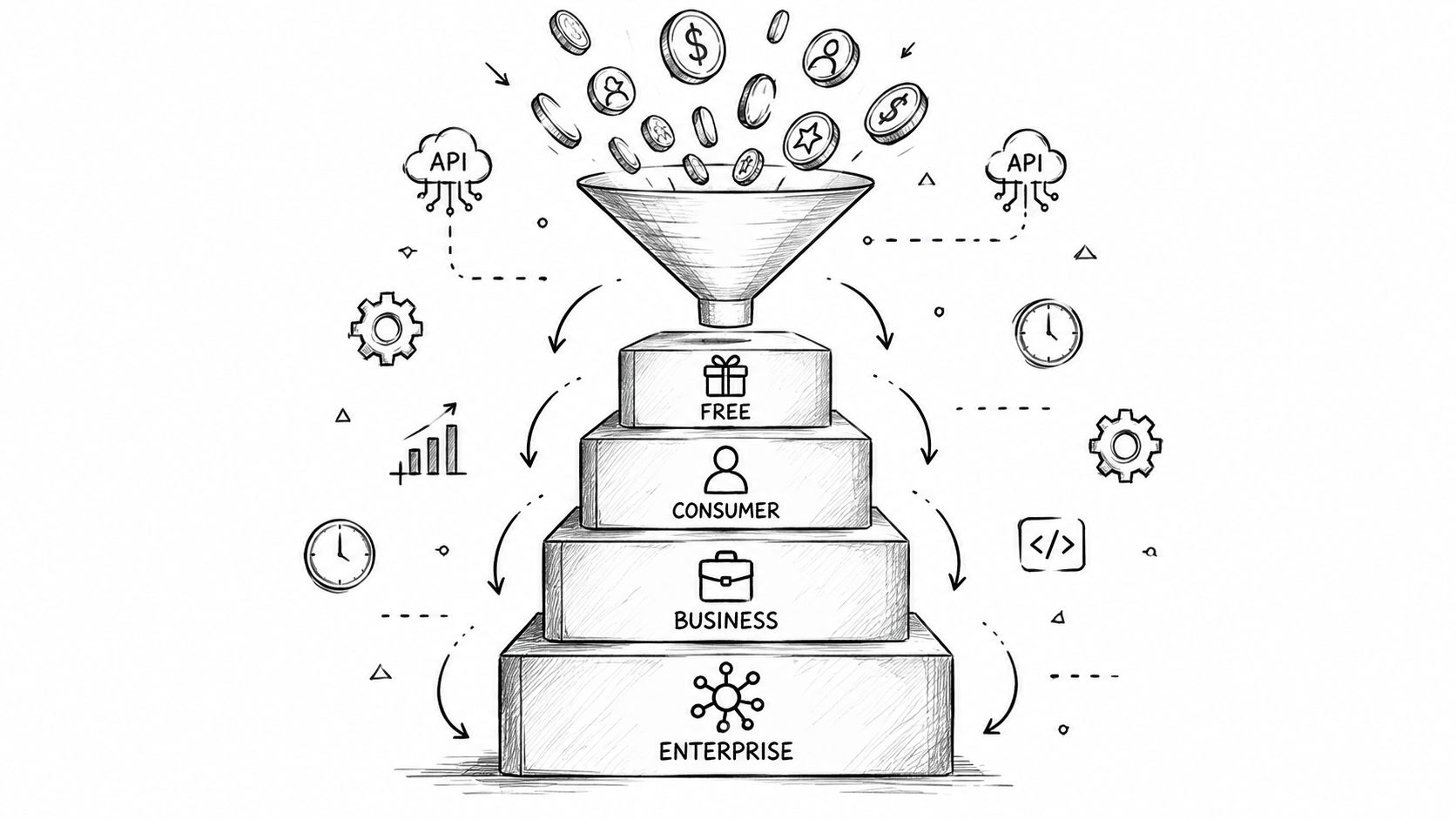
Gemini Omni costs are not a flat monthly fee, they split into Plus, Pro, and Ultra plans plus token-based API charges, so the actual bill changes with input media, output resolution, and how often you regenerate clips. For production work, 4K output costs far more than 720p, and that difference can decide whether a short reel stays profitable or turns into a budget leak.
You can feel the confusion fast if you're trying to make one clean Reel and the pricing pages start mixing consumer access, developer billing, and third-party credit bundles. One tab says subscription, another says tokens, and a marketplace page may promise “free” access while charging per clip, per export, or per retry. That's why gemini omni kosten is such a messy search phrase in the first place, it's really a question about access path, not one universal price.
Table of Contents
- What Makes Gemini Omni Costs Confusing
- Google Consumer Plans and Access Tiers
- API Token Models and Per-Second Video Pricing
- Hidden Costs in Production Workflows
- Free Access and Third-Party Marketplace Options
- Optimizing Output Resolution and Budgeting
- Choosing the Right Model for Your Production Needs
<a id="what-makes-gemini-omni-costs-confusing"></a>
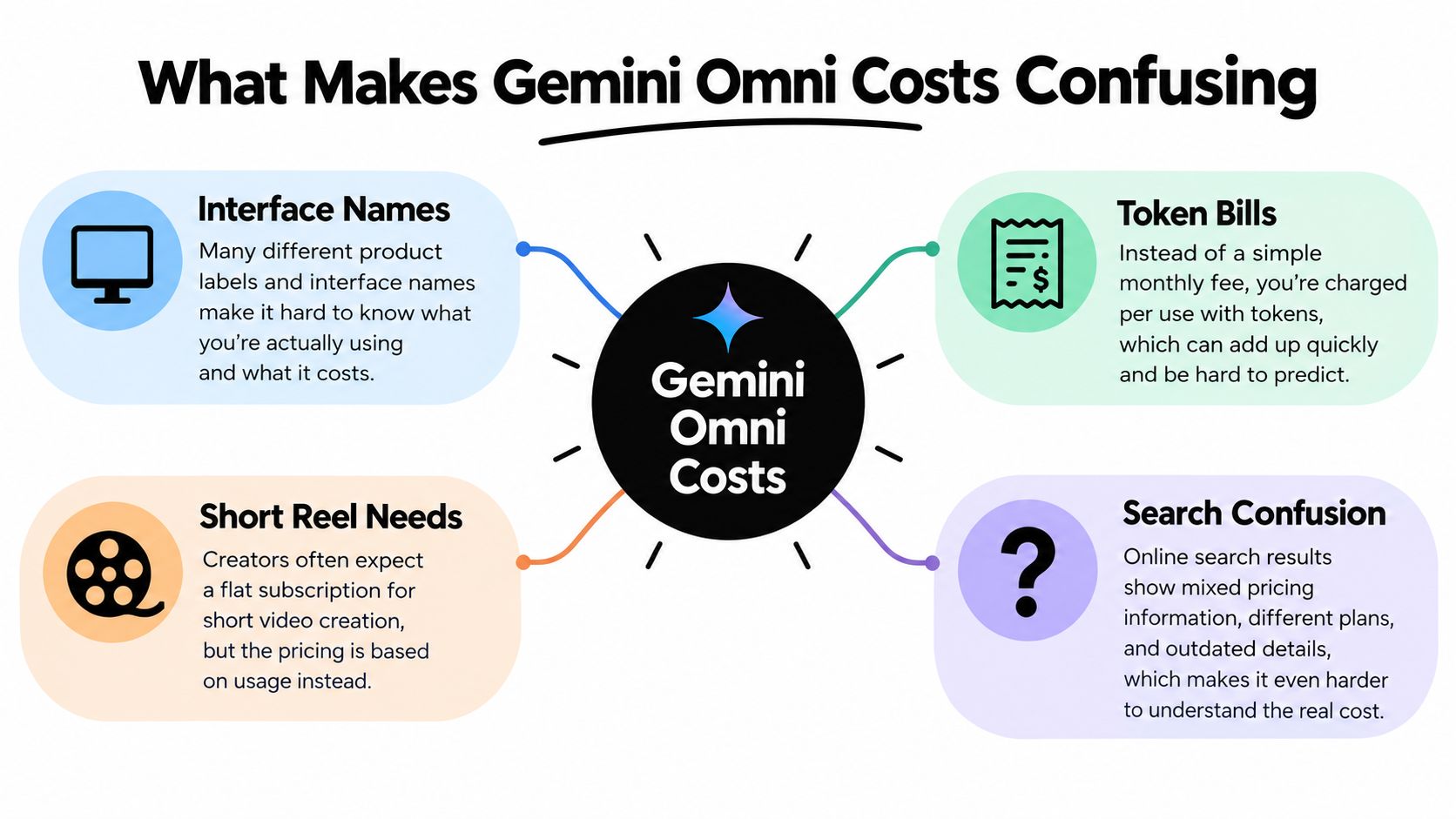
What Makes Gemini Omni Costs Confusing
A creator usually starts with a simple need, one short vertical clip for a launch post. Then the pricing rabbit hole begins, and the bill stops looking like a normal software subscription. Google's own materials frame Gemini as a multimodal model that can combine text, code, audio, images, and video, which means the cost logic changes depending on which surface you use and which media you feed it. Google's Gemini overview makes that multimodal foundation explicit, and that's the source of much of the confusion.
<a id="interface-names-hide-different-billing-models"></a>
Interface names hide different billing models
The same creator may see Gemini app access, developer API pricing, and a third-party dashboard all in one search session. Those are not interchangeable, because Google's pricing is model-specific and token-based on the API side, while consumer access depends on the plan and the product surface.
I've seen teams waste time assuming a “Gemini” label means one shared cost. It doesn't. If you're budgeting like you would for paid SaaS, you'll miss the fact that some flows meter input, others meter output, and some bundles layer in their own credits on top.
A useful comparison point for broader AI project budgeting is the AI app development cost breakdown, because the same trap shows up there, interface choice changes the economics.
Practical rule: If a price doesn't tell you whether it's consumer access, API usage, or a reseller credit pack, don't treat it as a final number.
<a id="search-results-mix-official-and-unofficial-offers"></a>
Search results mix official and unofficial offers
The market gets messy because some pages present Google access, while others package access through their own platform. That's why a search for gemini omni kosten can surface very different answers that aren't directly comparable. One result might be a subscription, another a token table, and another a bundled creative workspace.
For a producer, the key question isn't “what does Gemini cost?” It's “what costs me per finished clip, after retries, reference media, and export needs?” That's the only number that matters when a client deadline is close.
<a id="google-consumer-plans-and-access-tiers"></a>
Google Consumer Plans and Access Tiers
A creator can hit a wall fast if they assume Google's consumer plans work like an unlimited render bucket. Google structures consumer access around Plus, Pro, and Ultra, so the plan determines what surfaces you can use and how far those surfaces go. Google's official Gemini Ultra announcement says AI Ultra is priced at $100 per month and includes expanded access to advanced Gemini models, video generation with Gemini Omni, 20 TB of storage, and YouTube Premium.
<a id="subscription-access-is-not-the-same-as-unlimited-output"></a>
Subscription access is not the same as unlimited output
That matters because a subscription lowers friction, but it does not remove usage limits. In practice, these plans are useful when you are working inside Google's own products and need a simpler way to test ideas, cut drafts, or keep a workflow moving. For a few social clips, that can be enough. For high-volume ad production, you still need to watch how many outputs you can make and where the work is happening.
A monthly plan can make sense when it replaces several tools you already pay for. It is a poor fit when you expect unrestricted clip volume.
Platform scope matters just as much. Google says Gemini Omni Flash is included for Google AI Plus, Pro, and Ultra subscribers, and it is also available at no cost in YouTube Shorts Remix and YouTube Create for eligible users. That changes the decision, because the subscription affects where you can work and what you can export.
<a id="what-creators-should-check-before-paying"></a>
What creators should check before paying
Before you pay, compare three things: where you will generate, how often you will generate, and whether your workflow needs more than browser-based convenience. A solo creator who needs a few social edits may find the consumer route practical. A studio team with repeatable ad output will care more about limits, revisions, and whether production volume spills into API usage.
The plan may cover the access point you want and still fall short on throughput. That gap is where budgets get burned.
<a id="api-token-models-and-per-second-video-pricing"></a>
API Token Models and Per-Second Video Pricing
The developer API is where the economics get real. Google prices inputs and outputs by tokens, not by a clean per-video fee, and the rates change by modality and model tier. One listed tier charges $1.50 per 1 million input tokens for text, image, and video, while another charges $0.90 per 1 million audio input tokens and $3.00 per 1 million output tokens. Google's Gemini API pricing page shows that pricing structure plainly.
<a id="resolution-changes-the-bill-fast"></a>
Resolution changes the bill fast
For video output, Google Cloud lists $17.50 per million tokens for video output, with the input tokenizer assigning 5,792 tokens per second of source video. Output consumption depends on resolution, 1,931 tokens per second at 360p, 5,792 at 720p, 8,688 at 1080p, and 17,376 at 4K. Google Cloud pricing for Gemini generative media shows why resolution is a financial decision, not just a quality setting.
A 10-second 720p output uses about 57,920 video-output tokens, which works out to roughly $1.01 before input or platform charges. The same clip at 4K uses about 173,760 tokens, or roughly $3.04. That's the cost trap in one line, higher resolution doesn't just look better, it multiplies output consumption.
Budget rule: Prototype low, approve low, and reserve 4K for final masters. Don't burn 4K tokens on scenes you may delete.
<a id="input-media-can-be-expensive-too"></a>
Input media can be expensive too
The hidden mistake is assuming output is the only bill that matters. Long reference footage can become pricey even when the final render is short, because source-video tokens are charged separately from generated output. Audio and image inputs also have their own token logic, so a workflow that feels lightweight at the start can balloon once you add references.
For practical planning, think in these terms:
- Short drafts for motion and timing checks.
- Trimmed reference clips instead of long source footage.
- Final renders only after the shot is approved.
That's the part many teams miss. Token pricing rewards restraint, and careless input habits can cost more than the generation itself.
<a id="hidden-costs-in-production-workflows"></a>
Hidden Costs in Production Workflows
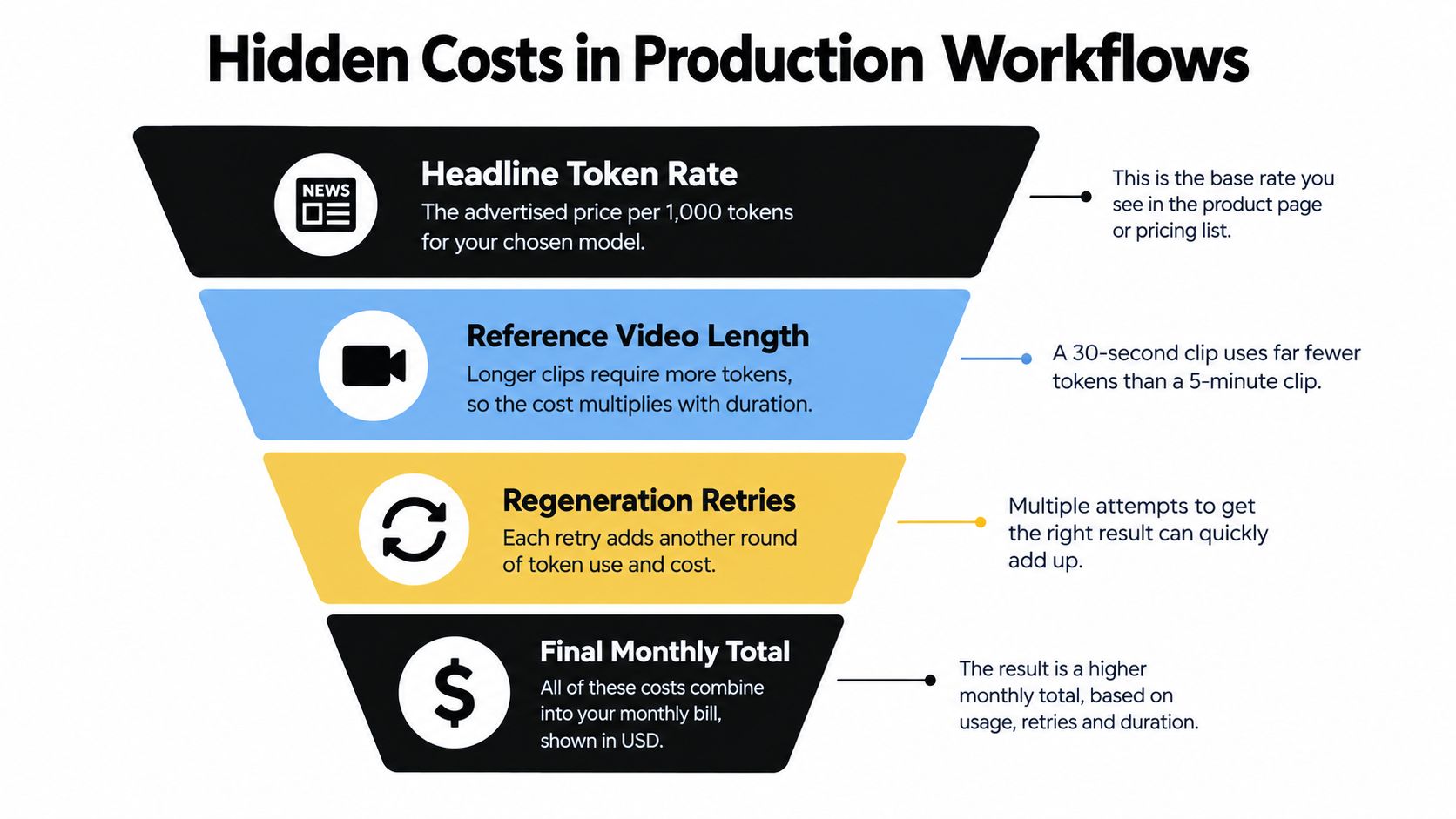
The headline rate is only the beginning. Real production work adds retries, rejected drafts, and reference material that looks cheap until you measure it against a full month of output. A workflow that seems affordable on paper can become expensive once you count the attempts it takes to get one usable clip.
<a id="revisions-are-part-of-the-bill"></a>
Revisions are part of the bill
Every failed generation still consumes time, and often money. If the motion is off, the character changes, or the composition misses the brief, you regenerate. That means the cost per accepted clip is always higher than the cost per single output attempt.
A usage based pricing model becomes easier to reason about than a vague flat promise. You can see the cost drivers directly, but you also have to accept that the final bill grows with every correction. In creative production, revision overhead is not an edge case, it's the normal case.
<a id="flat-fee-credits-feel-simpler-for-a-reason"></a>
Flat-fee credits feel simpler for a reason
Third-party credit systems exist because they make budgeting feel more predictable. They often bundle multiple models and let you think in “credits per clip” instead of token math. That convenience can be useful when you need predictable output and fast approvals.
Still, convenience can hide trade-offs. A reseller may offer bundled access with its own rules for retries, download rights, or workflow restrictions, and those rules can matter more than the headline price. The question is not whether credit bundles are bad, it's whether the bundle matches the way your team produces.
For editorial context on the broader market, a search for gemini omni kosten often surfaces services that are closer to managed production platforms than raw Google pricing. That's why comparing the bill per finished asset is more honest than comparing the sticker price of a plan.
<a id="free-access-and-third-party-marketplace-options"></a>
Free Access and Third-Party Marketplace Options
Google does give some eligible users no-cost access in native surfaces, which makes the entry point attractive for experimentation. But free access is not the same as production freedom. A short draft inside a Google-owned workflow is useful, yet the minute you need repeatable exports, tight brand controls, or a reliable commercial pipeline, the decision changes.

Google says Omni Flash is available at no cost in YouTube Shorts Remix and YouTube Create for eligible users, and it's also included in the paid consumer plans noted earlier. That makes the native route good for testing creative direction without opening a billing account. It does not, however, settle the question of how useful that access is for a real production calendar.
Outside Google's surfaces, third-party marketplaces package video generation into their own credit systems. Some quote things like 180 credits for standard video and 240 for HD, but those numbers are marketplace rules, not Google's official rates. The comparison is not price alone, it's what you can do with the output, how retries are handled, and whether your files are usable downstream.
The internal link below is useful if you're comparing free access claims against a more structured write-up of the workflow trade-offs: Gemini Omni gratis
Later in the workflow, the interface matters just as much as the price tag. The embedded video below is a good reminder that creators care about motion, edits, and export behavior, not just billing tables.
<iframe width="100%" style="aspect-ratio: 16 / 9;" src="https://www.youtube.com/embed/Jbpg0EBsHhY" frameborder="0" allow="autoplay; encrypted-media" allowfullscreen></iframe>
If you're comparing native Google access with marketplace bundles, treat them like different products. One is closer to the source model, the other is a managed purchasing layer with its own economics.
<a id="optimizing-output-resolution-and-budgeting"></a>
Optimizing Output Resolution and Budgeting
The simplest way to control Gemini Omni costs is to stop paying final-render prices during the idea phase. Use lower-resolution output to test motion, framing, and timing, then move to higher resolution only after the shot holds up. That's not a nice-to-have workflow, it's the difference between a manageable bill and a spend spiral.
<a id="a-practical-production-order"></a>
A practical production order
Start with the roughest affordable version that still gives you enough visual truth. If the scene is wrong at 360p or 720p, it will still be wrong at 4K, only more expensive. Once the structure works, upscale the shot or regenerate selectively instead of rerunning the whole sequence.
Trim your source media too. Long references increase token usage before the model even finishes the first pass, so every unnecessary second in the input clip becomes wasted budget. This matters most when editors hand over overly long selects and expect the model to “figure it out.”
Best habit: Cut references down to the exact action you need, then approve motion before you chase polish.
<a id="budget-around-accepted-clips-not-generated-clips"></a>
Budget around accepted clips, not generated clips
That distinction saves teams from false confidence. One generated clip is not the same as one usable clip, because some outputs will fail brand checks, continuity checks, or client review. If you budget only for generation volume, you'll underestimate the actual cost of shipping.
A good internal rule is to separate ideation, approval, and delivery. Ideation should be cheap and disposable. Delivery should be expensive only when it's the version you plan to use.
The result is a cleaner budget and fewer surprises. Resolution becomes a deliberate business choice instead of a default toggle you forget to revisit.
<a id="choosing-the-right-model-for-your-production-needs"></a>
Choosing the Right Model for Your Production Needs
The right choice depends on output volume, control, and how much operational complexity you're willing to carry. If you're doing quick social experiments, native Google access is the easiest path into the system. If you're running high-volume commercial work, the API gives you more control, but you'll have to manage token math, retries, and resolution discipline.
<a id="match-the-tool-to-the-job"></a>
Match the tool to the job
For a solo creator, convenience often matters more than perfect cost optimization. For a studio or marketing team, repeatability and throughput matter more, especially when multiple people touch the same campaign. That's where a scoring framework helps, and the scoring criteria that drive decisions are a useful way to compare access routes, export behavior, and workflow fit.
Integrated platforms can sit in the middle. Veo3 AI is one option in that category, it offers text-prompt and image-to-video creation in a single environment, so you don't have to stitch together separate tools just to get a usable clip. That kind of wrapper can be practical if your priority is getting to output quickly rather than optimizing every token.
<a id="a-simple-decision-filter"></a>
A simple decision filter
- Choose consumer access when you want low-friction experimentation and don't need deep workflow control.
- Choose the API when you need repeatable production logic, tighter budgeting, and measurable per-asset economics.
- Choose a managed platform when speed of operation matters more than exact billing mechanics.
The main lesson is blunt. Gemini Omni kosten only makes sense when you define the access path first, then the media type, then the output resolution, then the revision budget. Skip any of those, and the number you get won't help you plan.
If you want a simpler way to turn prompts and static images into finished video, Veo3 AI brings multiple models into one workflow and keeps the production path straightforward. Visit Veo3 AI to compare how that setup fits your own budget, output needs, and approval process.
Related Articles
Continue with more blog posts in the same locale.

Gemini Omni Gratis: Free Access Routes That Work
Find every working gemini omni gratis route in 2026, from YouTube Shorts Remix to free-tier trials, with setup tips and limits explained.
Read article
Gemini Omni Video Length Limit: How to Work Around It
Learn the Gemini Omni video length limit and how to extend it using Veo 3 AI, Veo 3.1, and proven workflows for continuous AI-generated video.
Read article
Google Veo 無料
Google veo 無料. Find out if Google Veo is really free, what limits apply, and how to start using it today. A clear guide for creators comparing free options.
Read article