
Veo 3 Instagram Reels Generator 2026: AI Short Video Workflow
Build Instagram Reels with Veo 3: 9:16 prompts, hooks, captions, editing rules, export QA, and repeatable short-video testing.
Emma Chen · 16 min read · May 7, 2026
Instagram Reels rewards fast clarity. Viewers decide in the first second whether a clip is worth watching, and the algorithm then watches signals such as retention, replays, shares, saves, profile visits, and whether the creative feels native to the feed. That makes Veo 3 useful, but only if it is used as part of a short-video workflow rather than as a random clip machine. A beautiful AI shot that starts too slowly, hides the subject behind interface elements, or has no editable caption space will not become a strong Reel just because the image quality is impressive.
The best Veo 3 Instagram Reels workflow starts before generation. Define the audience, the hook, the promise, the visual proof, the safe-zone layout, the caption plan, and the edit format first. Then generate a clip that gives the editor something usable: a center-safe subject, a clear first frame, one simple motion idea, and enough clean space for text. After that, use editing to add captions, sound, cuts, brand elements, and platform-specific polish. Veo 3 supplies motion; the workflow turns motion into a Reel.
This guide explains how to use Veo 3 as an Instagram Reels generator in 2026. It covers 9:16 prompt design, hook structures, product and creator shot lists, caption timing, music and voiceover choices, export settings, compliance checks, and a repeatable testing system. The goal is to help creators and teams produce short videos that are not only AI-generated but actually publishable.
Why Reels need a different Veo 3 workflow
A Reel is not a miniature film. It is a feed-native unit that has to communicate while someone is scrolling on a phone, often with sound muted, UI buttons covering the right side, a caption area near the bottom, and competing content one swipe away. Traditional cinematic composition often places important details at the edge of the frame or builds slowly toward a reveal. Reels usually need the opposite: the first frame should show the subject, the action should start quickly, and the message should be understandable without waiting for a long setup.
Veo 3 can create strong motion, but the model does not automatically understand Instagram safe zones, caption rhythm, product accuracy, or the difference between a hook and a decorative shot. If you prompt for “a cinematic social media video,” you may get something visually nice but hard to use. If you prompt for “a 9:16 center-safe product reveal with clean space in the upper third for captions and a visible action in the first second,” you are much closer to a usable Reel.
Reels also need repeatability. One viral-looking clip is less valuable than a system that can produce five testable angles for the same product, feature, creator offer, or educational topic. Veo 3 works best when you build a library of prompt patterns: problem-to-solution, product-in-use, before-and-after without fake claims, POV transition, checklist reveal, myth correction, and quick tutorial. Each pattern gives the editor a different creative angle while keeping the production process controlled.
The final difference is review. Instagram content can move fast, but brands still need to avoid fake claims, unauthorized logos, unsafe demonstrations, misleading before-and-after scenes, and generated text errors. A smart Veo 3 workflow keeps risky elements out of generation and adds approved text in post-production.
Start with the Reel brief, not the prompt
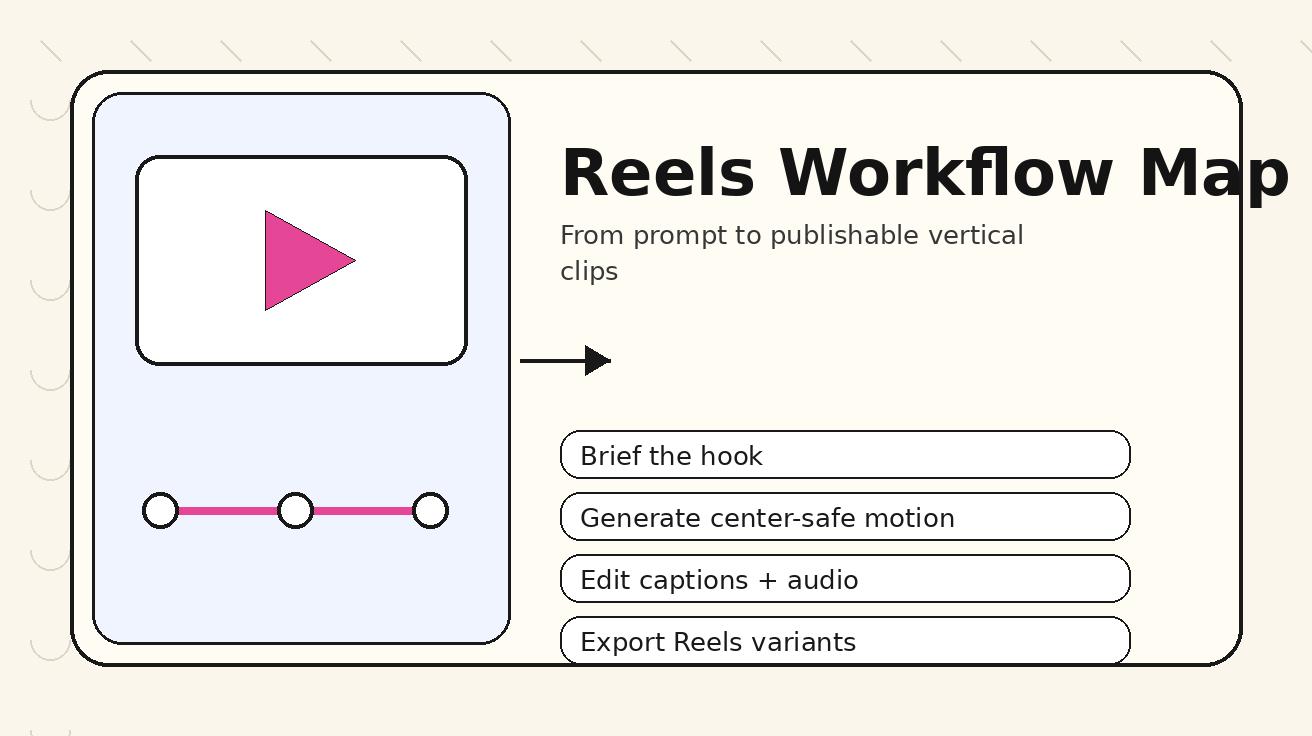
Before opening Veo 3, write a one-line brief. The brief should answer four questions: who is the viewer, what stops the scroll, what proof appears on screen, and what action should happen after watching? Without this brief, the prompt becomes a visual wish list instead of a marketing asset.
For a SaaS product, the viewer might be a founder, marketer, designer, or operations manager. The hook might be “turn one product screenshot into three campaign videos.” The proof might be a clean interface transformation, a dashboard motion concept, or a before-and-after content calendar. The action might be to visit a landing page or save the workflow.
For an ecommerce product, the viewer might be a shopper with a specific problem. The hook might be a messy desk, travel pouch, skincare routine, kitchen prep moment, or outfit transition. The proof should show the product solving one real problem, not a magical transformation that the product cannot support. The action might be to tap the profile, read the caption, or compare variants.
For a creator or educator, the viewer might be a beginner trying to learn a skill. The hook might be a visual mistake, a fast checklist, a myth, or a surprising result. The proof can be a step-by-step motion sequence or a clean visual metaphor. The action might be to save the post, follow for more, or open a longer guide.
Turn that brief into a prompt only after the message is clear. This keeps Veo 3 focused on a job instead of producing generic AI motion.
The 9:16 Veo 3 prompt framework
A strong Reels prompt has eight parts: format, subject, hook action, scene, camera, safe zones, edit space, and negative constraints. The format should explicitly say vertical 9:16 because a horizontal source often crops poorly. The subject should be specific and visually simple. The hook action should begin immediately. The scene should support the message without becoming cluttered. The camera should be stable enough for captions and cropping. Safe zones should protect important details from Instagram UI. Edit space should leave room for text. Negative constraints prevent common AI-video problems.
A reusable prompt framework looks like this:
Create a vertical 9:16 Instagram Reels video. The subject is [subject]. The first second shows [hook action]. Scene: [environment]. Camera: [stable close-up, handheld-feeling push-in, top-down reveal, or POV transition]. Keep the subject centered and away from the right-side UI zone and bottom caption area. Leave clean space in the upper third for editor-added captions. No generated text, no logos, no watermarks, no platform UI, no fake buttons, no distorted hands, no extra products, no celebrity likeness, and no unsafe action.
The safe-zone instruction matters. Instagram interface elements can cover the right edge, bottom caption area, and profile/action buttons. If Veo 3 places the product or key face at the edge, your final Reel may be technically vertical but practically unusable. Ask for center-safe framing and keep the most important visual in the middle 60% of the frame.
Use one motion idea per generation. A six-second Reel can show a product snapping into place, a desk changing from messy to organized, a creator turning toward the camera, a phone screen sliding into view, or an object reveal. It should not try to show a full story, three locations, five text cards, and a product demo all at once. Short video rewards compression, not confusion.
Hook structures that work with Veo 3
The problem-to-solution hook is the most reusable. Start with a visible problem, then show one satisfying change. A messy workspace becomes a clean desk setup. A blank campaign board fills with organized video ideas. A product photo becomes a moving ad concept. The key is to keep the problem realistic and the solution supported. Do not imply results the product or service cannot deliver.
The product-in-use hook is best for ecommerce and apps. Show the item or interface doing one clear job. If the product has a physical reference image, tell Veo 3 to preserve the exact shape, color, size, and included parts. If the product is software, avoid fake readable UI unless you provide approved screen assets. Use motion to suggest the workflow, then add precise text overlays later.
The POV transition hook works well for creator content. A viewer sees a realistic hand movement, phone angle, desk view, suitcase packing moment, kitchen prep scene, or camera reveal. Be careful with hands, faces, and brand marks. If the clip generates strange fingers or unauthorized logos, regenerate rather than trying to hide the problem with captions.
The checklist hook is useful for educational Reels. Instead of asking Veo 3 to generate readable checklist text, create a clean visual background with objects or motion that support the lesson. Add the checklist text in editing. This keeps spelling and pacing under control.
The myth-correction hook works for B2B and tutorial content. The visual might show a common mistake, such as a cluttered ad, a slow first frame, or a product hidden behind text. The caption can say “Stop making AI Reels like this.” The clip then transitions to a cleaner layout. Again, keep claims factual and avoid shaming real competitors or copying their logos.
Shot list templates for brands and creators
A repeatable shot list helps teams scale. Instead of inventing a new prompt every time, build a small menu of Veo 3 Reels shots.
The hero reveal shot is simple: the product, app, or offer appears in the first second with a small motion cue. This works for launches, landing pages, and product announcements. The prompt should ask for a clear background, central framing, and no generated text.
The use-case shot shows the product in context. For a travel accessory, it appears beside a suitcase. For a productivity app, it appears as an abstract dashboard transformation. For a skincare product, it sits on a clean vanity without making medical or transformation claims. The scene should match the viewer’s real life.
The comparison shot shows “before workflow” and “after workflow” visually, but not through fake results. A messy content board becomes organized. A static product photo becomes a clean motion concept. A long production timeline becomes a compact storyboard. The caption explains the comparison; the video supplies visual proof.
The tutorial background shot gives editors a clean canvas for three steps. Veo 3 generates movement that keeps attention, while the editor adds step text. This is safer than generating the text in the video.
The UGC-style shot creates a natural camera feel without pretending to be a real testimonial. It can show a hand placing a product on a desk, a phone filming a setup, or a creator-style room angle. Avoid fake faces, fake endorsements, or implied customer reviews unless they are real and approved.
Caption, audio, and editing rules
Captions should be added after generation. This is the easiest way to keep spelling, brand voice, and claims accurate. Use short lines, high contrast, and mobile-friendly placement. Put the first caption on screen immediately, not after a slow intro. A good first caption can be a direct promise, question, mistake, or result: “Turn one product photo into three Reels,” “Your AI video hook is too slow,” or “Make the product visible in second one.”
Audio should support the message instead of carrying the whole story. Many viewers watch muted or in noisy environments, so the visual and captions must stand alone. If you use trending audio, make sure it fits the brand and region. For paid or website reuse, be careful with music rights. A clean Veo 3 master plus separate audio tracks gives you more flexibility than a single native-platform edit.
Editing should tighten the first second. Trim any setup frames where nothing happens. If the first frame is weak but the second frame is strong, start there. Add a subtle zoom, cut, or caption pop only if it improves clarity. Over-editing can make AI footage feel cheaper, especially when motion already has artifacts.
For product clips, do not cover the product with huge text. For educational clips, do not place important captions under the username or bottom description area. For UGC-style clips, avoid fake spontaneity that looks uncanny. Keep the edit honest, direct, and easy to understand.
Export settings and quality checks
Export a clean master before uploading to Instagram. Use 9:16, preferably 1080 by 1920 or higher if your workflow supports it, with enough bitrate to preserve product edges and caption clarity. Avoid exporting through a tool that adds a watermark, outro, or trial badge. Watch the file outside the editor before posting.
Check the first frame, last frame, and loop point. Reels often replay automatically, so an awkward final frame can hurt the viewing experience. If the video loops, make sure the cut feels intentional. If the clip is an ad, confirm the visual still makes sense without the caption because previews and placements can display differently.
Inspect for AI artifacts. Look at hands, faces, logos, labels, product dimensions, text-like marks, and background signage. A small defect can become more visible after compression. If the clip includes a physical product, compare it to the real product. If it includes software, avoid showing fake UI details that viewers could interpret as real features.
Save platform variants. A Reel version might use large captions and fast pacing. A Story version might need different safe zones. A website embed might need no captions and a cleaner loop. A paid ad might need a different hook and approved copy. Start with one clean master and export variants from that file.
A simple Reels testing system
Do not judge Veo 3 by one Reel. Test angles. For each topic, create three hooks: problem-first, result-first, and process-first. Keep the same offer or subject so the test reveals creative angle performance rather than random differences. Publish or test them with consistent captions, timing, and audience where possible.
Track practical metrics. Retention and replays show whether the hook and motion work. Saves show whether the content is useful. Shares show whether the message is relatable or valuable. Profile visits and clicks show whether the Reel connects to business intent. Comments can reveal confusion, objections, or future topics.
Use results to improve the prompt library. If center-safe product reveals outperform abstract cinematic shots, make that the default. If checklist backgrounds get saves, create more educational templates. If UGC-style prompts create too many hand artifacts, tighten the prompt or use product-only compositions.
The workflow should get faster each week. Keep the prompts, source assets, exports, captions, results, and lessons in one folder or content calendar. Veo 3 becomes more valuable when your team learns which patterns produce publishable clips reliably.
Compliance and brand safety
Instagram Reels move quickly, but brand safety still matters. Do not use Veo 3 to create fake endorsements, fake customer reactions, fake medical results, unauthorized celebrity likenesses, competitor logos, or misleading before-and-after scenes. Do not imply a product does something that the product page cannot support. Do not rely on generated text for pricing, claims, guarantees, or legal details.
For regulated categories, use Veo 3 for neutral motion and add approved copy later. For beauty, wellness, finance, education, and software claims, keep the visual modest and the caption factual. For ecommerce, preserve product accuracy. For B2B, do not show fake dashboards with invented numbers unless they are clearly illustrative.
Also watch accessibility. Add captions for spoken content. Keep text large enough to read. Avoid flashing effects that may be uncomfortable. Use contrast that works on mobile. A Reel can be creative and still be responsible.
FAQ
Can Veo 3 generate Instagram Reels directly?
Veo 3 can generate vertical video clips that work as raw material for Instagram Reels, but the best results usually need editing. Add captions, audio, cuts, brand elements, and export checks after generation.
What aspect ratio should I use for Veo 3 Reels?
Use vertical 9:16 and keep the subject center-safe. Important details should avoid the right-side UI zone and the bottom caption area so the final Reel remains readable on Instagram.
How long should a Veo 3 Instagram Reel be?
For most AI-generated Reels, start with six to twelve seconds and make the first second visually clear. Longer clips can work for tutorials, but only if each section gives the viewer a reason to keep watching.
Should captions be generated inside Veo 3?
Usually no. Generate clean motion, then add captions in an editor. This keeps spelling, timing, brand voice, translations, and claim review under your control.
What prompts work best for Instagram Reels?
Problem-to-solution, product-in-use, POV transition, checklist background, and myth-correction prompts are reliable starting points. Keep each prompt focused on one motion idea and one viewer takeaway.
Can brands use Veo 3 Reels for ads?
Yes, if the assets, claims, music, product representation, and export rights are safe for commercial use. Brands should review every clip for accuracy, unauthorized logos, fake endorsements, and misleading results before publishing.
Final takeaways
Veo 3 is useful for Instagram Reels when it is treated as a motion engine inside a disciplined short-video system. Start with the viewer and hook, prompt for vertical center-safe footage, keep text out of the generation, edit captions and audio manually, export a clean master, and test multiple angles. The teams that win with AI Reels will not be the ones that generate the most random clips. They will be the ones that turn Veo 3 into a repeatable workflow for clear, native, measurable short-form creative.
<script type="application/ld+json"> { "@context": "https://schema.org", "@type": "FAQPage", "mainEntity": [ {"@type": "Question", "name": "Can Veo 3 generate Instagram Reels directly?", "acceptedAnswer": {"@type": "Answer", "text": "Veo 3 can generate vertical video clips that work as raw material for Instagram Reels, but the best results usually need editing. Add captions, audio, cuts, brand elements, and export checks after generation."}}, {"@type": "Question", "name": "What aspect ratio should I use for Veo 3 Reels?", "acceptedAnswer": {"@type": "Answer", "text": "Use vertical 9:16 and keep the subject center-safe. Important details should avoid the right-side UI zone and the bottom caption area so the final Reel remains readable on Instagram."}}, {"@type": "Question", "name": "How long should a Veo 3 Instagram Reel be?", "acceptedAnswer": {"@type": "Answer", "text": "For most AI-generated Reels, start with six to twelve seconds and make the first second visually clear. Longer clips can work for tutorials, but only if each section gives the viewer a reason to keep watching."}}, {"@type": "Question", "name": "Should captions be generated inside Veo 3?", "acceptedAnswer": {"@type": "Answer", "text": "Usually no. Generate clean motion, then add captions in an editor. This keeps spelling, timing, brand voice, translations, and claim review under your control."}}, {"@type": "Question", "name": "What prompts work best for Instagram Reels?", "acceptedAnswer": {"@type": "Answer", "text": "Problem-to-solution, product-in-use, POV transition, checklist background, and myth-correction prompts are reliable starting points. Keep each prompt focused on one motion idea and one viewer takeaway."}}, {"@type": "Question", "name": "Can brands use Veo 3 Reels for ads?", "acceptedAnswer": {"@type": "Answer", "text": "Yes, if the assets, claims, music, product representation, and export rights are safe for commercial use. Brands should review every clip for accuracy, unauthorized logos, fake endorsements, and misleading results before publishing."}} ] } </script>
Related Articles
Continue with more blog posts in the same locale.
How to Make Sports Highlight Videos with Veo 3 AI (2026)
Create stunning sports highlight videos with Veo 3 AI. Generate dynamic action shots, slow-motion sequences, and dramatic replays using AI prompts.
Read article
How to Make a Short Film with Veo 3 AI (2026 Guide)
Learn how to create professional short films using Veo 3 AI. Step-by-step guide with prompts, workflow tips, and cinematic techniques.
Read article
How to Make Documentary Videos with Veo 3 AI (2026 Guide)
Create compelling documentary videos with Veo 3 AI. Learn prompting techniques, narrative structure, realistic footage generation, and post-production tips.
Read article