
Veo 3 No-Watermark Video Generator 2026: Free Export Options
Use Veo 3 as a no-watermark video generator with clean prompts, free export paths, editor QA, and social-ready master files.
Emma Chen · 17 min read · May 7, 2026
A no-watermark export sounds simple until a video team has to use the clip in a real campaign. A visible editor logo, a stock-site badge, a generated corner mark, or an accidental app outro can make a Veo 3 clip look unfinished even when the motion is strong. For creators, marketers, agencies, ecommerce teams, and YouTube operators, the practical goal is not only “make an AI video.” The goal is to create a clean master file that can be posted, handed to a client, embedded in a landing page, or reused across campaigns without another platform’s branding sitting on top of the work.
Veo 3 can be part of a no-watermark video workflow when you separate three things: the generation layer, the editing layer, and the distribution layer. The generation layer should produce clean footage with no fake logos, no generated text, and no accidental brand marks. The editing layer should add only your approved captions, subtitles, music, voiceover, end card, or brand elements. The distribution layer should export in a format that does not add a tool watermark, does not compress the clip into mush, and does not hide a short branded outro after the final frame. If any one layer fails, the final video is not clean.
This guide explains how to use Veo 3 as a no-watermark video generator in 2026 without making unsafe promises about every free tool on the market. It covers free export options, prompt rules, editor choices, export QA, client delivery, social-platform crops, and a checklist for keeping watermarks out of the final asset. The focus is practical: how to keep the clip usable after generation.
What “no watermark” actually means for Veo 3 videos
No watermark can mean different things depending on who is asking. A creator usually means there is no visible logo from the generator, editor, stock library, template site, screen recorder, or mobile app. An agency usually means the exported file can be delivered to a client without disclosing the tool in the corner of every frame. A performance marketer usually means the ad creative does not carry a third-party mark that hurts click-through rate, trust, or platform review. A publisher usually means the video can be embedded on a site without looking like a trial export.
A clean Veo 3 workflow has to remove visible and hidden branding risks. The obvious risk is a logo overlay. The less obvious risk is generated text that looks like a watermark even when it is not. AI video models sometimes produce random letters, pseudo-logos, unreadable signs, or corner artifacts if the prompt asks for packaging, screens, news graphics, lower thirds, or social UI. Those artifacts can look like a watermark to viewers. They can also make a polished clip feel untrustworthy.
There is also a licensing and platform distinction. Removing a watermark from someone else’s copyrighted or trial-export file is not a legitimate workflow. A proper no-watermark process starts with assets you are allowed to use, exports from tools you are allowed to use, and brand elements you control. If a service requires a paid plan for commercial no-watermark exports, the clean option is to use that plan or choose a different tool that allows clean exports. The goal is not to hide the source of work; it is to avoid accidental or trial branding in finished creative.
For Veo 3 specifically, think of no watermark as an end-to-end delivery standard: clean prompt, clean source images, clean generation, clean edit, clean export, and clean archive. That is the system this article uses.
Free export options: realistic paths in 2026
The first free option is to export directly from a tool or environment that does not add a visible watermark to the downloaded file. Availability changes by region, account type, quota, and product packaging, so always test with a short clip before building a campaign around the workflow. Generate a five-second sample, download it, open it in a desktop player, inspect every corner, and confirm there is no intro, outro, badge, or metadata surprise. Do not assume a web preview and the final export behave the same way.
The second option is to use a free editing tool that supports clean exports. Many editors allow no-watermark exports on desktop, while some mobile apps add watermarks on free tiers or only remove them after sign-in. The safe test is simple: import a Veo 3 clip, add one caption, export at your target resolution, and watch the file from beginning to end. If the editor adds a logo, end card, or animated app badge, it is not suitable for client or commercial delivery unless you upgrade or switch tools.
The third option is to use platform-native editors only after saving a clean master. For example, you can keep a watermark-free master file and then adapt it inside a social platform for captions, stickers, or music. This is useful for short-form channels, but it should not be the only version you keep. Native platform edits can be difficult to reuse elsewhere, and downloading them later may add platform branding. The clean master should stay outside the platform.
The fourth option is a hybrid workflow: generate with Veo 3, edit locally, then export with open-source or desktop software. This is often the most predictable free path because the export behavior is under your control. It also supports batch processing, consistent bitrate, consistent file naming, and repeatable folder structure. The tradeoff is that the workflow takes more setup than a one-click mobile app.
The wrong option is to remove a watermark from a file that was watermarked by licensing design. That can violate terms, create client risk, and damage trust. If a tool marks free exports, treat the watermark as a signal that the file is not cleared for your intended use. Build the workflow around clean exports instead of cleanup hacks.
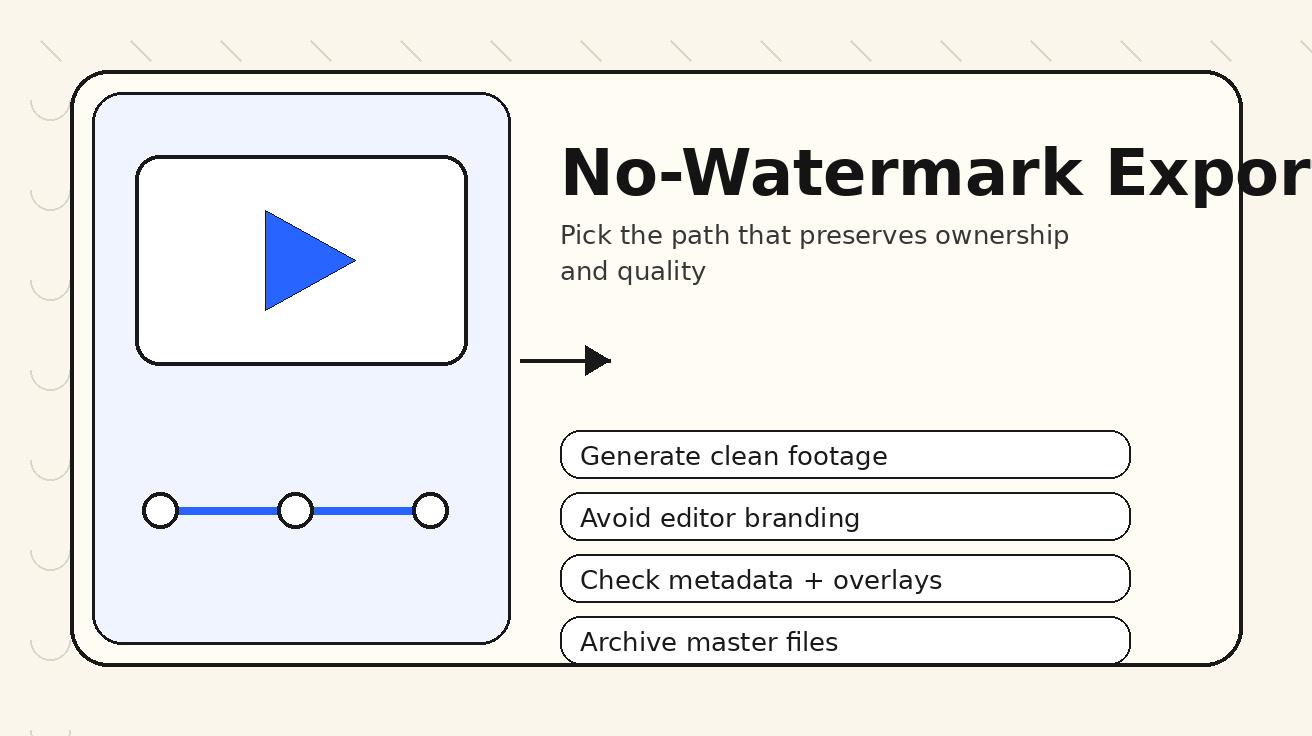
Prompting Veo 3 to avoid generated watermark artifacts
A surprising amount of no-watermark quality starts in the prompt. If you ask Veo 3 for a realistic product ad with packaging, text labels, social UI, news-style lower thirds, or futuristic interface panels, the model may invent marks that look like logos. Those marks are not official watermarks, but they create the same problem: the video looks branded by something you did not approve.
Use a clean prompt structure. Start with the subject, action, environment, camera, lighting, and style. Then add a negative constraint: no text, no subtitles, no logos, no watermarks, no app interface, no brand marks, no fake labels, no corner badges, no UI overlay, and no end card. If the asset needs text, add it later in an editor where spelling, typography, and claim review are controlled.
For product clips, tell Veo 3 to keep the product reference exact but avoid generating new packaging text. For social ads, ask for clean negative space where captions can be added later. For tutorials, avoid simulated screen recordings unless the screen content is essential and legally safe. For cinematic clips, avoid billboards, signage, jerseys, laptops with fake stickers, and branded storefronts unless you have a reason to show them.
A strong no-watermark prompt also avoids “template language.” Phrases like “viral TikTok layout,” “Instagram interface,” “YouTube subscribe animation,” or “TV commercial lower third” can encourage UI elements or fake platform graphics. Instead, describe the motion directly: “vertical close-up shot with clean background and empty space above the product for captions.” This gives the editor room to add real overlays later.
Here is a safe baseline prompt:
Create an eight-second clean AI video using the uploaded image as the visual reference. The scene is bright, realistic, and brand-neutral. The subject moves naturally with a stable camera and no generated text. Leave clean negative space for captions. Do not add logos, watermarks, badges, stickers, fake labels, platform UI, lower thirds, subtitles, app frames, QR codes, end cards, or unreadable text.
This prompt will not solve every generation issue, but it reduces the chance that the clip comes out with visual clutter you cannot use.
Editing workflow for clean master exports
After generation, treat the Veo 3 result as raw footage. Do not post the first download immediately. Open it in an editor and build a clean master. A clean master is the version you can archive, crop, translate, caption, and deliver without platform-specific baggage.
Start by trimming the clip. Remove frames where the subject has not started moving, where motion collapses, or where the final frame creates an awkward freeze. If the clip contains a tiny artifact in one corner, crop only if the crop does not damage composition or reduce resolution below your target. If the artifact is central, regenerate. Cropping should not become a habit that hides larger quality problems.
Add captions and overlays manually. This keeps spelling, wording, claims, and brand design under control. For ads and product videos, use short factual overlays instead of hype-heavy promises. For tutorials, keep text large enough for mobile viewing. For YouTube or website hero sections, consider exporting a version without captions as well, because the same motion may need different copy later.
Export using a predictable naming system. A good name includes the slug, aspect ratio, duration, and version number, such as veo-no-watermark-demo-9x16-v03.mp4. Save the raw Veo 3 output, the project file, the clean master, and each distribution export. This matters when a client asks for a square version two weeks later or a platform rejects one cut and you need to revise quickly.
Finally, watch the exported file outside the editor. Some tools show a clean preview but add branding during export. Others add an outro only when the file is shared through a mobile workflow. Always inspect the actual file you plan to upload.
Aspect ratios and no-watermark social exports
A no-watermark export still has to fit the destination. If the clip is technically clean but cropped badly, it will not perform. Veo 3 outputs often need adaptation for vertical, square, and horizontal placements.
For Instagram Reels, TikTok, Shorts, and vertical ads, use 9:16 framing with the subject centered and important details away from the top and bottom UI zones. Leave space for captions in the upper or middle area rather than putting critical visual information under platform buttons. If you generated a horizontal clip first, use a center-safe composition or regenerate a vertical version instead of forcing an aggressive crop.
For YouTube, landing pages, and blog embeds, horizontal exports are still useful. A clean 16:9 master can support hero banners, product demos, and editorial content. Keep the first frame strong because many platforms show it as a preview. If the clip will autoplay silently, make sure the visual story works without audio.
For paid social, export variants rather than one universal file. A performance marketer may need a 9:16 hook, a 1:1 feed version, and a 16:9 landing-page version. Each should be watermark-free, but each may use different captions, pacing, and safe zones. The mistake is to export one video from a free app, discover a watermark, and then try to crop it differently for every platform. Build clean masters first, then variants.
Best use cases for Veo 3 no-watermark videos
The most useful no-watermark Veo 3 projects are the ones where the video becomes part of a larger owned asset system. Website hero motion is a strong use case because a third-party watermark on a homepage immediately lowers perceived quality. Product demos are another strong fit, especially when teams need simple motion from existing product photos. Educational explainers can also work well when the visual is clean and the text is added later.
Social ads benefit from clean exports because a visible tool mark can make the creative feel recycled. If the ad is trying to sell a product, SaaS feature, course, app, or creator offer, the final frame should reinforce the advertiser’s brand, not the generator’s trial tier. The same applies to influencer kits and client previews. Agencies can use Veo 3 to create motion options quickly, but the delivered file must look intentional.
YouTube intros, newsletter embeds, sales decks, and course modules are also practical. In these formats, the video often stays live for a long time. A watermark that feels acceptable during a quick experiment can look unprofessional six months later. No-watermark discipline protects the asset’s shelf life.
There are also cases where no-watermark is not enough. If the clip contains a celebrity likeness, a fake news environment, misleading medical result, unauthorized brand use, or product inaccuracy, a clean export does not make it safe. Watermark checks are only one part of creative review.
A no-watermark QA checklist before publishing
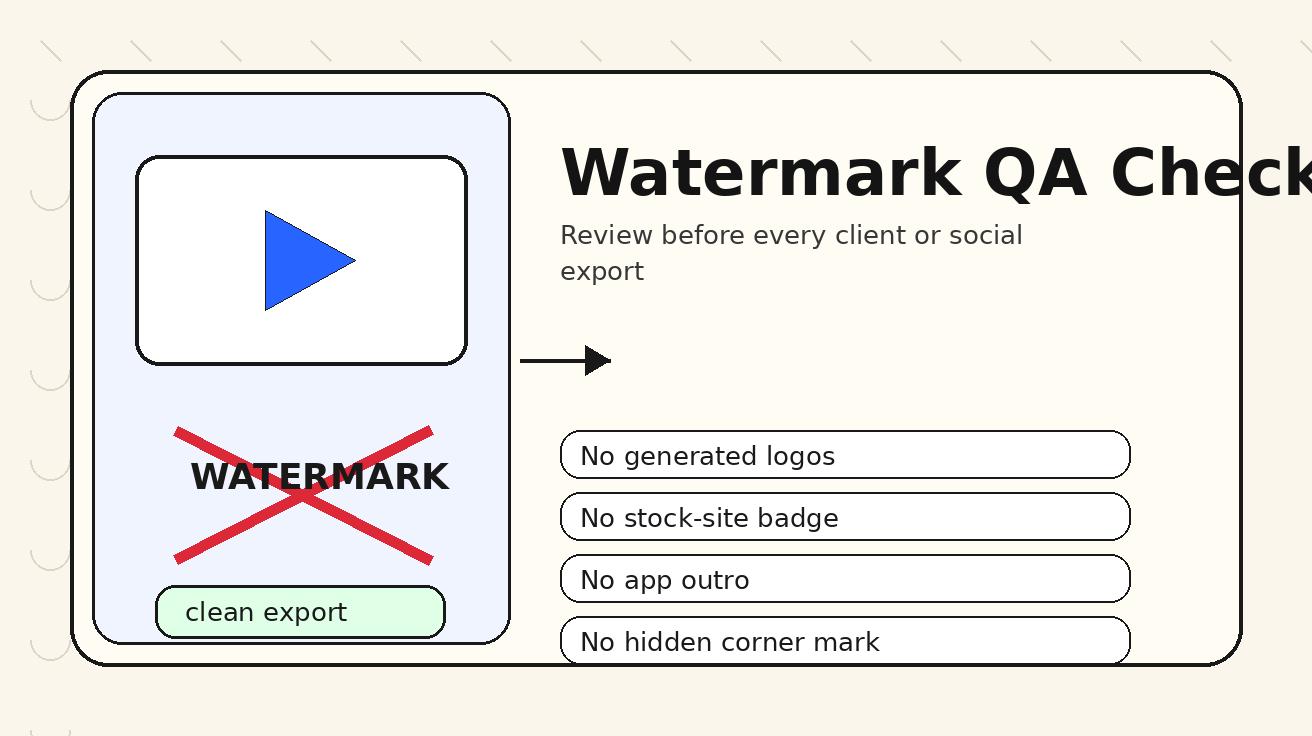
Before publishing, run a frame-by-frame review. Check all four corners, the center, and the final second. Look for logos, pseudo-text, badges, stickers, UI elements, app frames, QR codes, strange letters, fake labels, platform buttons, and hidden end cards. If the video loops, inspect the loop point as well.
Then check the editor export. Confirm the tool did not add a logo, animated outro, trial banner, or audio tag. If the export includes music from a library, confirm the license is valid for the platform and region. A clean visual watermark is not enough if the audio creates a copyright problem.
Next check compression. A heavily compressed free export can look worse than a watermarked preview. For website and ad use, preserve enough bitrate that edges, product details, and captions remain readable. Avoid repeatedly downloading and re-uploading through social apps before final delivery.
Finally, check ownership and documentation. Save the prompt, source assets, export settings, license notes, and final URLs. If a client or teammate asks how the clip was made, you should be able to explain the workflow without scrambling through downloads.
Common mistakes that add watermarks back into clean clips
The first mistake is using a mobile editor that watermarks exports on the free tier. Many creators only notice after finishing the edit. Test the export before investing time in captions and timing.
The second mistake is downloading a video from a social platform and reusing that download elsewhere. Some platforms add branding to downloaded posts, especially when the video includes native music, stickers, or edits. Keep the original clean file instead.
The third mistake is recording the screen instead of exporting. Screen recordings can capture browser UI, player controls, cursor movements, notification badges, and compression artifacts. They also look less professional than a proper export.
The fourth mistake is asking Veo 3 to generate text-heavy designs. Generated typography can become a pseudo-watermark or compliance issue. Add typography in post-production.
The fifth mistake is failing to archive the clean master. If the only file you keep is a version uploaded through a platform, you may lose the ability to make clean edits later. Treat the master as the source of truth.
FAQ
Can Veo 3 create videos with no watermark?
Veo 3 can fit into a no-watermark workflow when the generation, editing, and export steps all produce clean files. Always test your account and export path because visible branding can depend on product access, tool tier, editor choice, and download method.
What is the safest free export workflow for Veo 3 clips?
Generate clean footage, download the master, edit in a tool that you have tested for no-watermark exports, then inspect the final file outside the editor. Keep the raw clip, project file, clean master, and platform-specific exports in an archive.
Should I remove a watermark from a trial export?
No. If a service adds a watermark by design, use a licensed no-watermark export option or choose a different workflow. Removing watermarks from files you are not cleared to use can violate terms and create client risk.
How do I stop Veo 3 from generating fake logos or text?
Prompt for clean footage with no text, no logos, no badges, no platform UI, no lower thirds, no stickers, no watermarks, and no unreadable letters. Add all captions and brand elements later in an editor.
Which formats should I export for social media?
Keep a clean master, then export 9:16 for Reels, TikTok, and Shorts; 1:1 for feed tests; and 16:9 for YouTube, landing pages, or blog embeds. Check each version for corner marks and platform-safe cropping.
Is no-watermark enough for commercial use?
No. You also need rights to source assets, safe prompts, accurate product representation, approved claims, licensed music, and platform-compliant exports. A clean visual file is only one part of commercial review.
Final takeaways
The best Veo 3 no-watermark workflow is not a trick. It is a disciplined production pipeline. Prompt for clean footage, avoid generated text and fake logos, edit overlays manually, export through tested tools, inspect the finished file, and archive the clean master. Free export options can work when they are tested and documented, but the safest professional habit is to verify every layer before the video reaches a client, ad account, product page, or social channel.
For teams that create many AI videos, this discipline compounds. Every clean prompt, export preset, checklist, and archive folder makes the next campaign faster. The result is not just a video without a logo. It is a reusable motion asset that looks like it belongs to your brand.
<script type="application/ld+json"> { "@context": "https://schema.org", "@type": "FAQPage", "mainEntity": [ {"@type": "Question", "name": "Can Veo 3 create videos with no watermark?", "acceptedAnswer": {"@type": "Answer", "text": "Veo 3 can fit into a no-watermark workflow when the generation, editing, and export steps all produce clean files. Always test your account and export path because visible branding can depend on product access, tool tier, editor choice, and download method."}}, {"@type": "Question", "name": "What is the safest free export workflow for Veo 3 clips?", "acceptedAnswer": {"@type": "Answer", "text": "Generate clean footage, download the master, edit in a tool that you have tested for no-watermark exports, then inspect the final file outside the editor. Keep the raw clip, project file, clean master, and platform-specific exports in an archive."}}, {"@type": "Question", "name": "Should I remove a watermark from a trial export?", "acceptedAnswer": {"@type": "Answer", "text": "No. If a service adds a watermark by design, use a licensed no-watermark export option or choose a different workflow. Removing watermarks from files you are not cleared to use can violate terms and create client risk."}}, {"@type": "Question", "name": "How do I stop Veo 3 from generating fake logos or text?", "acceptedAnswer": {"@type": "Answer", "text": "Prompt for clean footage with no text, no logos, no badges, no platform UI, no lower thirds, no stickers, no watermarks, and no unreadable letters. Add all captions and brand elements later in an editor."}}, {"@type": "Question", "name": "Which formats should I export for social media?", "acceptedAnswer": {"@type": "Answer", "text": "Keep a clean master, then export 9:16 for Reels, TikTok, and Shorts; 1:1 for feed tests; and 16:9 for YouTube, landing pages, or blog embeds. Check each version for corner marks and platform-safe cropping."}}, {"@type": "Question", "name": "Is no-watermark enough for commercial use?", "acceptedAnswer": {"@type": "Answer", "text": "No. You also need rights to source assets, safe prompts, accurate product representation, approved claims, licensed music, and platform-compliant exports. A clean visual file is only one part of commercial review."}} ] } </script>
Related Articles
Continue with more blog posts in the same locale.
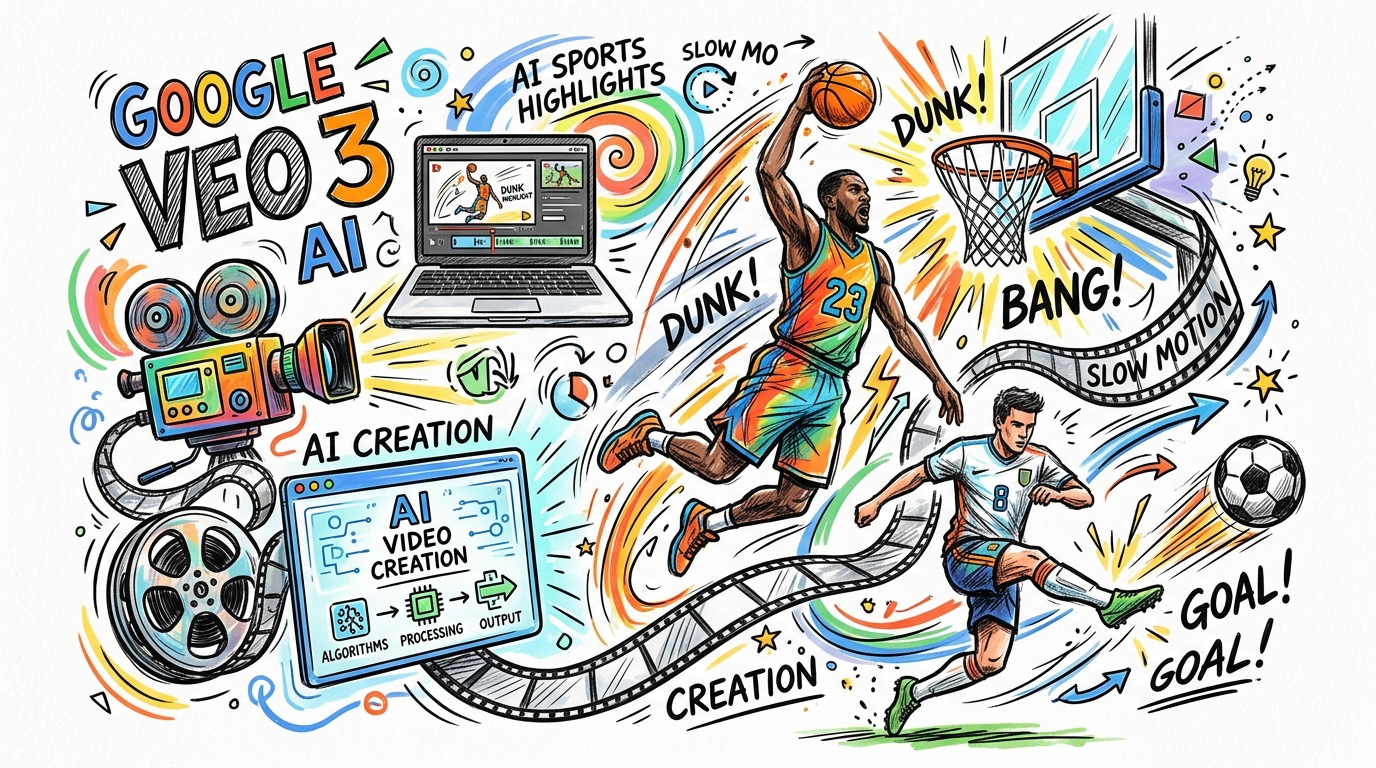
How to Make Sports Highlight Videos with Veo 3 AI (2026)
Create stunning sports highlight videos with Veo 3 AI. Generate dynamic action shots, slow-motion sequences, and dramatic replays using AI prompts.
Read article
How to Make a Short Film with Veo 3 AI (2026 Guide)
Learn how to create professional short films using Veo 3 AI. Step-by-step guide with prompts, workflow tips, and cinematic techniques.
Read article
How to Make Documentary Videos with Veo 3 AI (2026 Guide)
Create compelling documentary videos with Veo 3 AI. Learn prompting techniques, narrative structure, realistic footage generation, and post-production tips.
Read article