
Luma Ray3 vs Veo 3: 4K HDR, Physics, and Workflow Compared
Luma Ray3 vs Veo 3 compared for 4K HDR, native audio, physics, image-to-video, keyframes, pricing, and creator workflows in 2026.
Emma Chen · 15 min read · Apr 30, 2026
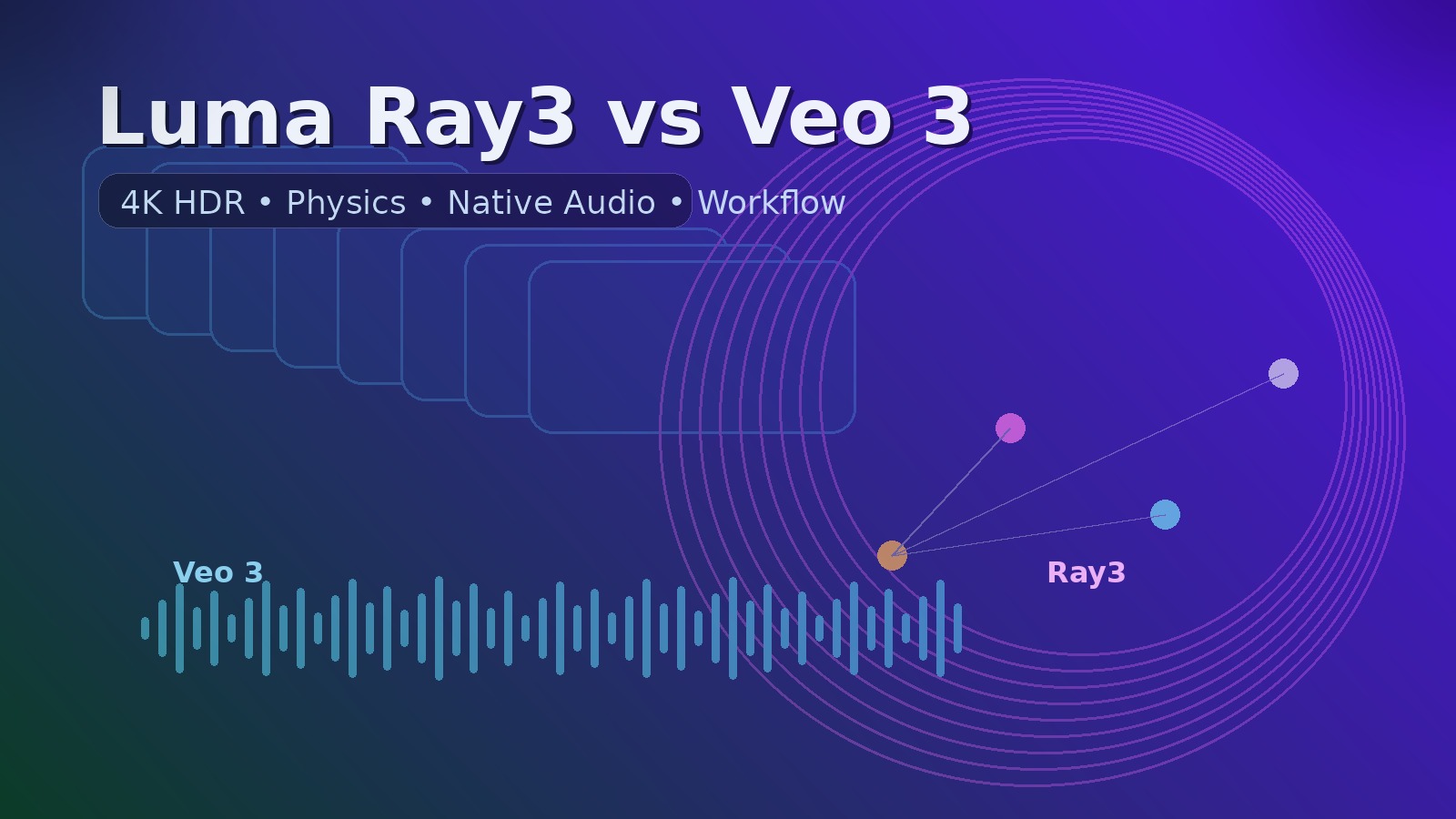
If you are choosing between Luma Ray3 and Google Veo 3, the short answer is this: choose Veo 3 when you need a prompt-to-video model with native audio, dialogue, strong real-world physics, and a workflow that fits Google Flow or AI Studio. Choose Luma Ray3 when your priority is a production-style visual pipeline: HDR/EXR output, keyframes, visual annotation, draft-to-master iteration, and image/video-to-video control inside Dream Machine.
Both models can produce cinematic AI video, but they are optimized for different creative decisions. Veo 3 feels like a complete story generator: prompt, motion, camera, scene logic, sound effects, ambient audio, and dialogue can live in one request. Ray3 feels like a professional shot-building system: start with an idea, iterate quickly, lock the composition, then master the best result into a higher-fidelity deliverable.
This comparison breaks down Luma Ray3 vs Veo 3 across quality, 4K HDR, physics, prompt adherence, native audio, image-to-video, keyframes, pricing considerations, and the workflow a creator should actually use in 2026.
Quick verdict
For most creators, Veo 3 is the better all-round AI video generator because it combines strong prompt following with native audio generation. That matters for ads, social videos, product explainers, YouTube Shorts, and cinematic clips where sound design is part of the final asset.
For studios, agencies, and visual teams, Luma Ray3 is the more specialized production choice because its strongest features are built around control: HDR, EXR, Draft Mode, visual annotation, keyframes, video-to-video, and the ability to explore a shot before committing to final quality.
The best choice depends on the job:
| Use case | Better choice | Why |
|---|---|---|
| Text-to-video with dialogue and sound | Veo 3 | Native audio, dialogue, ambient sound, and strong prompt adherence |
| Cinematic image-to-video with shot control | Ray3 | Keyframes, visual annotation, and draft-to-master iteration |
| Fast social concepts | Veo 3 | Fewer pipeline steps when audio and video are generated together |
| HDR or post-production finishing | Ray3 | HDR/EXR workflow and 4K mastering are core Ray3 differentiators |
| Brand storyboards and product demos | Depends | Veo 3 wins for complete audio scenes; Ray3 wins for controlled visuals |
| Longer directed sequences | Depends | Veo workflows help scene creation; Ray3 helps preserve shot intent through keyframes and extensions |
What is Luma Ray3?
Ray3 is Luma AI's next-generation video model for Dream Machine. Luma describes it as a reasoning-driven, high-fidelity model built with creative input from entertainment, advertising, and gaming workflows. Its positioning is not only "make a video from text"; it is closer to "build a controllable cinematic shot and prepare it for a professional pipeline."
The official Ray3 materials emphasize several capabilities:
- Reasoning-driven generation for more coherent scene planning and intent matching.
- HDR output, including professional bit-depth formats such as 10-, 12-, and 16-bit EXR.
- Draft Mode for rapid exploration before mastering a preferred version.
- 4K HDR mastering for turning the selected draft into a higher-fidelity result.
- Visual Annotation, where users can guide movement or composition directly on a frame.
- Improved image-to-video, keyframes, extend, and loop workflows.
Luma also released Ray3.14, which adds native 1080p generation, faster performance, lower cost at 720p compared with Ray3, better stability, and improved prompt adherence. That matters because many comparisons still refer to older Dream Machine behavior, while the current Ray3 line is positioned more aggressively as a production model.
In practical terms, Ray3 is strongest when the creator already knows what the shot should look like. If you have a product image, a storyboard frame, a character reference, a camera path, or a composition you want to preserve, Ray3 gives you more ways to steer the result than a simple text box.
What is Veo 3?
Veo 3 is Google's advanced video generation model, presented by Google DeepMind as a model with expanded creative controls, native audio, prompt adherence, realism, and physics. Google highlights Veo 3's ability to generate sound effects, ambient noise, and dialogue natively with the video. That is the biggest practical difference from many competing video models.
Veo 3 is also closely tied to Google creative tooling such as Flow and AI Studio. For creators, this matters because the model is not only about raw output quality; it is about how easily a prompt becomes a usable clip, how well the model follows instructions, and how much post-production work is required after generation.
The major Veo 3 strengths are:
- Native audio generation, including dialogue, sound effects, and ambient noise.
- Strong text-to-video prompt adherence for cinematic scenes.
- Realistic physics and motion, especially when prompts describe real-world interactions.
- Image-to-video and first/last-frame style workflows in the broader Veo ecosystem.
- Scene extension and story-building workflows for creators who want more than a one-off clip.
- Integration with Google Flow, which makes it easier to assemble clips into a larger creative sequence.
If Ray3 is the shot-finishing specialist, Veo 3 is the scene-generation generalist. It can be a better starting point when you need a complete clip with motion, atmosphere, and audio in one pass.
Video quality and realism
Both Ray3 and Veo 3 can produce realistic results, but they express realism differently.
Veo 3 realism is strongest when the prompt describes a scene with clear physical behavior: people interacting, objects moving, vehicles, environments, handheld camera movement, or a dramatic moment with sound. Google's Veo page emphasizes realism, fidelity, physics, and audio. In everyday use, that means Veo 3 is attractive when you want the output to feel like a finished scene rather than a silent visual test.
Ray3 realism is strongest when the creator gives the model more structure. The model's strengths list includes photorealism, motion blur, detail nuance, complex crowds, interactive lighting, caustics, world exploration, and physics simulations. Ray3 can be especially compelling for cinematic mood, stylized commercials, product shots, and shots where a visual director wants to refine the same idea multiple times.
The distinction is important. If you are comparing one random text prompt, Veo 3 may feel more complete because it can include audio and a natural scene rhythm. If you are comparing a controlled production pipeline, Ray3 may feel more useful because it gives you more tools to iterate toward a specific final shot.
4K HDR and EXR: Ray3's clearest advantage
Ray3's biggest unique advantage is its HDR and finishing workflow. Luma's documentation positions Ray3 as capable of native HDR generation in professional bit-depth formats, and Draft Mode can be used to explore variations before mastering a preferred result into a high-detail 4K HDR version.
That matters for:
- Advertising teams that need color-gradeable assets.
- Film and trailer experiments where dynamic range affects the final look.
- Product visuals with glossy materials, lights, reflections, or complex highlights.
- Agencies that want to treat AI clips as part of a post-production pipeline instead of disposable social content.
Veo 3 can generate high-quality video, but its most distinctive advantage is not HDR finishing. Its advantage is complete scene generation with audio and strong instruction following. If your deliverable needs to pass through color grading, compositing, or a high-end editorial process, Ray3 deserves serious consideration.
For most web creators, however, HDR/EXR may be less important than speed and completeness. If you are publishing a TikTok, YouTube Short, landing page background, or ad concept, native audio and fewer workflow steps may matter more than a professional HDR container.
Native audio: Veo 3's clearest advantage
Veo 3's strongest differentiator is native audio. Google explicitly highlights sound effects, ambient noise, and dialogue generation. This is not a small feature. In video production, audio often determines whether a clip feels finished or unfinished.
A Veo 3 prompt can describe:
- A character line of dialogue.
- City ambience or room tone.
- A cinematic music mood.
- Sound effects synchronized to motion.
- A scene where audio changes the emotional meaning.
Ray3 can produce excellent visuals, but when the job requires an integrated audiovisual scene, Veo 3 has the cleaner path. With Ray3, creators may still need a separate music, voice, or sound design workflow. That is workable for professional teams, but it adds production steps.
Choose Veo 3 if the final output needs to feel like a complete video asset immediately. Choose Ray3 if the visual shot quality and controllability are more important than one-pass audio.
Prompt adherence and reasoning
Both models advertise better prompt adherence, but the workflow changes how prompt adherence feels.
Veo 3 prompt adherence is valuable because a single prompt may include the subject, action, camera move, audio, dialogue, and atmosphere. When it follows that prompt well, the creator gets a complete scene. This is why Veo 3 is strong for narrative snippets, product demos, educational clips, social ads, and cinematic micro-scenes.
Ray3 prompt adherence is valuable because it can be combined with other controls. Luma's Ray3 materials emphasize reasoning, visual annotation, keyframes, and controlled workflows. That means a creator does not have to rely only on text. You can steer the model with frames, marks, references, and iteration.
A practical rule:
- If your prompt is the whole creative brief, use Veo 3 first.
- If your prompt is only one part of a directed visual workflow, test Ray3.
Image-to-video comparison
For image-to-video, both tools are highly relevant.
Veo 3 is strong when the image should become a complete scene. For example, a product photo can become a short ad with lighting movement, camera motion, ambience, and a voice line. A character image can become a dramatic moment with environmental sound. This makes Veo 3 appealing for marketers who want a fast, finished clip.
Ray3 is strong when the starting image needs careful motion control. Luma highlights improved image-to-video, smoother transitions, fewer morphing artifacts, keyframes, visual annotation, and better identity preservation. If the creator wants to preserve product shape, direct the camera path, or avoid the "AI melted object" look, Ray3's control layer is useful.
For product teams, the choice is not obvious. Veo 3 may be faster for a complete product ad. Ray3 may be better for a hero shot where the product must stay accurate and color grading matters.
Keyframes, visual annotation, and control
Ray3 wins the control category. Keyframes and visual annotation make the model feel more like a directed creative tool. Instead of hoping the model interprets a motion phrase correctly, the creator can guide the start, path, or end state more explicitly.
This is useful for:
- Camera pushes and pullbacks.
- Product rotations.
- Character movement between two poses.
- Maintaining composition across frames.
- Turning a storyboard into a shot sequence.
- Correcting motion direction without rewriting the entire prompt.
Veo 3 also has creative controls in the broader Veo ecosystem, especially through Flow and related workflows, but Ray3's public positioning is more directly centered on visual control and post-production fidelity. If your team thinks in keyframes, boards, and shot continuity, Ray3 will feel more familiar.
Speed and iteration
Speed is more complicated than a single benchmark because each platform has different modes, plans, queues, and output settings. Ray3's Draft Mode is specifically designed for quick exploration, and Ray3.14 is positioned as faster and cheaper than Ray3 at 720p. That gives Luma a clear workflow story: iterate quickly, then master the winner.
Veo 3's speed advantage is workflow compression. Even if an individual generation is not always faster, it can reduce the number of steps because it can include audio and scene logic in the first output. A creator may need fewer external tools to reach a usable result.
Think about speed in terms of total production time:
- Need ten silent visual variations before client review? Ray3 Draft Mode is attractive.
- Need one social clip with ambience and dialogue quickly? Veo 3 may be faster overall.
- Need a final shot for post-production? Ray3 may save time later by preserving visual quality and HDR options.
- Need a complete narrative clip? Veo 3 may save time by including sound from the beginning.
Pricing and access considerations
Pricing changes often, so creators should check the official Luma and Google access pages before budgeting a campaign. The better question is not simply "which is cheaper?" It is "which model wastes fewer generations for my workflow?"
Ray3 can be cost-effective when Draft Mode helps you explore many variations before mastering only the best version. If you are a director or designer, that workflow can reduce expensive final-output attempts.
Veo 3 can be cost-effective when native audio reduces the need for separate sound tools, voice tools, and editing passes. If a single Veo output is closer to publish-ready, the total project cost may be lower even if the model itself is not the cheapest option.
For teams, evaluate cost by deliverable:
- How many generations does it take to get a usable visual?
- How many editing tools are needed after generation?
- Does the clip need native audio?
- Does the clip need HDR, EXR, or heavy post-production?
- Does the workflow need client approvals or internal iteration?
Best workflows for creators
Workflow 1: Fast social ad
Use Veo 3 when the output needs to include the product, a camera move, ambient sound, and a short voice line. Prompt the full scene, then edit the best output into a vertical ad.
Example prompt structure:
A close-up cinematic product shot of a matte black wireless earbud case opening on a reflective table, soft morning light, slow push-in, realistic hand interaction, subtle room tone, gentle click sound when the case opens, no text overlays.
Workflow 2: Premium product hero shot
Use Ray3 when a product image must stay stable and the final visual may need high-end finishing. Start with the product image, use visual annotation or keyframes to guide motion, explore in Draft Mode, then master the best version.
Workflow 3: Storyboarded brand film
Use both. Generate fast concepts in Veo 3 to test mood and audio. Then rebuild the best shots in Ray3 when you need controlled camera movement, consistent composition, and high-fidelity finishing.
Workflow 4: Cinematic YouTube or landing page clip
Use Veo 3 when audio and story rhythm matter. Use Ray3 when the clip will sit behind typography, be graded, or need a polished HDR visual identity.
Which model should you choose?
Choose Veo 3 if:
- You need native audio, dialogue, ambience, or sound effects.
- You want a complete scene from one prompt.
- You publish social clips, ads, explainers, or fast creative tests.
- You prefer a simpler prompt-to-result workflow.
- You already work inside Google Flow or AI Studio.
Choose Luma Ray3 if:
- You need HDR, EXR, or 4K mastering options.
- You care more about shot control than one-pass audio.
- You work with keyframes, product images, storyboard frames, or references.
- You want to iterate quickly in Draft Mode and finish only the best version.
- You are building visuals for advertising, film, design, or agency review.
For many creators, the answer is not one model forever. Use Veo 3 when speed and audiovisual completeness matter. Use Ray3 when visual control, post-production quality, and directed iteration matter.
Luma Ray3 vs Veo 3 FAQ
Is Luma Ray3 better than Veo 3?
Ray3 is better for controlled visual production, HDR/EXR workflows, keyframes, and draft-to-master iteration. Veo 3 is better for native audio, dialogue, ambient sound, and complete prompt-to-video scenes.
Does Ray3 support 4K HDR?
Luma positions Ray3 around HDR workflows and 4K HDR mastering from selected drafts. Its documentation also highlights professional HDR formats such as EXR, which is why Ray3 is attractive for post-production teams.
Does Veo 3 generate audio?
Yes. Veo 3's clearest advantage is native audio generation, including sound effects, ambient noise, and dialogue. This makes it especially useful when the clip needs to feel finished without a separate sound workflow.
Which is better for image-to-video?
Veo 3 is better when you want an image to become a complete audiovisual scene. Ray3 is better when you need more control over motion, identity preservation, keyframes, and visual direction.
Which is better for product videos?
For fast product ads, Veo 3 is often easier because it can generate audio and scene atmosphere. For premium product hero shots where the product shape, lighting, and color pipeline matter, Ray3 may be the better choice.
Should I use Ray3 or Veo 3 for YouTube Shorts?
Use Veo 3 if the Short needs dialogue, sound effects, or a complete scene quickly. Use Ray3 if the Short is visually driven, based on a specific image, or needs a polished cinematic look before editing.
Can I use both models together?
Yes. A strong workflow is to use Veo 3 for rapid audiovisual concepting, then use Ray3 for controlled visual shots that require keyframes, HDR, or more precise image-to-video direction.
Final recommendation
The practical winner in Luma Ray3 vs Veo 3 depends on your production goal. Veo 3 wins for complete audiovisual generation: native audio, dialogue, ambience, strong prompt adherence, and a shorter path from idea to publishable clip. Ray3 wins for directed visual production: HDR, EXR, Draft Mode, keyframes, visual annotation, and 4K-style mastering.
If you are a solo creator, marketer, or social video producer, start with Veo 3. If you are a visual team, agency, or filmmaker who wants more control over the shot, test Ray3. If you are serious about AI video production in 2026, learn both workflows and choose based on the deliverable, not the model hype.
Related guides: Veo 3.1 vs Runway Gen-4.5, Google Flow Veo 3 guide, and Veo 3 vs Luma AI Dream Machine. Official sources: Luma Ray3, Ray3 User Guide, Ray3.14 update, and Google DeepMind Veo.
Related Articles
Continue with more blog posts in the same locale.
How to Make Sports Highlight Videos with Veo 3 AI (2026)
Create stunning sports highlight videos with Veo 3 AI. Generate dynamic action shots, slow-motion sequences, and dramatic replays using AI prompts.
Read article
How to Make a Short Film with Veo 3 AI (2026 Guide)
Learn how to create professional short films using Veo 3 AI. Step-by-step guide with prompts, workflow tips, and cinematic techniques.
Read article
How to Make Documentary Videos with Veo 3 AI (2026 Guide)
Create compelling documentary videos with Veo 3 AI. Learn prompting techniques, narrative structure, realistic footage generation, and post-production tips.
Read article