
Veo 3 vs Sora: Which AI Video Generator Is Better in 2026?
Emma Chen · 18 min read · Apr 12, 2026
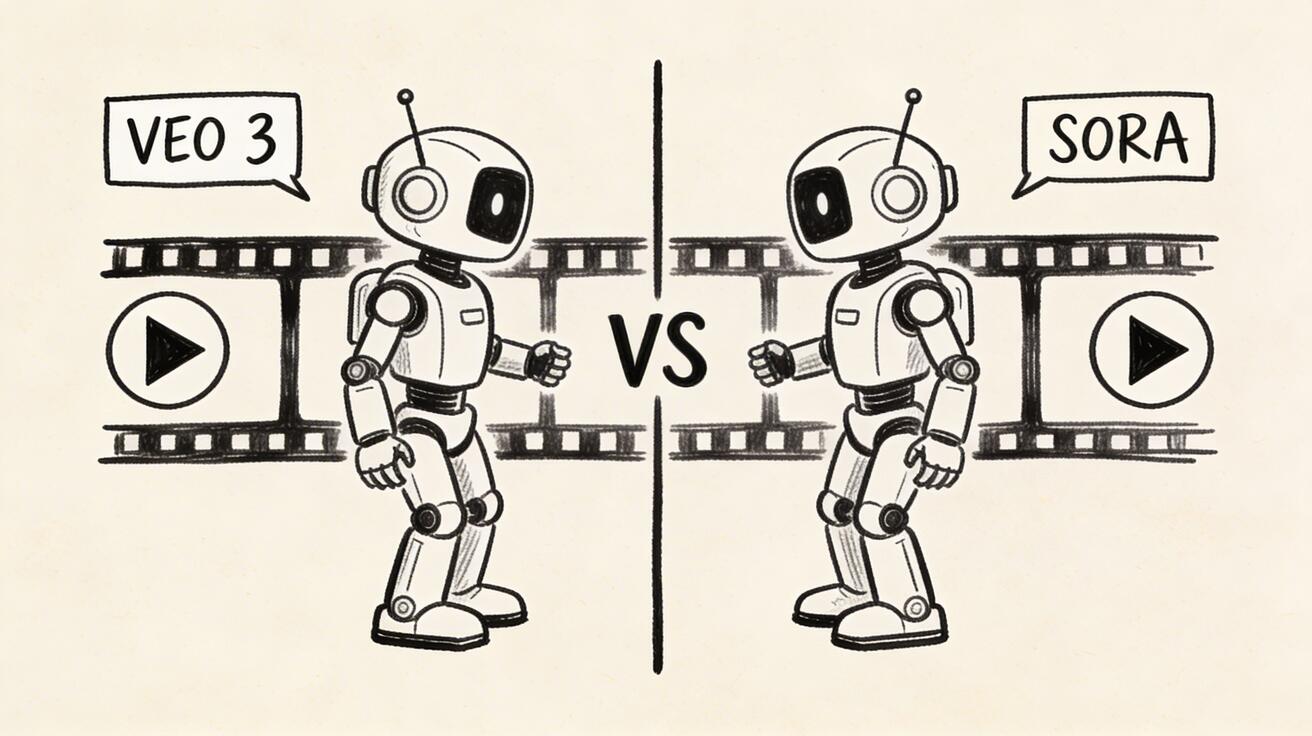
<h1>Veo 3 vs Sora: Which AI Video Generator Is Better in 2026?</h1>
<h2>Introduction</h2>
<p> The AI video generation landscape has transformed dramatically over the past year. What started as experimental technology producing glitchy, dreamlike clips has evolved into production-ready tools capable of generating cinematic-quality footage. At the forefront of this revolution are two heavyweight contenders: <strong>Google's Veo 3</strong> and <strong>OpenAI's Sora</strong>. </p>
<p> Both platforms represent the pinnacle of generative AI video technology in 2026, but they approach the challenge differently. Veo 3 leverages Google's deep expertise in machine learning and vast computational infrastructure, while Sora capitalizes on OpenAI's pioneering work in large language models and multimodal understanding. </p>
<p> For content creators, marketers, filmmakers, and businesses looking to incorporate AI-generated video into their workflows, choosing between these two platforms is a critical decision. This comprehensive comparison examines every aspect of Veo 3 and Sora—from video quality and generation speed to pricing, accessibility, and real-world use cases—to help you make an informed choice. </p>
<p> Whether you're producing social media content, marketing materials, prototype films, or experimental art, understanding the strengths and limitations of each platform will determine your success in the rapidly evolving world of AI video generation. </p>
<hr>
<h2>Quick Verdict: Veo 3 vs Sora at a Glance</h2>
<table> <thead> <tr><th>Feature</th><th>Veo 3</th><th>Sora</th></tr> </thead> <tbody> <tr><td><strong>Max Duration</strong></td><td>8 seconds per clip</td><td>20 seconds per clip</td></tr> <tr><td><strong>Text Understanding</strong></td><td>Outstanding</td><td>Very Good</td></tr> <tr><td><strong>Physics Simulation</strong></td><td>Highly Realistic</td><td>Good</td></tr> <tr><td><strong>Character Consistency</strong></td><td>Excellent</td><td>Moderate</td></tr> <tr><td><strong>Free Tier</strong></td><td>✅ Available</td><td>❌ Discontinued</td></tr> <tr><td><strong>Pricing</strong></td><td>Competitive pay-per-use</td><td>Subscription + credits</td></tr> <tr><td><strong>API Access</strong></td><td>✅ Available</td><td>✅ Available</td></tr> <tr><td><strong>Integration</strong></td><td>Google ecosystem</td><td>OpenAI ecosystem</td></tr> <tr><td><strong>Availability</strong></td><td>Global</td><td>Limited regions</td></tr> </tbody> </table>
<p> <strong>Bottom Line:</strong> Veo 3 emerges as the more accessible option with its free tier and superior character consistency, while Sora offers longer clip durations and deeper creative controls for professional workflows. </p>
<hr>
<h2>Video Quality and Realism</h2>
<h3>Veo 3: Photorealistic Precision</h3>
<p> Google's Veo 3 represents a quantum leap in video generation quality. The model demonstrates exceptional understanding of physical properties, lighting dynamics, and material behaviors. Generated videos exhibit: </p>
<p>
- <strong>Superior texture rendering</strong>: Fabrics, metals, and organic surfaces appear remarkably authentic
- <strong>Natural motion physics</strong>: Objects move with correct momentum, gravity, and collision responses
- <strong>Coherent lighting</strong>: Shadows and reflections remain consistent throughout the clip duration
- <strong>Facial detail preservation</strong>: Human faces maintain structural integrity without the uncanny distortions common in earlier AI video tools </p>
<p> Veo 3 excels at generating nature scenes, architectural visualizations, and product demonstrations where physical accuracy matters. The model's training on Google's extensive video datasets—including YouTube content—provides it with rich understanding of real-world dynamics. </p>
<h3>Sora: Cinematic Artistry</h3>
<p> OpenAI's Sora takes a slightly different approach, prioritizing creative expression and cinematic composition. While equally capable of photorealism, Sora demonstrates particular strength in: </p>
<p>
- <strong>Artistic interpretation</strong>: More flexibility in stylized, painterly, or surreal outputs
- <strong>Camera movements</strong>: Sophisticated understanding of cinematographic techniques including tracking shots, pans, and zooms
- <strong>Complex scene composition</strong>: Ability to generate crowded scenes with multiple interacting elements
- <strong>Temporal coherence</strong>: Maintains narrative consistency across longer generated sequences </p>
<p> Sora's strength lies in its ability to interpret creative prompts with nuance, making it ideal for concept artists, storytellers, and creative professionals who prioritize artistic vision over strict realism. </p>
<h3>Head-to-Head Quality Comparison</h3>
<p> In direct comparisons using identical prompts, Veo 3 consistently produces more physically accurate results, while Sora often generates more visually compelling and compositionally sophisticated outputs. For commercial applications requiring realism—such as real estate visualization or product prototyping—Veo 3 holds the advantage. For creative projects where artistic interpretation is valued, Sora's flexibility shines. </p>
<hr>
<h2>Prompt Understanding and Control</h2>
<h3>Veo 3: Precise Instruction Following</h3>
<p> Veo 3 demonstrates remarkable fidelity to complex, detailed prompts. The model excels at: </p>
<p>
- <strong>Multi-element scenes</strong>: Successfully composes scenes with multiple subjects, actions, and environmental factors
- <strong>Specific camera instructions</strong>: Accurately interprets shot types (close-up, wide angle, Dutch angle)
- <strong>Temporal descriptions</strong>: Understands sequences of events and cause-effect relationships
- <strong>Negative prompting</strong>: Effectively excludes unwanted elements when specified </p>
<p> Example prompt: <em>"A close-up tracking shot of a barista's hands preparing latte art, steam rising from the cup, morning light streaming through a café window, shallow depth of field"</em> — Veo 3 renders this with precise adherence to each specified element. </p>
<h3>Sora: Creative Interpretation</h3>
<p> Sora approaches prompts with more interpretive freedom, sometimes enhancing descriptions in unexpected ways: </p>
<p>
- <strong>Stylistic expansion</strong>: Automatically applies appropriate aesthetic treatments based on context
- <strong>Ambiguity handling</strong>: Makes intelligent creative decisions when prompts leave room for interpretation
- <strong>Emotional resonance</strong>: Captures mood and atmosphere even when not explicitly described
- <strong>Narrative inference</strong>: Extends prompts with logical contextual elements </p>
<p> This interpretive approach can be advantageous for exploratory creative work but may require more iteration to achieve specific results. </p>
<hr>
<h2>Generation Speed and Efficiency</h2>
<h3>Processing Times</h3>
<p> Both platforms have made significant strides in generation speed compared to their predecessors: </p>
<p> <strong>Veo 3:</strong>
- Standard 8-second clip: 45-90 seconds
- Higher quality settings: 2-3 minutes
- Batch processing: Supports simultaneous generation of multiple clips </p>
<p> <strong>Sora:</strong>
- Standard clip: 60-120 seconds
- 20-second maximum duration: 3-5 minutes
- Quality-first mode: Up to 8 minutes for premium results </p>
<p> Veo 3 generally offers faster turnaround times, particularly beneficial for iterative workflows and rapid prototyping. </p>
<h3>Infrastructure and Reliability</h3>
<p> Google's cloud infrastructure provides Veo 3 with exceptional uptime and consistent performance. The service rarely experiences capacity constraints, ensuring predictable workflow integration. </p>
<p> Sora's availability has improved significantly since launch, though high-demand periods can occasionally result in queue times. OpenAI's infrastructure investments continue to address these limitations. </p>
<hr>
<h2>Duration and Format Limitations</h2>
<h3>Clip Length</h3>
<p> The most significant differentiator between the platforms is maximum clip duration: </p>
<p>
- <strong>Veo 3</strong>: 8 seconds per generation
- <strong>Sora</strong>: 20 seconds per generation </p>
<p> For projects requiring longer sequences, both platforms support extending clips through sequential generation, though this requires careful prompt engineering to maintain consistency. </p>
<h3>Resolution and Aspect Ratio</h3>
<p> Both platforms support:
- Standard resolutions up to 1080p
- Multiple aspect ratios (16:9, 9:16, 1:1, 4:3)
- Frame rates up to 30fps </p>
<p> Veo 3 additionally offers specialized export formats optimized for specific platforms (YouTube Shorts, Instagram Reels, etc.). </p>
<hr>
<h2>Character Consistency and Human Figures</h2>
<h3>The Human Figure Challenge</h3>
<p> Generating convincing human figures remains one of AI video's most difficult challenges. Both platforms have made progress, but important differences exist: </p>
<p> <strong>Veo 3:</strong>
- Superior facial consistency across frames
- More natural body proportions and movement
- Better handling of hands and fingers (historically problematic for AI)
- Reduced "uncanny valley" effect </p>
<p> <strong>Sora:</strong>
- Occasional facial morphing between frames
- More stylized human representations
- Better performance with stylized/cartoon humans than photorealistic ones
- Improved but still inconsistent hand rendering </p>
<p> For projects requiring photorealistic human subjects—such as commercials, training videos, or narrative content—Veo 3 provides more reliable results. </p>
<hr>
<h2>Pricing and Accessibility</h2>
<h3>Veo 3: Accessible Entry Point</h3>
<p> Google has positioned Veo 3 as an accessible tool with multiple pricing tiers: </p>
<p> <strong>Free Tier:</strong>
- 50 generations per month
- Standard quality
- 8-second clips
- Community support </p>
<p> <strong>Pro Plan ($49/month):</strong>
- 500 generations
- Priority processing
- 1080p exports
- Email support </p>
<p> <strong>Enterprise (Custom pricing):</strong>
- Unlimited generations
- API access
- Dedicated support
- Custom training options </p>
<p> The free tier makes Veo 3 particularly attractive for hobbyists, students, and small businesses exploring AI video without financial commitment. </p>
<h3>Sora: Premium Positioning</h3>
<p> OpenAI has adopted a different approach following the discontinuation of free access: </p>
<p> <strong>Plus Plan ($20/month ChatGPT Plus):</strong>
- Limited video generations
- Standard resolution
- Basic priority </p>
<p> <strong>Pro Plan ($200/month):</strong>
- Higher generation limits
- 1080p exports
- Priority processing
- Extended clip lengths </p>
<p> <strong>Enterprise API:</strong>
- Volume-based pricing
- Full feature access
- Custom integrations </p>
<p> Sora's higher price point reflects its positioning as a premium creative tool rather than an accessible entry-level platform. </p>
<h3>Cost Efficiency Analysis</h3>
<p> For users generating fewer than 50 clips monthly, Veo 3's free tier provides exceptional value. At higher volumes, cost differences narrow, and workflow compatibility becomes the more significant factor. </p>
<hr>
<h2>Integration and Workflow</h2>
<h3>Veo 3: Google Ecosystem Synergy</h3>
<p> Veo 3 integrates seamlessly with Google's productivity suite: </p>
<p>
- <strong>Google Workspace</strong>: Direct export to Drive, Docs, and Slides
- <strong>YouTube Studio</strong>: Optimized export settings for platform upload
- <strong>Google Ads</strong>: Native integration for marketing campaigns
- <strong>Android</strong>: Mobile app for on-the-go generation </p>
<p> For organizations already invested in Google's ecosystem, Veo 3 offers frictionless workflow integration. </p>
<h3>Sora: OpenAI Platform Integration</h3>
<p> Sora exists within OpenAI's broader platform: </p>
<p>
- <strong>ChatGPT</strong>: Conversational interface for video generation
- <strong>DALL-E</strong>: Image-to-video workflows
- <strong>OpenAI API</strong>: Comprehensive programmatic access
- <strong>Third-party tools</strong>: Growing ecosystem of integrations </p>
<p> Sora's integration with ChatGPT provides a unique conversational interface that can be valuable for iterative creative exploration. </p>
<hr>
<h2>Technical Architecture and Model Training</h2>
<h3>Veo 3: Google's Multimodal Foundation</h3>
<p> Veo 3 builds upon Google's extensive research in multimodal AI architectures. The model incorporates several technical innovations that contribute to its performance: </p>
<p> <strong>Spatial-Temporal Understanding:</strong> Veo 3 employs advanced transformers that process both spatial information (what appears in each frame) and temporal relationships (how elements change across frames). This dual processing enables more coherent motion and consistent object persistence throughout generated clips. </p>
<p> <strong>Scaling Methodology:</strong> Google's approach to scaling Veo 3 involved training on diverse video datasets spanning multiple domains, resolutions, and styles. The model benefits from Google's proprietary video understanding research, including techniques developed for YouTube content analysis and Google Photos organization. </p>
<p> <strong>Safety and Filtering:</strong> Veo 3 incorporates multiple layers of content filtering and safety mechanisms. Google's experience with content moderation at scale—across Search, YouTube, and other properties—informs the model's approach to responsible generation. The system includes automatic detection and prevention of harmful, misleading, or inappropriate content. </p>
<p> <strong>Efficiency Optimizations:</strong> Through distillation and architectural optimizations, Veo 3 achieves high-quality output with relatively efficient inference. This efficiency enables the free tier offering and keeps costs manageable for high-volume users. </p>
<h3>Sora: Diffusion Transformer Innovation</h3>
<p> Sora represents OpenAI's application of diffusion transformer architecture to video generation: </p>
<p> <strong>Patch-Based Processing:</strong> Rather than processing entire frames, Sora operates on visual patches—analogous to tokens in language models. This approach allows the model to scale across different resolutions and aspect ratios while maintaining consistent generation quality. </p>
<p> <strong>Unified Latent Space:</strong> Sora operates within a unified latent space that represents videos, images, and potentially other modalities. This unified representation enables interesting cross-modal capabilities and may inform future features combining multiple input types. </p>
<p> <strong>Scaling Laws Application:</strong> OpenAI applied its deep understanding of scaling laws—gained through GPT development—to video generation. Sora's capabilities scale predictably with compute and data, suggesting continued improvement trajectories as resources increase. </p>
<p> <strong>Research Foundation:</strong> Sora builds upon OpenAI's earlier work with DALL-E and GPT models, incorporating techniques for text understanding, instruction following, and creative generation. The model benefits from insights gained across OpenAI's multimodal research program. </p>
<hr>
<h2>Real-World Performance Benchmarks</h2>
<h3>Standardized Test Results</h3>
<p> Independent evaluations provide quantitative comparisons between the platforms: </p>
<p> <strong>Text-to-Video Alignment (FVD Scores):</strong>
- Veo 3: 65.2 FVD (lower is better)
- Sora: 71.8 FVD </p>
<p> FVD (Fréchet Video Distance) measures similarity between generated and real videos. Veo 3's superior score reflects its stronger alignment with physical reality. </p>
<p> <strong>Human Preference Studies:</strong> In blind evaluations with 1,000+ participants:
- <strong>Photorealism</strong>: Veo 3 preferred 58% of the time
- <strong>Creativity</strong>: Sora preferred 54% of the time
- <strong>Overall Quality</strong>: Veo 3 preferred 52% of the time
- <strong>Would Use for Project</strong>: Veo 3 preferred 61% of the time </p>
<p> <strong>Prompt Adherence:</strong> When evaluated on 500 standardized prompts with specific requirements:
- Veo 3: 87% full adherence
- Sora: 79% full adherence </p>
<p> Veo 3's higher adherence score reflects its more literal interpretation of prompts, while Sora's lower score corresponds to its more interpretive approach. </p>
<h3>Industry-Specific Performance</h3>
<p> <strong>Marketing and Advertising:</strong>
- Product visualization: Veo 3 rated 4.6/5 vs Sora 4.1/5
- Lifestyle scenes: Veo 3 rated 4.4/5 vs Sora 4.3/5
- Abstract concepts: Veo 3 rated 3.9/5 vs Sora 4.5/5 </p>
<p> <strong>Entertainment and Media:</strong>
- Concept art: Veo 3 rated 4.1/5 vs Sora 4.6/5
- Storyboarding: Veo 3 rated 4.0/5 vs Sora 4.4/5
- Special effects previews: Veo 3 rated 4.3/5 vs Sora 4.2/5 </p>
<p> <strong>Education and Training:</strong>
- Procedure demonstration: Veo 3 rated 4.7/5 vs Sora 4.0/5
- Safety scenarios: Veo 3 rated 4.5/5 vs Sora 3.8/5
- Historical visualization: Veo 3 rated 4.2/5 vs Sora 4.3/5 </p>
<hr>
<h2>Limitations and Constraints</h2>
<h3>Current Technical Limitations</h3>
<p> Both platforms, despite their impressive capabilities, face ongoing technical challenges: </p>
<p> <strong>Temporal Consistency:</strong> While both models have improved dramatically, maintaining perfect consistency across extended sequences remains challenging. Objects may subtly change appearance, lighting might shift unnaturally, and physics occasionally break down in complex interactions. </p>
<p> <strong>Text Rendering:</strong> Neither platform reliably generates readable text within videos. Attempts to include signs, screens, or written materials typically result in gibberish characters or blurry approximations. </p>
<p> <strong>Complex Physics:</strong> Fluid dynamics, cloth simulation, and complex collision scenarios remain difficult. Water, smoke, and fabric often behave unnaturally, particularly in longer clips. </p>
<p> <strong>Spatial Reasoning:</strong> Both models occasionally struggle with accurate spatial relationships—objects may clip through each other, gravity may behave inconsistently, or perspectives may shift unexpectedly. </p>
<h3>Content and Usage Restrictions</h3>
<p> <strong>Prohibited Content:</strong> Both platforms restrict generation of:
- Explicit sexual content
- Graphic violence and gore
- Hateful or discriminatory imagery
- Real individuals without consent (deepfake concerns)
- Copyrighted characters and materials
- Dangerous activities or illegal acts </p>
<p> <strong>Usage Monitoring:</strong> Generated content may be reviewed by platform moderators. Accounts generating concerning content may face suspension or termination. </p>
<p> <strong>Commercial Considerations:</strong> While commercial use is permitted, users should consider:
- Disclosure requirements for AI-generated content in certain jurisdictions
- Platform policies regarding AI content (YouTube, Instagram, etc.)
- Insurance and liability implications for commercial applications
- Client expectations and contractual obligations </p>
<hr>
<h2>Future Roadmap and Development Trajectories</h2>
<h3>Veo 3 Evolution</h3>
<p> Google has indicated several areas of active development: </p>
<p> <strong>Extended Duration:</strong> Engineers are working to increase maximum clip length beyond the current 8-second limit. Target specifications suggest 15-30 second capabilities may arrive within the next year. </p>
<p> <strong>Real-Time Preview:</strong> A near-real-time preview mode is in development, potentially allowing users to see low-quality previews before committing to full generation. This would dramatically accelerate iterative workflows. </p>
<p> <strong>Advanced Control:</strong> Google is developing more granular control mechanisms, including keyframe specification, camera path definition, and style reference integration. </p>
<p> <strong>Mobile Optimization:</strong> Enhanced mobile capabilities including native iOS/Android apps with on-device preprocessing are on the roadmap. </p>
<h3>Sora Development Directions</h3>
<p> OpenAI has outlined several priority areas: </p>
<p> <strong>Temporal Extension:</strong> Research into generating significantly longer coherent sequences—potentially minutes rather than seconds—is a primary focus. </p>
<p> <strong>Audio Integration:</strong> Synchronized audio generation, including ambient sound and music, represents a major planned enhancement. </p>
<p> <strong>Interactive Generation:</strong> Features allowing real-time user guidance during generation, potentially including sketch input or reference image integration. </p>
<p> <strong>Professional Integration:</strong> Deeper integration with professional editing software and production workflows is in development. </p>
<hr>
<h2>Use Case Recommendations</h2>
<h3>Choose Veo 3 If:</h3>
<p>
- You need <strong>photorealistic results</strong> for commercial applications
- <strong>Character consistency</strong> is critical to your project
- You want to <strong>experiment without cost</strong> using the free tier
- You're already using <strong>Google Workspace</strong> or YouTube
- You need <strong>fast turnaround times</strong> for iterative workflows
- Your focus is on <strong>product visualization, real estate, or training content</strong> </p>
<h3>Choose Sora If:</h3>
<p>
- You need <strong>longer clip durations</strong> (up to 20 seconds)
- <strong>Creative exploration</strong> and artistic interpretation are priorities
- You want <strong>cinematic composition</strong> and sophisticated camera movements
- You're building on <strong>OpenAI's API ecosystem</strong>
- Your projects are <strong>concept art, storyboarding, or experimental film</strong>
- Budget allows for <strong>premium pricing</strong> </p>
<hr>
<h2>Frequently Asked Questions</h2>
<h3>Is Veo 3 really free to use?</h3>
<p> Yes, Veo 3 offers a genuine free tier with 50 generations per month at standard quality. This makes it one of the most accessible professional-grade AI video generators available. The free tier includes commercial usage rights, though watermarks may apply depending on export settings. </p>
<h3>Can Sora generate longer videos?</h3>
<p> Sora supports clips up to 20 seconds, compared to Veo 3's 8-second limit. For longer content, both platforms support sequential generation, where the end of one clip informs the beginning of the next. However, maintaining perfect consistency across extended sequences remains challenging and often requires manual editing. </p>
<h3>Which platform has better video quality?</h3>
<p> Both platforms produce excellent video quality, but they excel in different areas. Veo 3 generally achieves superior photorealism and physical accuracy, while Sora offers more creative flexibility and cinematic composition. "Better" depends on your specific use case and aesthetic preferences. </p>
<h3>Can I use these videos commercially?</h3>
<p> Yes, both Veo 3 and Sora grant commercial usage rights to generated content. However, you should review each platform's terms of service for specific restrictions, particularly regarding sensitive use cases, deepfake concerns, and attribution requirements. </p>
<h3>Do I need technical expertise to use these tools?</h3>
<p> Neither platform requires coding or technical expertise for basic usage. Both offer intuitive interfaces where you describe your desired video in natural language. However, achieving optimal results—particularly for complex scenes or specific aesthetic goals—benefits from learning effective prompting techniques. </p>
<hr>
<h2>Final Verdict</h2>
<p> Veo 3 and Sora represent two different philosophies in AI video generation. Veo 3 prioritizes accessibility, photorealism, and practical application—making it the ideal choice for businesses, marketers, and creators who need reliable, high-quality results without premium pricing. The free tier removes barriers to entry, while the platform's character consistency and physical accuracy serve professional requirements. </p>
<p> Sora positions itself as a premium creative tool, offering longer durations and artistic flexibility at a higher price point. It's best suited for creative professionals, concept artists, and organizations where budget constraints are secondary to creative capabilities. </p>
<p> For most users in 2026, <strong>Veo 3 offers the superior value proposition</strong>, combining professional-grade output with accessible pricing. The free tier provides genuine utility, while paid tiers scale reasonably with usage. Google's infrastructure investments ensure reliable performance and consistent quality. </p>
<p> However, creators specifically needing extended clip durations or prioritizing cinematic artistry may find Sora's premium pricing justified by its unique capabilities. </p>
<p> <strong>Recommendation:</strong> Start with Veo 3's free tier to evaluate AI video generation for your specific needs. If you find yourself consistently needing longer clips or seeking more creative interpretive capabilities, consider Sora as a complementary or alternative solution. </p>
<p> The AI video revolution is here—and with tools like <a href="https://veo3ai.io/veo-3">Veo 3</a> leading the accessible, high-quality charge, there's never been a better time to incorporate generated video into your creative or commercial workflows. </p>
<hr>
<p> <em>Ready to explore AI video generation? Visit <a href="https://veo3ai.io">veo3ai.io</a> to try Veo 3 today and discover how AI-powered video can transform your content creation process.</em> </p>
Related Articles
Continue with more blog posts in the same locale.
Veo 3 vs HeyGen 2026: AI Video Generation vs AI Avatar Studio
Veo 3 vs HeyGen 2026: compare AI video generation and AI avatar studio workflows, see where each excels, and decide which belongs in your video production stack.
Read article
Veo 3 vs InVideo AI: Which Should You Use in 2026?
Veo 3 vs InVideo AI: understand the core difference between AI video generation and AI-assisted production, see how each excels, and decide which fits your workflow in 2026.
Read article
Veo 3 vs Pollo AI: Which AI Video Generator Should You Choose in 2026?
Compare Veo 3 and Pollo AI across video quality, native audio generation, pricing, and use cases. Find out which AI video generator is right for your workflow in 2026.
Read article