
What Is AI Marketing and How It Transforms Growth
Learn what is AI marketing, how it works, key use cases, benefits and how to implement it effectively with real examples and tools.
Veo3 AI · 14 min read · Sep 22, 2026
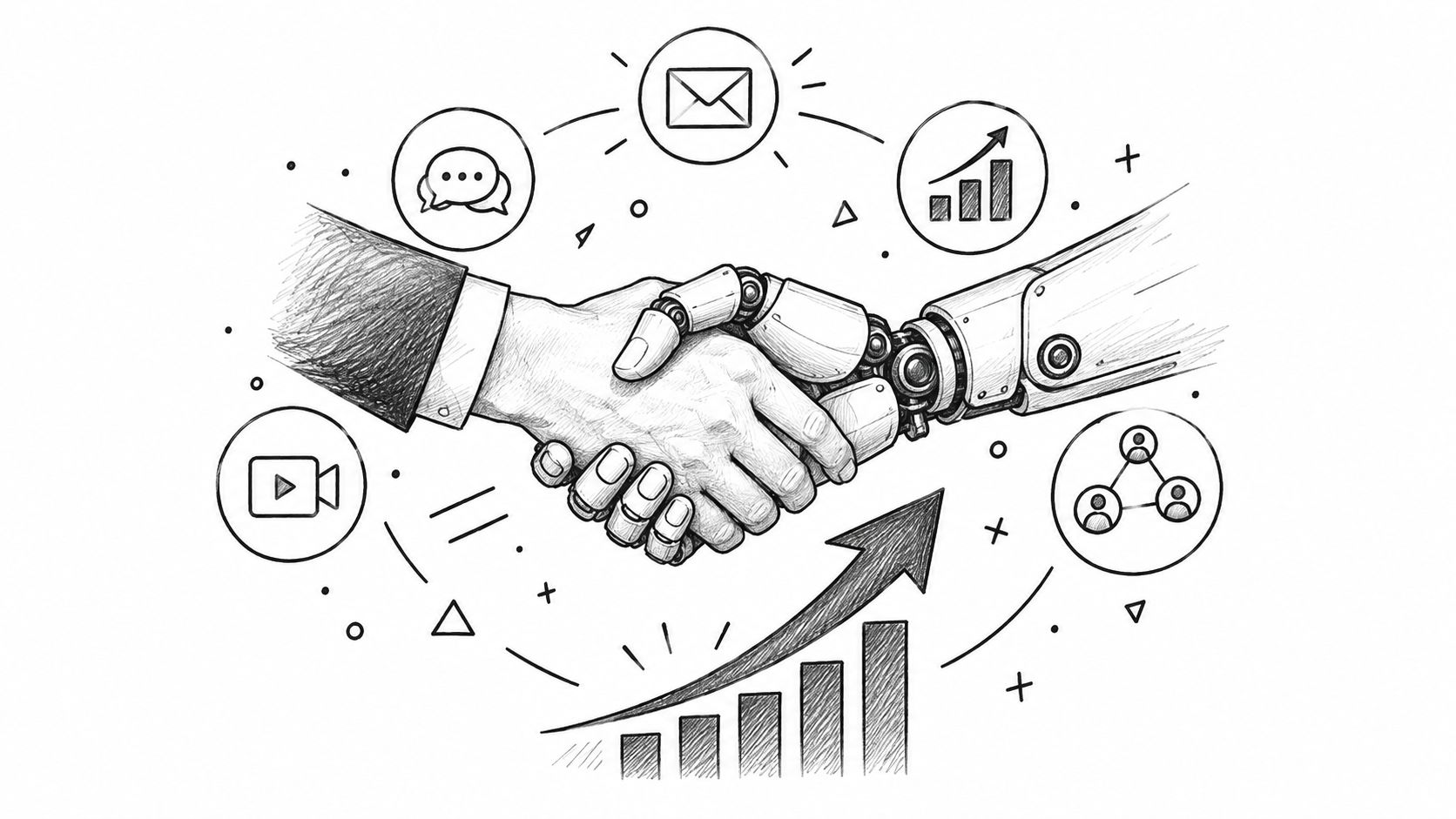
You've spent the morning moving between spreadsheets, ad platforms, email drafts, customer messages, and performance reports. By the time you've finished the routine work, there's little energy left for the strategic thinking that should improve the next campaign. That's the situation behind the growing interest in AI marketing.
AI marketing isn't a faster way to write captions or produce ad variations. It's a connected operating system that uses customer and campaign data to identify patterns, support decisions, personalize experiences, automate actions, and learn from results. The tools matter, but data quality, governance, measurement, and workflow integration determine whether those tools create business value.
In 2026, 87% of marketers reported using generative AI in at least one workflow, compared with 51% in 2024, while an independent industry survey found 86.4% of marketing teams using AI in part of their workflow (Digital Applied's 2026 AI marketing adoption data). The important question is no longer whether marketers have access to AI. It's whether they've built the conditions that let it work reliably.
Introduction to AI Marketing in Everyday Practice
A small ecommerce team begins Monday with a crowded checklist. The marketer reviews customer behavior, groups subscribers, drafts email versions, refreshes paid social ads, answers product questions, and prepares a campaign report. Each task is manageable, yet the combined workload leaves little time for deciding what the next campaign should do differently.
AI can connect those steps inside the team's existing workflow. It may compare activity across channels, identify customers with similar signals, recommend a message, suggest a delivery time, and return campaign results to the next planning cycle. The marketer remains responsible for choosing the offer, reviewing the copy, protecting the brand voice, and judging whether the outcome supports the business.
The practical difference appears in the handoffs. A draft created by one tool needs approved customer data, a clear review step, a destination in the right campaign platform, and a measurement plan. Without those connections, a team may produce more content while learning little from its results. Data hygiene, governance, and workflow integration determine whether AI creates value.
Why the topic matters now
AI now supports ordinary marketing work, including content drafting, personalization, ad copy, and audience research. Industry reporting describes time savings from an average of 6.1 hours per week in one report to 11 hours per week in another (Digital Applied's 2026 adoption data). Those gains can give marketers more room for analysis, but saved time does not automatically improve targeting, conversion, or customer experience.
A campaign team also needs rules for permitted data, human approval, brand standards, and success measures. If customer records are inconsistent or the output cannot enter the team's working systems, adoption often stops after the first promising experiment.
This guide develops the subject step by step, from a plain-English definition and the technologies involved to campaign examples, performance levers, and operating safeguards.
The practical mindset: Use AI to reduce repetitive effort, improve decision quality, and give people more time for judgment and creativity.
What AI Marketing Really Means and How It Works
A useful answer to what is AI marketing is this: AI marketing uses artificial intelligence to interpret marketing data, predict customer or campaign outcomes, create or adapt messages, and automate selected decisions and actions.
That definition becomes clearer through a simple analogy. Think of a capable marketing assistant who observes customer behavior, remembers what happened after previous campaigns, recognizes patterns across thousands of interactions, and recommends the next action. Unlike a basic rule-based automation, this assistant can adjust its recommendation when new evidence appears.
The four-part cycle
The system generally works through a repeating cycle:
- Data collection: It gathers permitted information from sources such as website activity, purchases, email engagement, advertising interactions, customer conversations, and campaign results.
- Intelligent analysis: Models look for relationships and signals. They may identify a group with similar behavior, estimate purchase intent, classify a customer message, or predict which creative is most relevant.
- Automated action: The system applies an approved action, such as sending a message, changing an audience segment, recommending content, routing a support question, or adjusting a campaign variation.
- Continuous learning: Results return to the system as feedback. The next decision can use what the campaign revealed about engagement, conversion, customer satisfaction, or wasted spend.
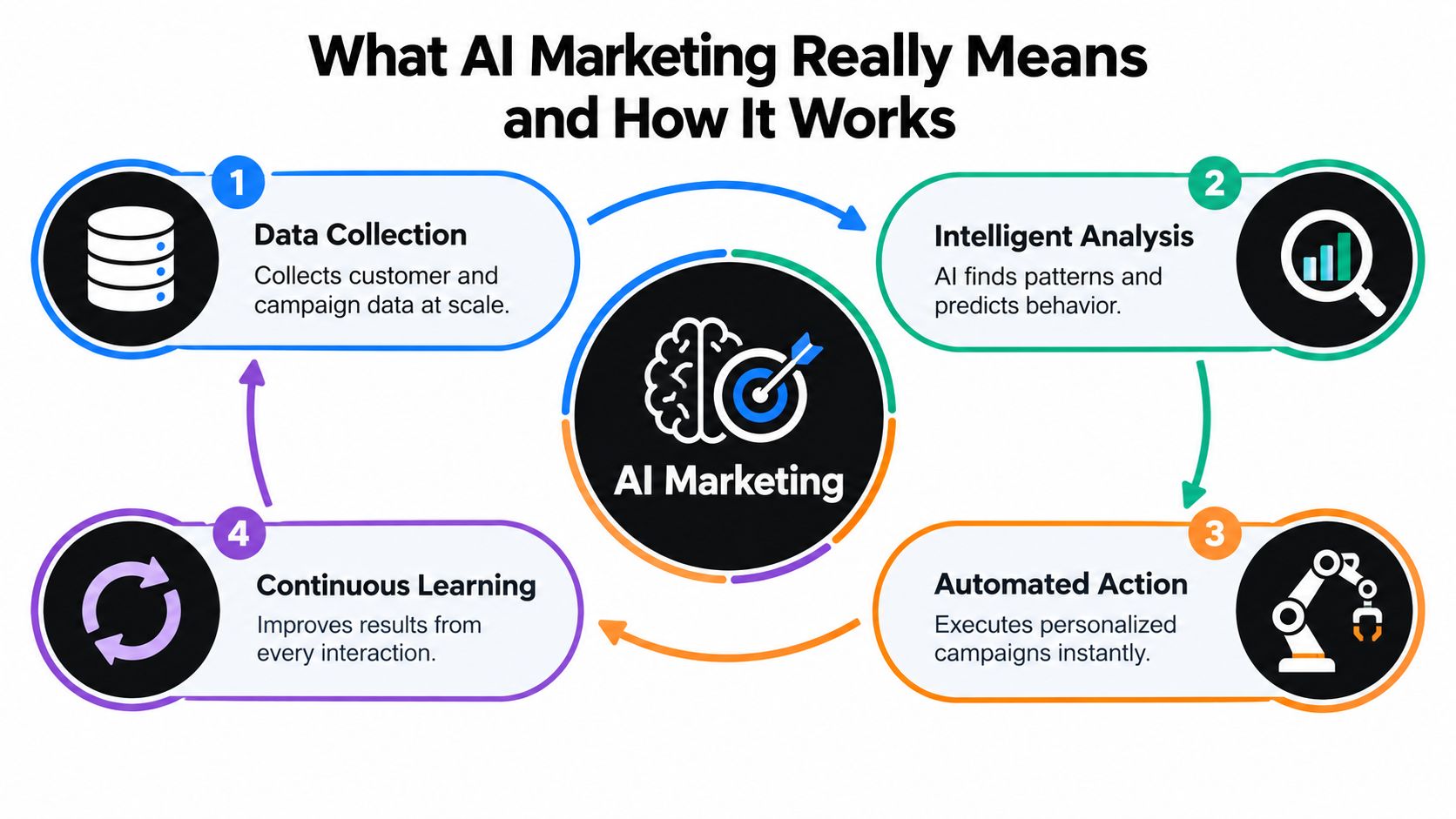
The cycle doesn't mean a marketer should hand over every decision. A team might allow AI to recommend audience groups but require human approval before launch. It might automate responses to routine questions while routing complaints, sensitive issues, and unusual requests to a person.
Automation versus adaptation
Traditional automation follows explicit instructions. For example, “If a visitor submits this form, send this email.” AI can support a more flexible instruction, such as “Identify subscribers showing strong interest in this product and choose the approved message most relevant to their behavior.”
That flexibility depends on trustworthy inputs and carefully defined boundaries. A model can only learn from the data it receives, and an automated action can only be as responsible as the rules surrounding it. Marketers exploring social engagement workflows may find a practical example in this comment and DM automation tool, especially when deciding which interactions can be handled automatically and which need human review.
Core Technologies Behind AI Marketing Systems
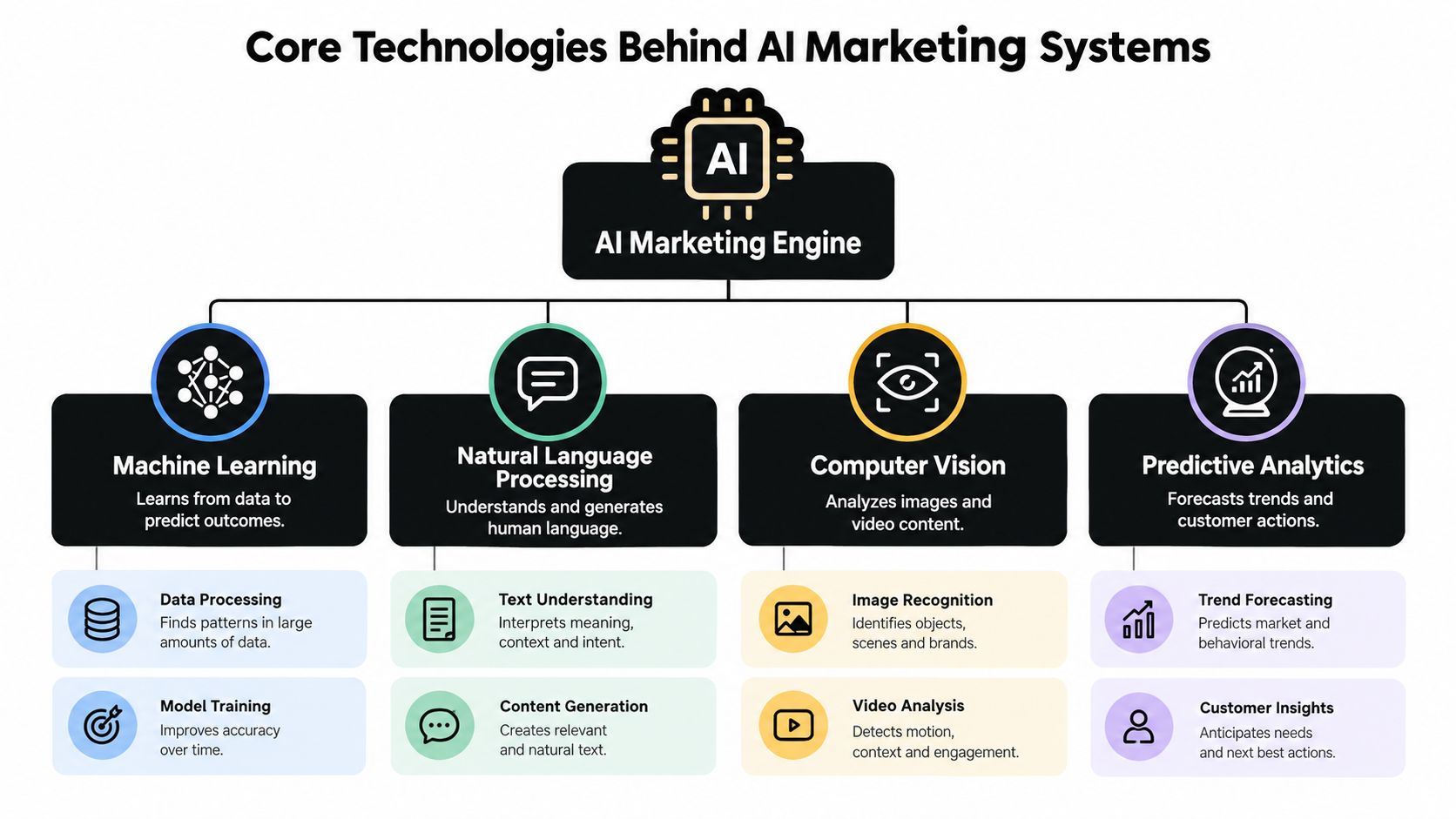
AI marketing combines several technologies that perform different jobs. They aren't interchangeable, and a campaign rarely succeeds because of one model alone. The value comes from connecting data, interpretation, creative production, action, and measurement into a workflow.
Machine learning
Machine learning identifies patterns in historical and live data, then uses those patterns to make predictions or classifications. A marketer might use it to estimate whether a lead is likely to convert, identify customers at risk of disengaging, or determine which audience resembles existing high-value customers.
The model doesn't understand a customer in the human sense. It calculates relationships within the data it has been trained or configured to use. That's why clean labels, consistent event tracking, and relevant conversion signals matter so much.
Natural language processing
Natural language processing, or NLP, helps software work with human language. It can classify support requests, summarize reviews, identify recurring concerns, analyze sentiment, or help generate email and ad copy.
For a marketing team, NLP turns unstructured language into usable information. Hundreds of customer comments can become grouped themes, but a person should still verify whether the categories accurately represent customer concerns before changing the campaign or product message.
Computer vision
Computer vision analyzes visual content such as product photographs, social videos, and creative assets. It can help identify objects, recognize visual patterns, check whether an image matches a campaign brief, or support the creation of new visual variations.
This capability is useful when a brand manages a large creative library. It can make assets easier to search and organize, while human reviewers remain responsible for cultural context, legal suitability, and brand standards.
Predictive analytics and generative AI
Predictive analytics forecasts likely behavior or outcomes from available data. It can support demand planning, lead prioritization, budget allocation, and campaign forecasting. Generative AI, by contrast, produces new text, images, audio, or video from instructions and source material.
A connected workflow might ingest customer events, use machine learning to identify likely buyers, apply predictive analytics to estimate response, generate approved creative variants, and send performance signals back into the system. The technology stack is therefore less important than the handoffs between components. If the audience data lives in one disconnected tool, the creative in another, and the conversion data is incomplete, the system can't form a dependable learning loop.
Real World Use Cases That Show AI Marketing in Action
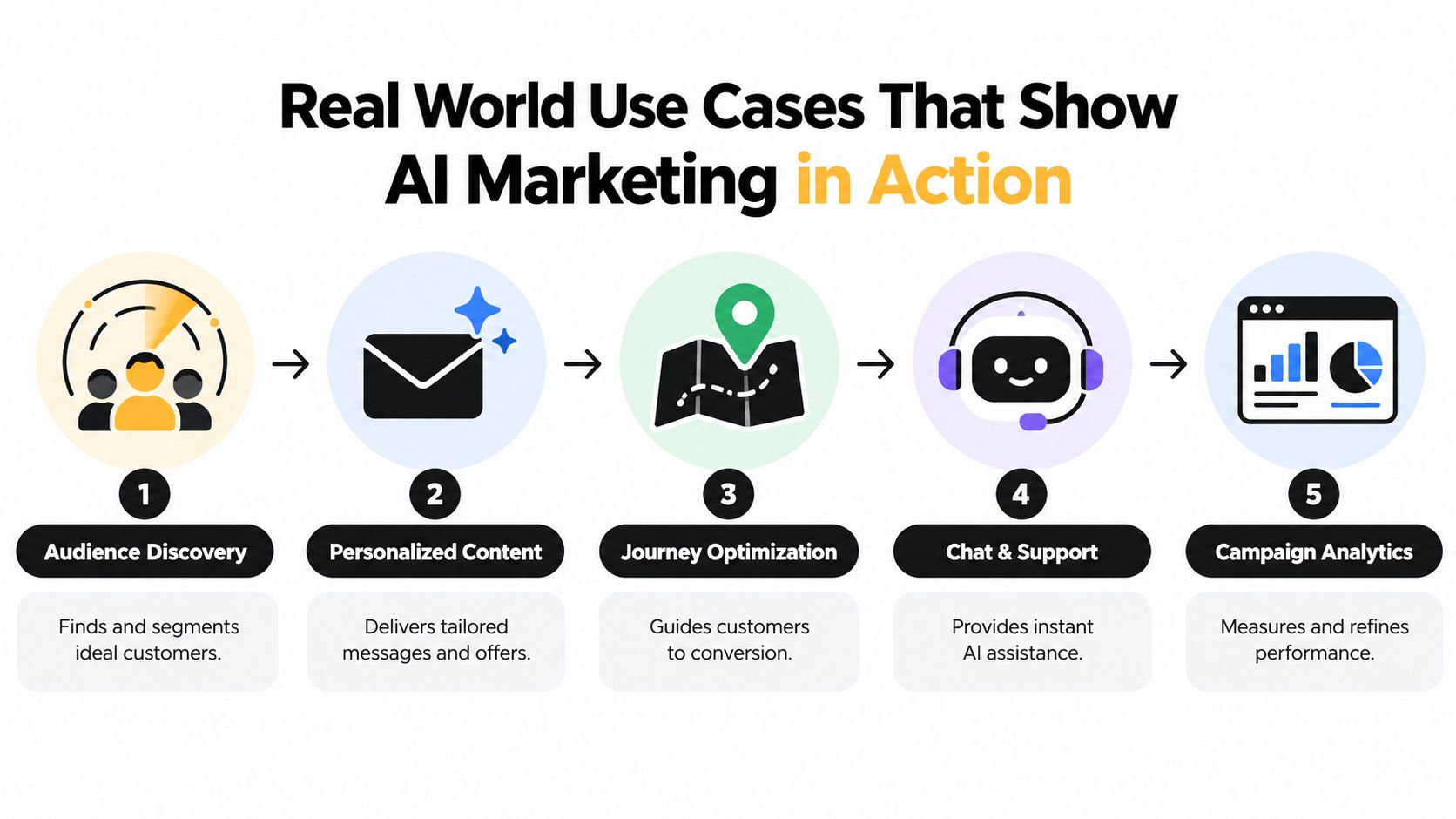
The clearest way to understand AI marketing is to follow it through a campaign. Consider a small online retailer preparing a seasonal product launch. The team has customer records, browsing behavior, prior email activity, paid media data, and a collection of product images, but not enough time to interpret everything manually.
Audience discovery and segmentation
The retailer begins by grouping customers according to meaningful behavior rather than broad assumptions. AI can distinguish recent browsers from repeat buyers, identify people showing interest in a product category, and flag customers whose activity suggests declining engagement.
The marketer then checks whether the groups make strategic sense. A segment shouldn't exist merely because a model created it. It should support a clear decision, such as changing the offer, message, channel, or follow-up.
Personalized content and email
The team creates a core campaign message, then generates variations for different audiences. A recent buyer may receive product education, while an interested browser receives comparison information or a reminder about the product's practical benefit.
Human review protects tone and accuracy. AI can help tailor language at scale, but it shouldn't invent product claims, change approved terms, or create artificial urgency that the brand wouldn't use.
Ad targeting and journey optimization
Paid media systems can use behavioral signals to prioritize likely prospects and test different creative combinations. The wider ecosystem of automated marketing tools can also connect campaign actions to attribution and workflow management, provided the underlying events are tracked consistently.
The retailer might send a person from an ad to a landing page that reflects the promise of that ad. AI can help identify where people drop out, but the team still needs to inspect the page, offer, checkout process, and measurement setup before blaming the audience.
Chat and customer support
A conversational system can answer routine questions about delivery, product features, or availability. When a customer reports a damaged order or raises a sensitive concern, the system should route the conversation to a human rather than forcing an automated response.
Governance becomes visible to customers. A fast answer is useful only when it's accurate, appropriately limited, and easy to escalate.
Video creation for campaign assets
A creator may start with a product photo and need short-form video versions for several social channels. A generative video platform can turn a prompt or static image into a moving concept, giving the marketer an early creative direction before investing in a more elaborate production.
For a closer look at this workflow, see the guide to an AI advertising video generator. Tools in this category can reduce the number of separate production steps, but the marketer still needs to check visual accuracy, product representation, rights, captions, and platform fit.
<iframe width="100%" style="aspect-ratio: 16 / 9;" src="https://www.youtube.com/embed/NmN3glyjQJ0" frameborder="0" allow="autoplay; encrypted-media" allowfullscreen></iframe>
The final use case is campaign analytics. Instead of waiting for a manual report, the team can monitor audience response, creative performance, conversion signals, and unusual changes as the campaign runs. That information becomes useful only when the organization has agreed on which outcomes matter and who can act on the findings.
Measurable Benefits and Performance Gains You Can Expect
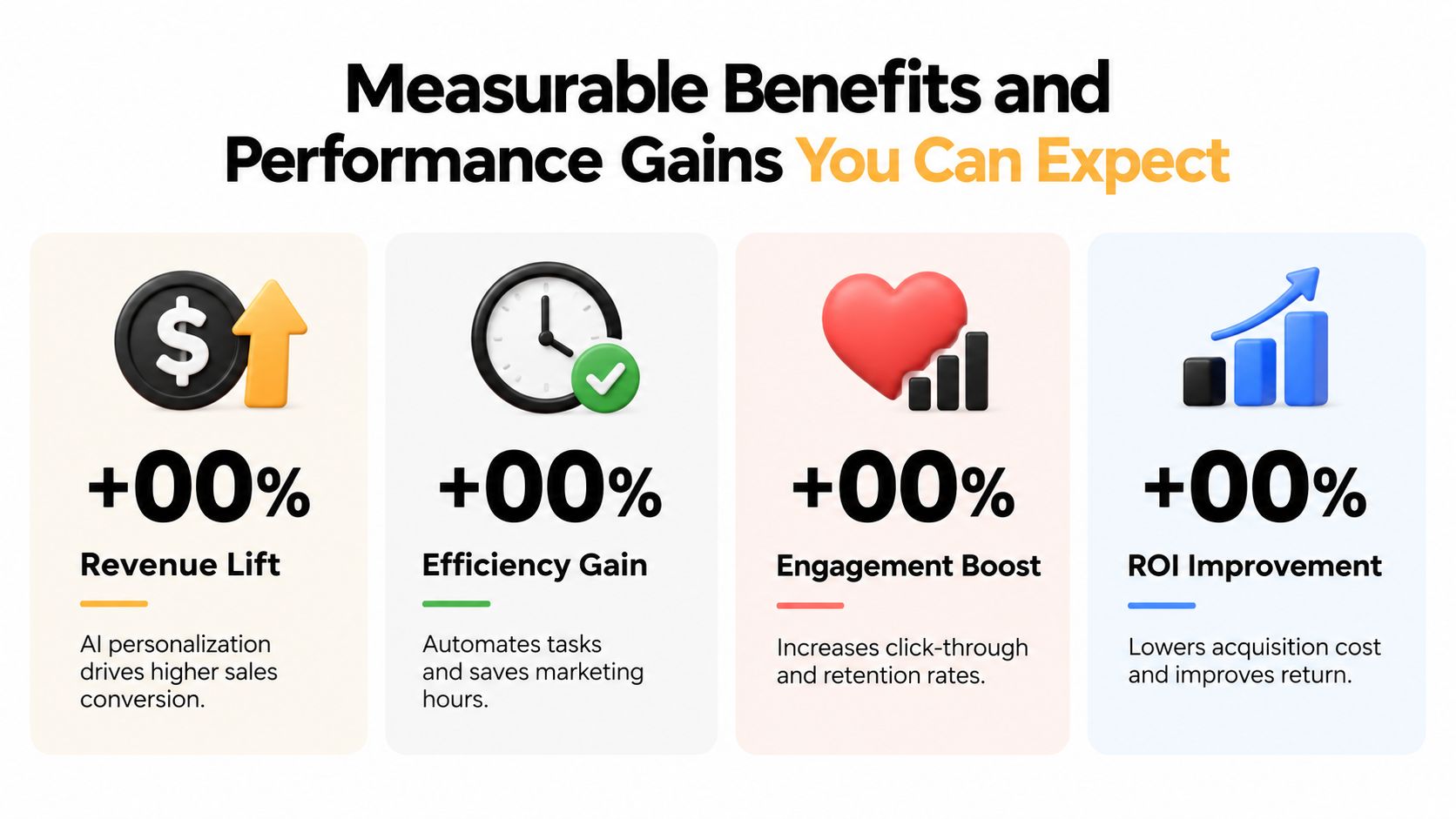
AI marketing creates measurable value through connected improvements in targeting, personalization, and operations. Personalization can lift revenue by 5% to 15% and improve marketing ROI by 10% to 30%, while predictive targeting paired with segment-specific creative can reduce customer acquisition costs by up to 50%, according to industry reporting summarized by Shno's AI marketing statistics.
The mechanism is practical. A model reviews first-party behavioral data, estimates conversion propensity, matches messages with relevant segments, and limits impressions for people showing little buying intent. The campaign then directs more attention and budget toward signals connected to its business objective.
Revenue and acquisition efficiency
Personalization produces value when it changes a meaningful part of the customer experience. A relevant product recommendation, a direct answer to an immediate question, or a landing page that matches the ad promise can remove friction. The model supports better allocation of attention and spend, but the offer and customer experience still determine whether interest becomes action.
Productivity and operating cost
AI can reduce the labor needed to produce, coordinate, and evaluate marketing work. One industry summary reports an average ROI near 3.2x in 2026, with top performers reaching 5.7x or higher. Teams using AI for 18 months or more achieved 2.4x higher ROI than teams in their first six months. The same source reports about 44% lower content production costs, 38% less campaign planning time, and 52% less reporting labor (Presenc AI's AI ROI statistics).
These figures are reported benchmarks, not promises. Results depend on clean data, connected workflows, approval speed, and measurement tied to business outcomes instead of activity volume. A system that generates more assets can still reduce ROI if those assets create inaccurate claims, inconsistent customer experiences, or additional review work.
Measurement rule: Track the business result, the operational saving, and the quality cost of automation. Faster production is not a gain when it creates inaccurate claims or extra review work.
The learning curve also affects performance. AI systems improve when they receive reliable feedback, such as campaign exposure connected to meaningful conversion data. That information gives bidding, creative rotation, and budget decisions a stronger basis. Disconnected tools may save time on isolated tasks while leaving the organization with little insight into the customer journey.
Implementation Considerations and Best Practices for Success
Many teams don't stall because they lack access to AI. They stall because the system has no dependable foundation. A model can generate polished copy while the customer data remains duplicated, consent records are unclear, conversion events are missing, and campaign tools can't share results.
A Gartner survey reported that 87% of CMOs experienced campaign performance issues during the previous 12 months, and 45% sometimes or often ended campaigns early because performance was poor. The same verified reporting says only 30% of agencies, brands, and publishers had fully integrated AI across the media campaign lifecycle, while nearly two-thirds identified data quality, data protection, and fragmented tools as major barriers (Gartner's survey on generative AI adoption in marketing campaigns).
Prepare the operating foundation
Start with a small, clearly measured workflow rather than adding AI everywhere.
- Audit data quality: Remove duplicates, define important customer events, document field meanings, and identify gaps in conversion tracking.
- Set privacy boundaries: Decide which data the system may use, where it may be stored, and which information must never enter a public or unapproved tool.
- Create brand controls: Provide approved claims, tone guidance, visual rules, prohibited language, and escalation conditions.
- Choose human checkpoints: Keep people responsible for strategy, sensitive customer interactions, legal review, final publication, and unusual decisions.
- Connect the workflow: Make sure audience selection, creative production, deployment, analytics, and attribution can exchange the information needed for learning.
Start with a defensible experiment
A good first experiment has one audience, one workflow, one primary outcome, and a clear review process. For example, a team might use AI to classify incoming customer questions and measure routing accuracy, or generate approved email variants and compare their contribution to a defined conversion event.
Marketers who want a broader view of Sight AI generative marketing can use strategy resources like this to think beyond copy generation and consider governance, workflow design, and team responsibilities. Career planning matters too, especially as roles increasingly combine creative judgment, data literacy, testing, and automation. The discussion in AI marketing jobs offers a useful lens for the skills teams may need.
Make failure visible
Create a record of model errors, rejected outputs, customer complaints, and campaign anomalies. Review it regularly. This practice helps the team improve prompts and rules, but it also reveals when a workflow should remain human-led.
Putting It All Together and Next Steps With AI Marketing
The answer to what is AI marketing is broader than “using AI to create content.” It's a connected system that turns data into insight, insight into approved action, and campaign feedback into better decisions. Generative content is one component. The durable advantage comes from orchestration across audiences, messages, channels, customer interactions, and measurement.
Start by choosing a repetitive workflow with a visible business outcome. Clean the relevant data, define the human approval points, connect the reporting loop, and test the system against a baseline you trust. A creator may begin with content production, while a demand team may begin with lead prioritization or campaign analysis.
Video can fit into that system when the team has a clear audience, message, distribution channel, and measurement plan. The broader video content marketing strategy should determine where generated video belongs, rather than allowing a new tool to dictate the campaign.
The central lesson: AI marketing works best when teams treat it as an operating discipline with creative tools inside it.
Veo3 AI turns text prompts or static images into professional-quality videos, combining Veo3, Seedance, and Hailuo models in one platform for product ads, explainers, and social content. Visit Veo3 AI to explore how generated video could support a governed, measurable AI marketing workflow.
Related Articles
Continue with more blog posts in the same locale.

Karaoke Video Creator Guide to Pro Sing-Along Videos
Learn how a karaoke video creator turns audio and lyrics into pro karaoke videos with Veo3 AI backgrounds, sync tips and export settings.
Read article
AI Advertising Video Generator Guide to High Converting Ads
Learn how to use an AI advertising video generator to plan, prompt, render and publish high-converting ads for TikTok, YouTube and Instagram.
Read article
Social Media Video Sizes: The 2026 Spec Sheet
Master social media video sizes in 2026 with platform-by-platform specs, aspect ratios, export presets, and safe-area tips for every major network.
Read article