
Short Form Video Ads: Formats, Principles and Metrics
Short form video ads explained: platform specs for TikTok, Reels and Shorts, creative rules that hold attention, and the metrics that show what works.
Veo3 AI · 17 min read · Nov 23, 2026
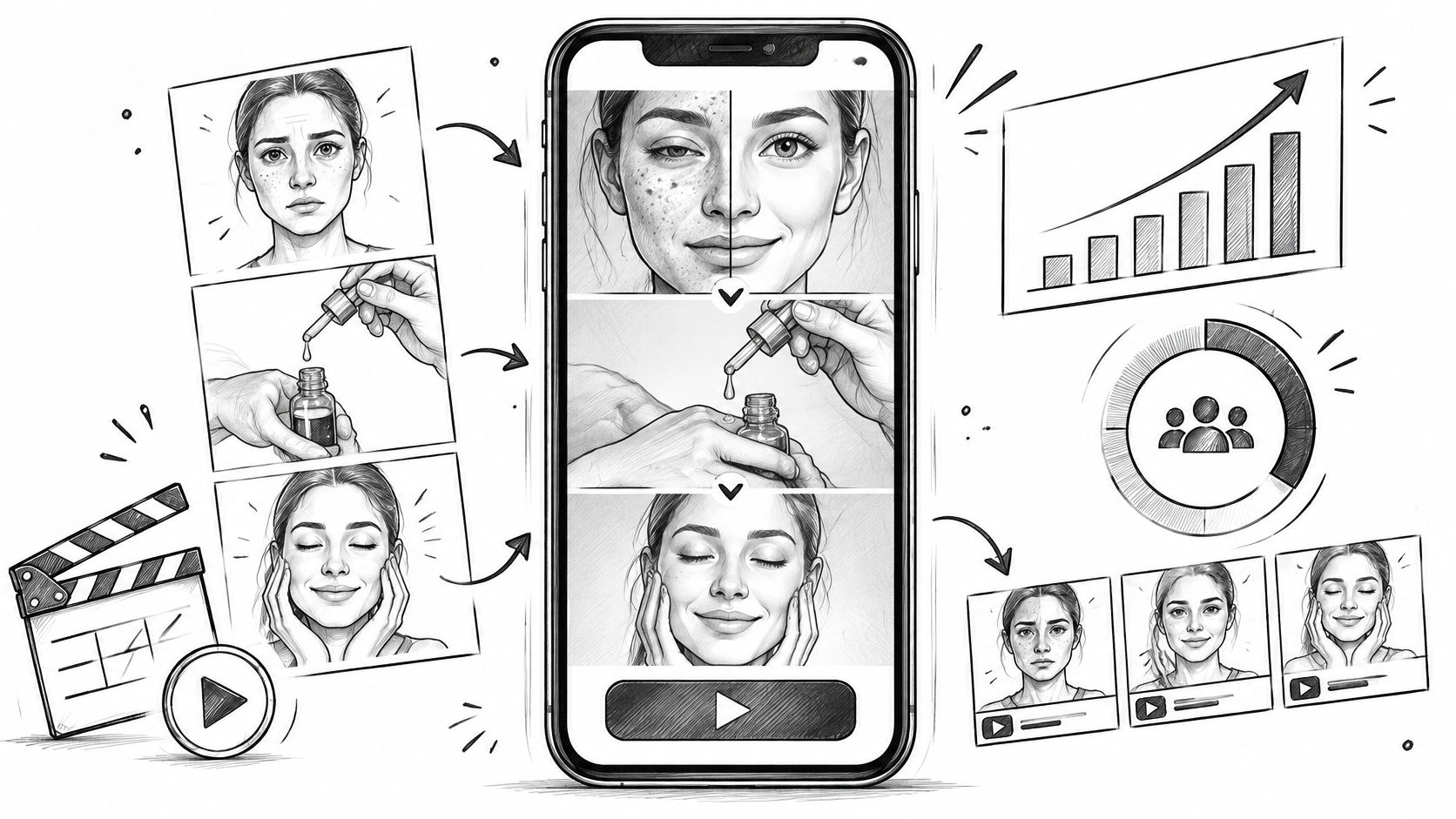
Global spending on short form video advertising reached $111 billion in 2025, according to figures reported by Kapwing's short form video statistics. The audience underneath that number is just as lopsided. By 2025, TikTok, Instagram Reels and YouTube Shorts were collectively reported to generate well over 200 billion video views a day, reaching audiences in the billions globally (Growth Market Reports).
That scale changes what an ad has to do. Nobody opens a feed hoping to watch a commercial, so the format borrows a second or two from someone actively looking for a reason to keep swiping. Everything worth knowing about short form video ads follows from that constraint: the specs that decide whether your file plays at all, the creative rules that survive a fast thumb, and the metrics that should tell you which cut to make next.
This is a working walkthrough for an advertiser who has bought media elsewhere and has now been handed a vertical brief. Each rule comes with the reason it exists, because a rule you understand is a rule you can break deliberately when the data says so.
Table of Contents
- What Short Form Video Ads Are and Why They Matter
- Platform Specs You Need Before You Film
- Ad Formats and the Goal Each One Serves
- Creative Principles That Hold Attention
- Choosing Length and Building Versions
- Measuring Results and Spotting Creative Fatigue
- Build and Test Your First Short Form Video Ad
<a id="what-short-form-video-ads-are-and-why-they-matter"></a>
What Short Form Video Ads Are and Why They Matter
A short form video ad is a vertical, sound-friendly video, usually between 5 and 60 seconds depending on the placement, that runs between organic posts in a feed rather than interrupting a clip someone chose. The three placements this guide works through are TikTok, Instagram Reels and YouTube Shorts, each serving the ad to a person who arrived for entertainment and can leave with a flick of the thumb.
Three things change when an ad moves into that feed:
- The viewer holds the remote. There's no programme to sit through and no contract to watch the break. Every second gets re-earned.
- The frame is vertical and close. Your product sits on a phone screen at arm's length, which rewards tight product shots and punishes wide, scenic compositions.
- The message arrives mid-scroll. Context is whatever the previous clip happened to be, so the ad has to establish its own frame of reference immediately.
Think of it as a shop window, not a billboard. A passer-by sees the display at walking speed. They won't study a wide shot of the storefront and they won't wait for the sign at the end. The window shows what the product is, who it's for, and what changes when someone uses it, before their foot lifts off the pavement.
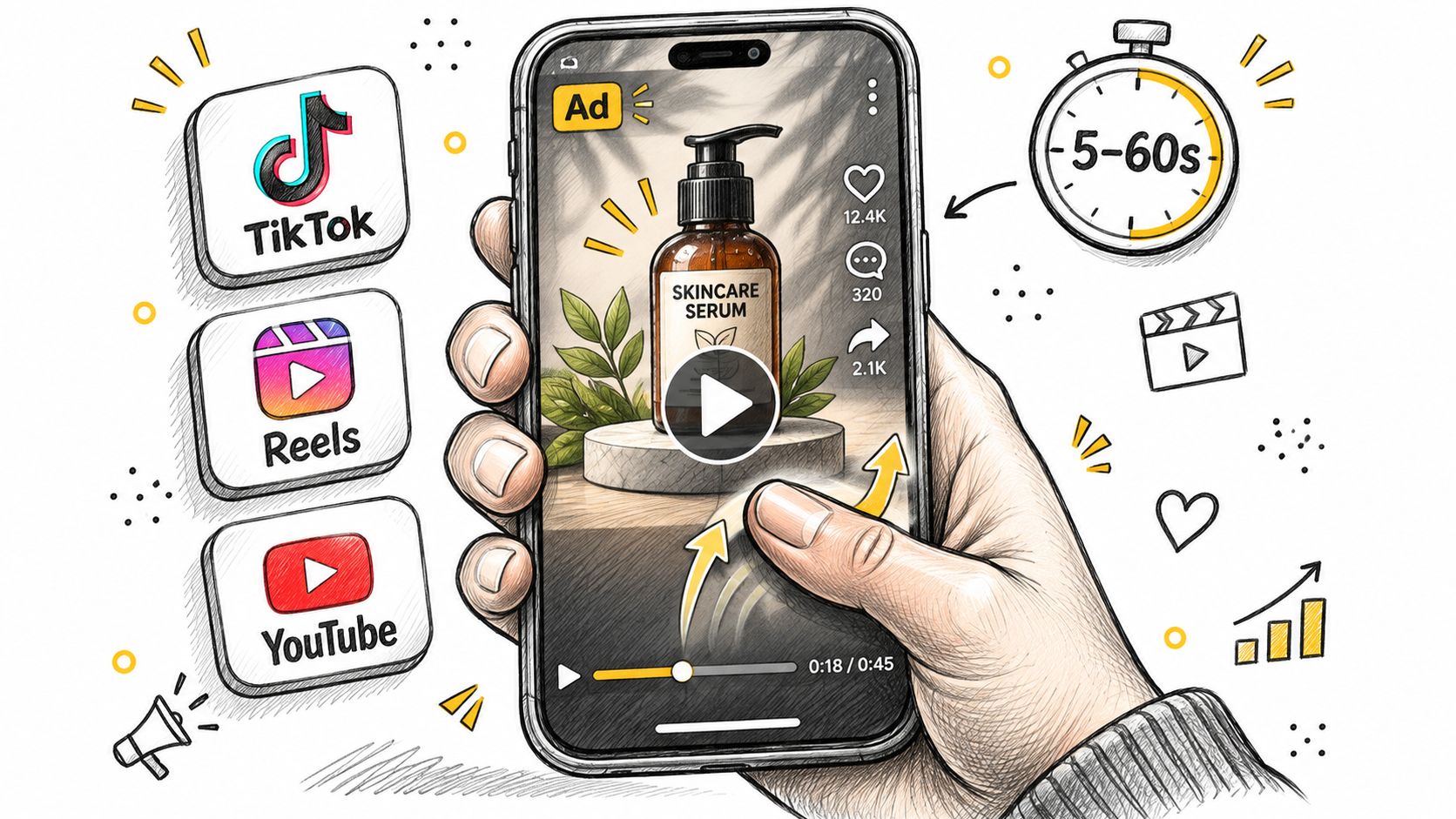
The money followed the attention. Global spending on the format rose from approximately $4.6 billion in 2018 to more than $88 billion in 2023, and the same forecast put 2024 at $99.4 billion, about 11% growth year over year (Wix video marketing statistics). Short form was projected to take roughly 60% of total digital video ad spending by 2028, against 52% in 2024.
It also closes sales, which is the part a budget holder cares about. In 2025, 42% of U.S. consumers surveyed by Clutch said they had purchased a product after watching a brand's short-form video (Statistics Global).
Those two facts set the working rule for the rest of this guide. Short form video ads reward many tested variants built around one clear message, not one expensive film. The Rapid Ads short form video playbook is a practical companion for the production side of that loop.
<a id="platform-specs-you-need-before-you-film"></a>
Platform Specs You Need Before You Film
A 20-second edit can pass review in one placement and fail in another because the platform checks the container before it judges the creative. Specs work like a gate: the file either fits, or it does not run. Set them before you design the hook, caption, or call to action.
| Platform | Aspect ratio and resolution | Length guidance | Notes |
|---|---|---|---|
| YouTube Shorts ads | 9:16, 1080 × 1920 | Up to 3 minutes; under 60 seconds recommended | Only the first 60 seconds play in the feed; an overlay at 50 seconds points to the watch page |
| Instagram Reels ads | 9:16, 1440 × 2560 | 0 seconds to 15 minutes | Captions optional but recommended; sound optional but strongly recommended |
| TikTok non-Spark and Spark Ads Push | 9:16, minimum 540 × 960 | 5 to 60 seconds; 9 to 15 seconds recommended | MP4, MOV, MPEG or 3GP; up to 500 MB; minimum 2,500 kbps |
| TikTok Spark Ads Pull | 9:16 | Uses the length of the published organic video | Runs an existing organic post as the ad; the format choice changes your production rules |
One master can cover three placements. Each uses vertical 9:16, so you can design one full-screen cut instead of reshaping a horizontal commercial for every channel. Google's Shorts ad guidance identifies 1080 × 1920 pixels as the standard resolution and recommends keeping ads shorter than 60 seconds, even though 3-minute uploads are permitted (Google Ads Solutions).
YouTube is where beginners most often misread the limit. A Shorts ad can run up to 3 minutes, but only the first 60 seconds play directly in the feed, and an overlay at 50 seconds sends viewers to the watch page for the rest (Google Ads Help). Put the product, message, and call to action inside that first minute. If completion data shows viewers leaving before the call to action, make the next cut shorter rather than defending the longer edit.
Reels allows the widest duration range, accepting anything from 0 seconds to 15 minutes at a recommended 9:16 ratio and 1440 × 2560 pixels, with captions and sound both listed as optional but recommended (Meta's Instagram Reels ads guide).
TikTok needs the tighter file. Its in-feed ad specifications call for 9:16 at a minimum of 540 × 960 pixels, MP4, MOV, MPEG or 3GP files up to 500 MB, a minimum bitrate of 2,500 kbps, and a duration between 5 and 60 seconds, with 9 to 15 seconds recommended. Reservation placements follow different rules, so confirm the in-feed requirements for non-Spark creative and Spark Ads Push before export. Spark Ads Pull is the exception: it runs an existing organic post and inherits whatever length that post already has.
Before you export, confirm four things: the aspect ratio, the message inside the first minute, the file size against the platform limit, and whether the video will run as a paid placement or a pulled organic post. For ratios and safe zones beyond these three placements, our guide to social media video sizes covers the full set.
<a id="ad-formats-and-the-goal-each-one-serves"></a>
Ad Formats and the Goal Each One Serves
Format is a decision about the job the ad has to do, not a style you pick because it looks current. A testimonial and a brand film can both run 20 seconds of vertical video, and only one of them will move a hesitant buyer who has compared three alternatives and is stuck on price.
- UGC-style testimonial. A real-seeming person holds the product, names the problem, and describes the result. It wins on trust, which is why it dominates crowded categories where every claim sounds identical. The failure mode is delivery: a scripted read announces itself as an ad within two seconds, so keep the take where the speaker restarts a sentence.
- Product demonstration. The item does its job on screen. Fabric stretches, the blender crushes, the serum absorbs. This is the format for considered purchases, where the buyer needs evidence before comparing prices. If the mechanism hides behind mood lighting, the shot is decoration.
- Problem and solution. Opens on the frustration and resolves it with the product, which is why it converts. The problem has to be specific enough to be recognized, a foundation that separates by mid-afternoon rather than a vague complaint about skin.
- Unboxing and first impression. The product leaves the box and gets used for the first time. Curiosity about the object carries the watch, so it suits physical goods with a satisfying reveal. The reveal has to come early; a slow box opening loses people before the product appears.
- Tutorial. Teaches a task and places the product inside the method. Best for mid-funnel awareness, where the viewer isn't shopping yet but is solving something. If the tutorial works perfectly without your product, you've published a free lesson.
- Cinematic brand film. The strongest recall tool and the slowest to test, because the parts that make it memorable (light, motion, music) are the parts you can't swap cheaply between variants.
Two production habits carry across all six. An AI avatar can hold the same face and voice across a dozen cuts, which matters when a viewer meets three of your ads in a week and needs to file them under one brand. And the logo has to be readable before the first likely swipe; a mark that appears at second eight is a mark most viewers never see.
When two formats look equally plausible, pick the one that shows the product doing something. Demonstration is the cheapest way to answer the question a viewer already has, which is whether the thing works.
Once the format is settled, the TikTok ads playbook for small businesses covers the campaign structure that sits around the creative.
<a id="creative-principles-that-hold-attention"></a>
Creative Principles That Hold Attention
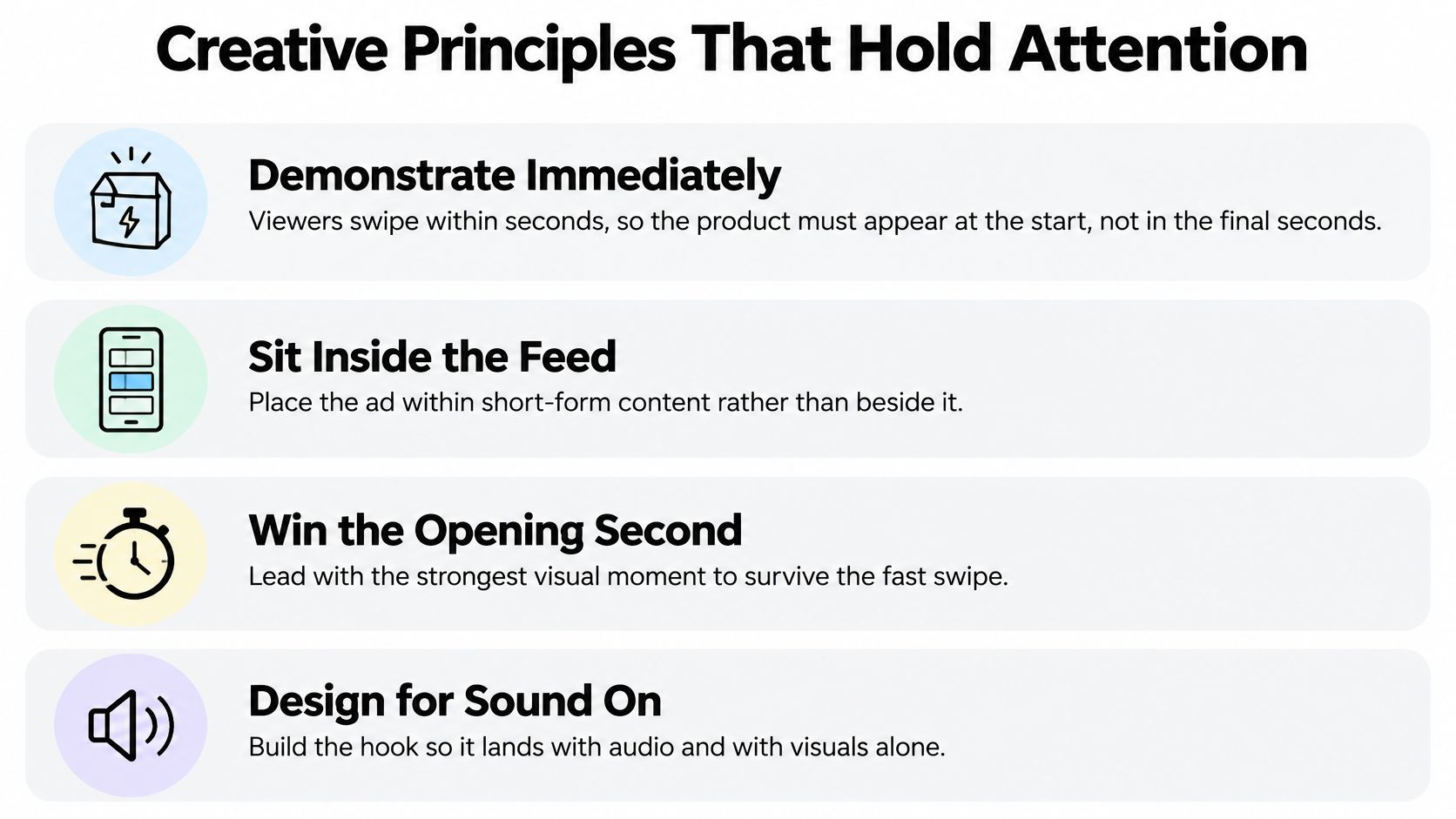
The first rule is structural rather than aesthetic. Because the viewer can leave at any moment, the product demonstration belongs at the front, not in the final seconds. An ad that saves the payoff for second twenty is an ad whose payoff most viewers never reach.
Four principles do most of the work, and they reinforce each other.
<a id="why-placement-changes-completion"></a>
Why placement changes completion
Ads placed inside short-form video complete at a lower rate than comparable creative placed in long-form: about 67%, and roughly 4.2% less likely to complete, in a quasi-experiment on video ad performance (the UMass video ad study). Four points of completion sounds trivial until you multiply it. Across a million impressions, that gap represents roughly 42,000 fewer completed views.
The mechanism is the surrounding habit. A short-form viewer is trained to swipe, so an interruption feels expensive compared with the clip they were about to see. Build each cut as a self-contained message that still works if the viewer leaves after three seconds.
Practical rule: show the result in the first two seconds, prove it in the middle, and carry the brand and call to action in the last seconds. A skincare ad opens on the skin after four weeks, then cuts back to the bottle. It doesn't open on the bottle.
<a id="where-visual-complexity-backfires"></a>
Where visual complexity backfires
Adding spectacle feels like a safe way to stop the scroll, especially when generating footage is cheap. It usually isn't. An analysis of 2,520 viewing experiences across 42 public service ads found that short, visually simple scenes produced greater agreement about where viewers were looking, that visual complexity had a delayed negative effect on attention, and that scene cuts could raise attention (Journal of the Academy of Marketing Science).
Read that as a budget instruction. Build the scene around the one element the viewer must remember, then add cuts and camera movement only where they serve that element. Ten generated shots of particles swirling around a serum bottle are ten chances for the viewer to lose the bottle.
<a id="make-the-message-survive-a-muted-phone"></a>
Make the message survive a muted phone
Assume the sound is off until something earns a tap. The opening claim has to live on screen as a caption or a visual, and the product has to be identifiable without a voiceover. Build the audio anyway, because sound is what makes a cut feel native in a feed, and a tone of voice carries information a caption can't.
Here's how those principles look in motion.
<iframe width="100%" style="aspect-ratio: 16 / 9;" src="https://www.youtube.com/embed/2byPP_9F0-Q" frameborder="0" allow="autoplay; encrypted-media" allowfullscreen></iframe>
Views are exposure, not persuasion. A creative with a large view count and weak completion relative to its placement is telling you the hook worked and the body didn't. If you want to study how other brands handle those opening two seconds before writing your own, the AdLibrarySpy guide to UGC formats collects examples across categories.
<a id="choosing-length-and-building-versions"></a>
Choosing Length and Building Versions
Duration is one of the few variables you fully control, which makes it a good place to run an actual test instead of an argument.
| Ad length | Reported completion (mobile) | Best use |
|---|---|---|
| 10 seconds or less | 75.44% | Hook-and-proof cut for cold audiences |
| 15 seconds | 68.83% | Retargeting or mid-funnel viewers |
| 30 seconds | 72.26% | Offers that need an explanation |
Those mobile figures come from a benchmark synthesis that also reports ads shorter than 15 seconds achieving a 53% higher completion rate than ads longer than 30 seconds (Adwave's AI video ad statistics).
<a id="why-the-numbers-refuse-to-move-in-a-straight-line"></a>
Why the numbers refuse to move in a straight line
Look at the middle row again. Fifteen-second ads completed at a lower rate than thirty-second ads in the same dataset, which breaks the tidy assumption that shorter always wins. Platform averages blend audiences, placements, auction prices and creative quality, so the duration effect is real but not isolated. Treat the table as a starting hypothesis you still have to test.
<a id="a-modular-build-that-answers-the-question"></a>
A modular build that answers the question
Produce one 6 to 10 second hook-and-proof cut: result first, one proof point, logo and call to action. Then extend it twice, to 15 and 30 seconds, for retargeting or for audiences who need the mechanism explained before they'll consider the price.
Keep the opening visual, the first spoken line and the central proposition identical across all three versions. If the opening frame changes between cuts, you've altered at least two variables and can no longer attribute the difference to length. Rendering every duration from the same source image or prompt is the simplest way to keep that frame honest.
Budget the test properly: compare cost per completed view and conversion rate, never completion rate alone. A six-second ad can win every attention metric and still fail to explain enough for someone to buy.
One master asset, three durations, one identical opening frame, and a fixed review window before you judge any of them.
<a id="measuring-results-and-spotting-creative-fatigue"></a>
Measuring Results and Spotting Creative Fatigue
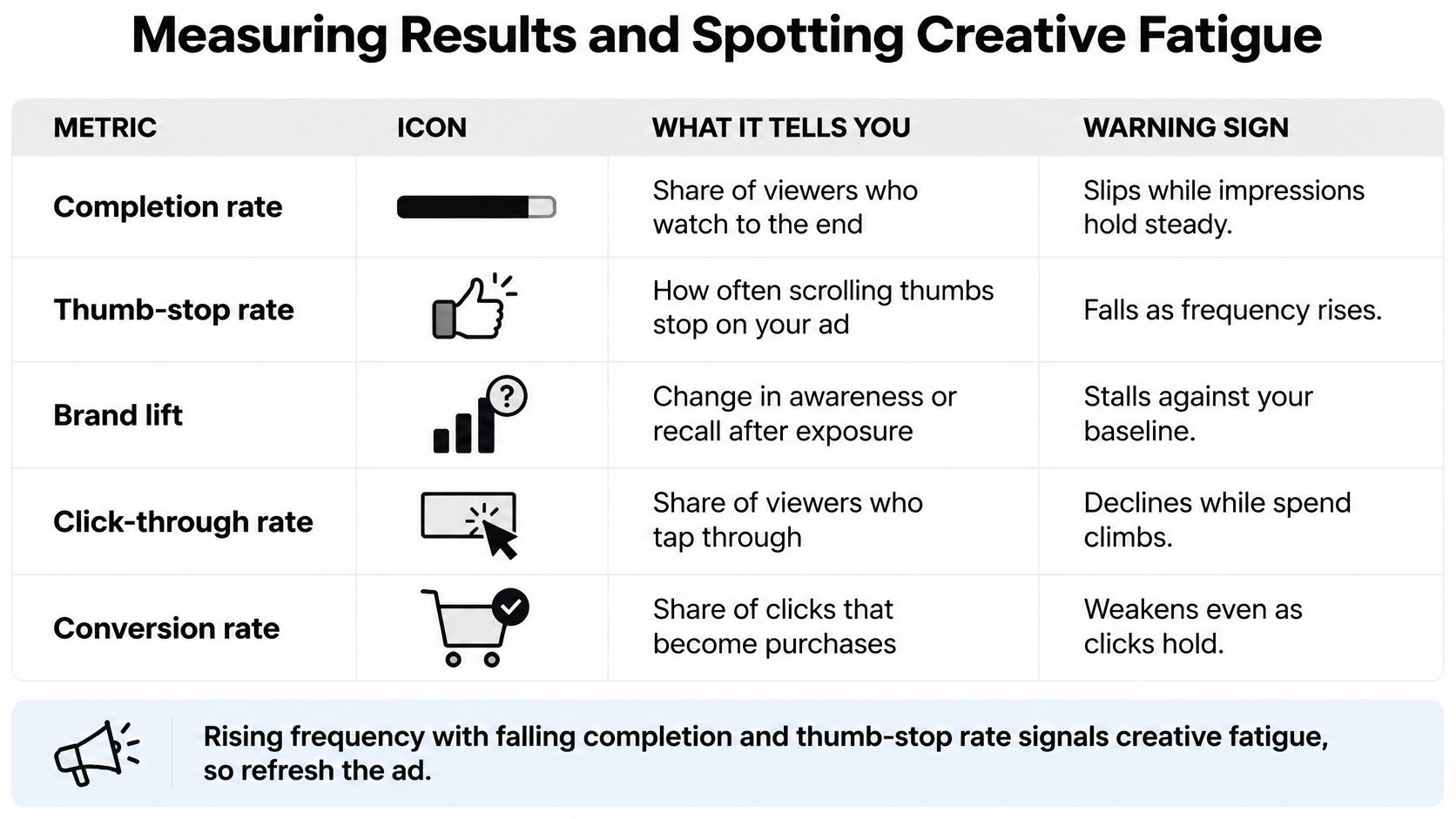
Once a creative is live, the question stops being whether it's good and becomes whether it's still working. Those are different questions and they need different numbers.
| Metric | What it tells you | Warning sign |
|---|---|---|
| Completion rate | Share of viewers who watch to the end | Falls while brand attribution holds: pacing is weak |
| Thumb-stop rate | Share who pause on the opening seconds | Low: the first frame does not promise a payoff |
| Brand lift | Change in recall or consideration among exposed users | Flat despite high views: the brand is not identifiable |
| Click-through rate | Share who tap the call to action | Declining over weeks at high frequency: offer fatigue |
| Conversion rate | Share of clicks that buy or sign up | Stable views with falling conversions: message fatigue |
<a id="two-cases-that-look-similar-and-arent"></a>
Two cases that look similar and aren't
Case one: completion is sliding, frequency is climbing, brand attribution holds steady. The concept is fine and the pacing is not. The middle of the video is asking for patience the placement never granted.
Case two: views hold, clicks hold for a while, then conversions drop. Nothing in the edit is broken. The offer or the message has been seen too many times by the same people, so refresh the claim or widen the audience.
That distinction has been tested at scale. A global study ran 887 short-form ads with more than 84,000 TikTok users across eight markets, linked responses to 239 brand-lift and 119 conversion-lift studies, and separately exposed 8,000 users across six markets to controlled levels of repetition to examine fatigue (System1's TikTok creative effectiveness study). Repeated exposure does not wear down brand and conversion outcomes on the same schedule, which is why a single declining number rarely tells you what to fix.
<a id="change-one-element-not-the-whole-video"></a>
Change one element, not the whole video
When a creative tires, keep the concept and swap a single component: the opening frame, the voiceover, the demonstration shot, or the ending. Replacing the entire video resets your learning along with your performance.
More variants is not the same as more insight. Five cuts that differ in four ways teach you nothing about which change restored the result.
Keep a short weekly note per creative: the date it first showed decline, the metric that moved, and the element you changed. Three weeks of that record will tell you more about your audience than any single dashboard.
<a id="build-and-test-your-first-short-form-video-ad"></a>
Build and Test Your First Short Form Video Ad
The shortest path from a blank page to a live test runs in five steps.
- Pick one goal and one format. Awareness suits the tutorial or the brand film. Conversions suit problem and solution. Write the goal at the top of the brief so every later decision has something to be judged against.
- Write the first two seconds before anything else. Show the result or the problem. If the opening frame needs a caption to explain it, rewrite the frame rather than the caption.
- Export a vertical 9:16 master that clears the specs for the placement you're buying. Check file type, file size, and whether the post runs as paid creative or a pulled organic Spark Ad. A 500 MB export the platform rejects is a deadline you lose.
- Build the hook-and-proof cut first, at 6 to 8 seconds, then extend it into 15- and 30-second versions that keep the same opening frame. Shoot or generate that opening once and reuse it everywhere, so a viewer who saw the short cut recognizes the long one instantly.
- Publish the variants with identical budgets and review completion, brand lift and conversion after a fixed window. Judge the variants against each other, not against a feeling.
For steps 3 and 4, the Veo 3 AI video generator is one option that turns a product photo or a text prompt into vertical variants. You add a product image, choose an AI avatar, or start from a template, write a prompt describing the scene and hook, then generate and download the video. No editing or design skills are required. The generator produces clips up to 8 seconds on all plans, which covers the hook-and-proof cut. The 15- and 30-second versions are a separate job: extend the same generated opening frame in an editing tool so the longer cuts inherit the hook you already tested. Generated videos can be used for commercial purposes, and current plan details sit on the Veo3 AI pricing page.
Run the loop, not the campaign. The metrics from a live test decide which element changes in the next render, and that render becomes the next test.
Veo3 AI turns a single product photo or a text prompt into a product ad video in seconds rather than weeks, exporting 16:9 or 9:16 at up to 1080p for TikTok, Reels, Shorts and Facebook, with AI avatars and templates covering UGC, product launch, unboxing and problem-and-solution styles. That speed is what makes the loop above practical: the short cut renders while you storyboard the longer versions, and completion data from the first live test tells you which element to change in the next render. Start with one product image or one prompt and visit Veo3 AI to render your first short form ad.
Related Articles
Continue with more blog posts in the same locale.
10 Cinematic Techniques Examples for AI Video Creators
Explore 10 cinematic techniques examples from classic films, with visual effects explained and prompt tips for creating each shot in AI-generated video.
Read article
How to Create Video Ads with AI in 2026
Create video ads with AI using a 6–15 second blueprint, one-variable tests, platform labels, and separate exports for every placement.
Read article
AI Video Editing Explained: Workflows, Tools and Limits
Learn what ai video editing does well, where it still needs human review, and how to build a reliable workflow from raw footage to export.
Read article