
Veo 3 Crowdfunding Video Generator 2026: Kickstarter Story Clips, Rewards, and Launch Prompts
A practical 2026 Veo 3 crowdfunding video generator workflow for Kickstarter and Indiegogo launch videos, reward-tier clips, campaign teasers, founder stories, prompts, QA, and compliance checks.
Emma Chen · 23 min read · May 9, 2026
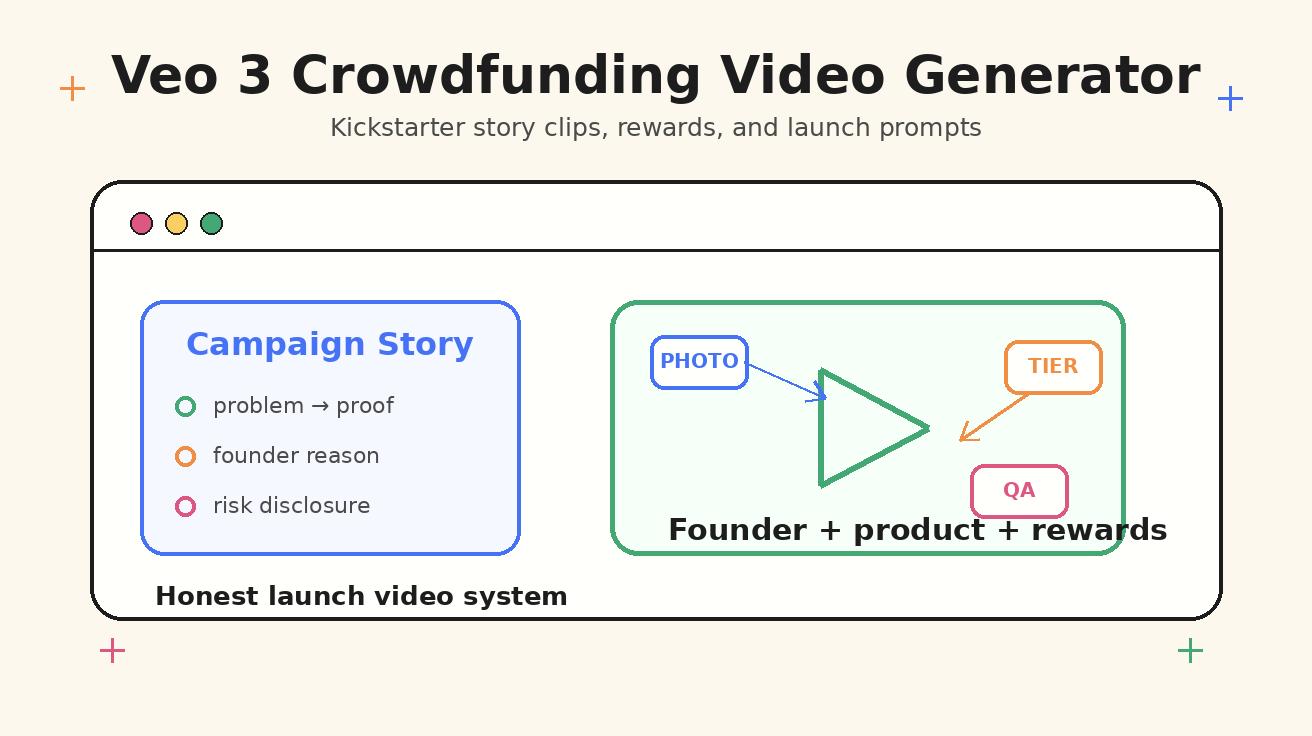
A Veo 3 crowdfunding video generator workflow has to do more than create a beautiful launch clip. A Kickstarter or Indiegogo video asks strangers to trust a product before it is fully delivered. That makes the creative standard different from a normal product ad. The video needs emotion, proof, reward clarity, and compliance discipline at the same time. It should help backers understand the founder story, the product state, the campaign promise, and the risks without implying facts that the team cannot support.
This guide is written for founders, product marketers, campaign agencies, and creators preparing Kickstarter story clips, Indiegogo launch videos, reward tier videos, campaign teaser videos, and product launch video assets with Veo 3. The practical goal is not to ask AI to invent a whole campaign. The practical goal is to build a controlled system: prepare truthful source material, generate modular clips, review every frame, and assemble a final video that can survive platform review and backer scrutiny.
The core keyword is veo 3 crowdfunding video generator. Secondary use cases include kickstarter video generator, crowdfunding video prompts, product launch video, reward tier video, and campaign teaser video. If you need related production methods, keep these internal references nearby: Veo 3 image reference workflow, Veo 3 camera control prompts, Veo 3 product ads video generator, and Veo 3 safety filters guide.
Quick answer: what should the workflow create?
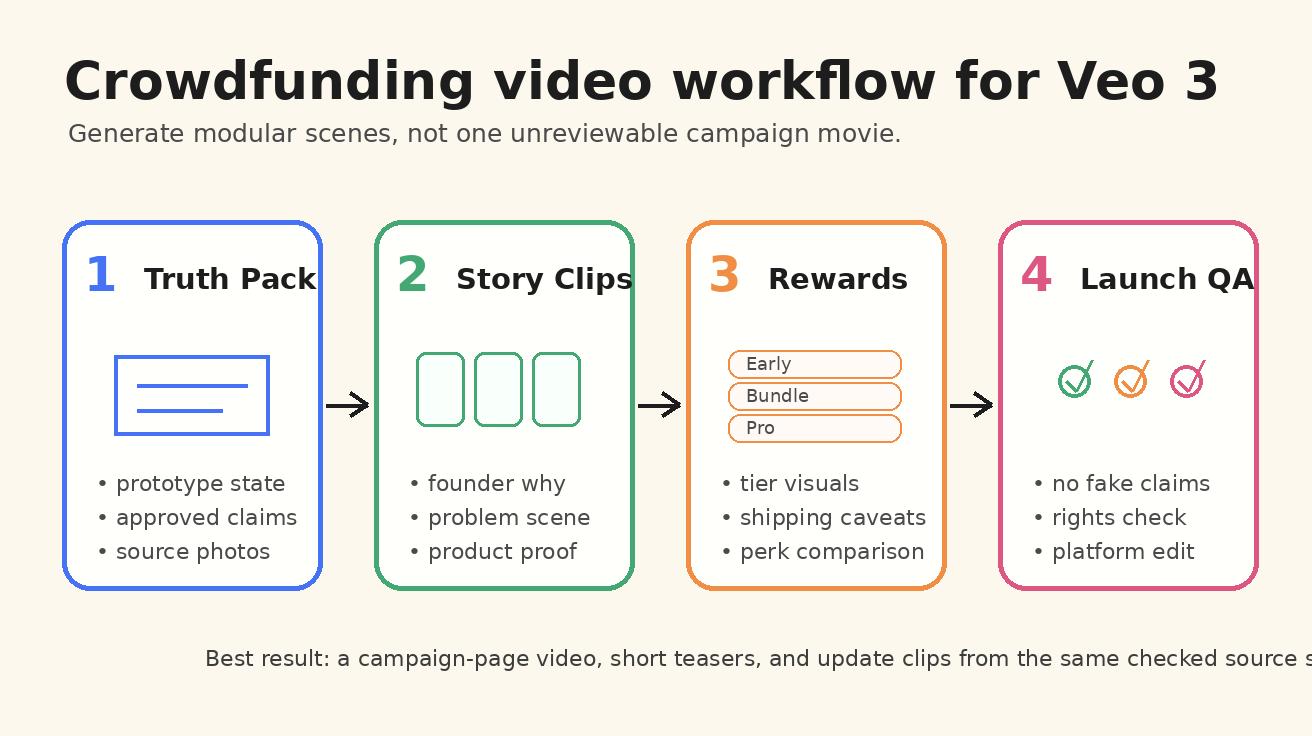
A good crowdfunding workflow creates a kit of short, checked clips rather than one long unreviewable movie. The kit should include a founder introduction, a problem scene, a product proof shot, a usage moment, a reward-tier explanation, a timeline or fulfillment moment, a risk transparency scene, and a call-to-action clip. Those pieces can become a two-minute campaign page video, a thirty-second pre-launch teaser, a ten-second ad, an update clip, and a short organic social post.
The safest approach is to treat Veo 3 as a scene generator, not as a campaign strategist. Your strategy should come from the real product, real backer research, real production plan, and real risk assessment. Veo 3 can help visualize scenes quickly, explore camera language, test emotional pacing, and turn approved product photos into more dynamic clips. It should not invent customer testimonials, manufacturing status, test results, certifications, press coverage, delivery dates, or reward availability.
Why crowdfunding videos need a different AI workflow
A standard product launch video often has one simple job: make the product look desirable. A crowdfunding video has a harder job. It must make the product desirable while also explaining why it exists, why the founder can deliver it, what backers receive, when they may receive it, and what uncertainty remains. That means your prompts need more than cinematic style. They need truth boundaries.
Kickstarter and Indiegogo audiences are also sensitive to trust signals. Backers expect enthusiasm, but they also look for evidence. They notice when a product is only shown as a polished render. They notice when a campaign hides the development state. They notice when reward tiers feel confusing. AI-generated visuals can help a team communicate, but they can also create risk if they make a prototype look finished or make a concept look already manufactured.
Use a simple rule: if a clip would make a reasonable backer believe something false about the product, the clip should not be used. This applies even when the clip is beautiful. A founder holding a production-ready box is risky if no production-ready box exists. A warehouse full of units is risky if manufacturing has not started. A happy customer testimonial is risky if the person is fictional. A chart showing performance results is risky if the test did not happen. Your Veo 3 workflow should prevent those mistakes before they enter the edit.
The crowdfunding truth pack
Before opening the generator, create a truth pack. This is a short document that defines what the video is allowed to show and what it must avoid. It becomes the source of truth for prompts, editing notes, captions, and final QA.
The truth pack should include the campaign promise in one sentence. For example: “We are raising funds to manufacture a compact desk device that helps remote teams capture clearer meeting notes.” It should include the current product state: concept sketch, working prototype, beta hardware, final tooling, software demo, or production sample. It should list approved product claims, such as battery target, app feature, material, compatibility, or current test status. It should also list forbidden claims, especially anything still pending.
Add reward details. Write the exact tier names, what each tier includes, what is limited, what is optional, and what should not be implied visually. Add timeline language, but avoid turning estimates into promises. Add risk notes that should appear in the campaign page and inform the video. Add rights notes: who can appear on camera, which product photos are approved, which logos are owned, which music is licensed, and whether any UI screenshot is final or a mockup.
This truth pack is the difference between a helpful Kickstarter video generator workflow and an unsafe one. Without it, the model may produce persuasive scenes that are hard to verify. With it, every prompt can carry boundaries such as “show prototype status clearly,” “do not show mass production,” “do not show fake customer reviews,” and “captions will be added in editing.”
Story structure for a Kickstarter or Indiegogo video
Most crowdfunding videos work best when they follow a backer decision path. The viewer first needs to recognize the problem. Then they need to believe the founder understands the problem. Then they need to see a credible product solution. Then they need to understand what backing means. Finally, they need a clear call to action and a responsible reminder that crowdfunding includes uncertainty.
A practical structure is seven scenes. Scene one is the hook: a real frustration or opportunity shown visually. Scene two is the founder reason: why this team cares and why now. Scene three is the product proof: the prototype, app, device, board game, tool, accessory, or creative project in action. Scene four is the transformation: how life changes when the product works. Scene five is the rewards: what backers can choose and how tiers differ. Scene six is the plan: what has been built, what remains, and what risks exist. Scene seven is the call to action: back the campaign, share it, or join updates.
Generate each scene separately. This gives you control. If the founder clip feels unnatural, replace only that clip. If the reward tier visual implies the wrong bundle, replace only that clip. If the prototype proof shot looks too finished, rewrite that prompt. Modular generation also lets you use the same source scenes for different placements. The campaign page may need a longer story, while pre-launch ads need only the problem and promise.
Prompt formula for crowdfunding clips
Use a repeatable formula: source truth, scene role, visual action, product state, camera direction, safety boundary, and edit instruction. A weak prompt says, “Make a viral Kickstarter video for my product.” A strong prompt says, “Create a six-second founder workshop clip for a Kickstarter campaign. Show a working prototype on a desk, not a final retail unit. The founder explains the design problem with calm confidence. Use a slow push-in, warm natural light, no fake charts, no customer testimonials, and leave clean space for captions.”
The source truth tells the model what is real. The scene role tells it why the clip exists. The visual action prevents vague output. The product state keeps the clip honest. Camera direction creates consistency. Safety boundaries prevent misleading imagery. Edit instructions make the clip useful in a timeline.
Here is a reusable master prompt:
Create a short crowdfunding campaign video scene for [Kickstarter or Indiegogo]. Scene role: [hook, founder story, prototype proof, reward tier, timeline, risk disclosure, call to action]. Product: [plain description]. Current state: [prototype, working demo, mockup, final sample]. Visual action: [what happens on screen]. Camera: [framing and movement]. Tone: honest, optimistic, practical, not exaggerated. Boundaries: do not invent customer reviews, certifications, production footage, delivery guarantees, brand logos, or readable UI text. Important captions will be added later in editing. Leave clean negative space for captions.
Use that formula as a baseline, then customize by scene.
Founder story clip prompts
Founder clips should build trust without becoming theatrical. The founder does not need to look like a celebrity. They need to look credible, specific, and connected to the problem. If you have real founder footage, use it. If you are generating supporting visuals, keep the person generic or use consent-based references. Avoid implying that a fictional person is the actual founder.
Prompt example:
Six-second founder story clip for a Kickstarter campaign about [product]. A real workshop-style setting with sketches, prototype parts, and a laptop in the background. Show the founder reviewing notes beside the prototype, calm and focused, documentary product launch style, handheld micro-movement, warm daylight. The clip should feel honest and in-progress. Do not show a finished retail box, mass production, fake awards, fake press logos, or exaggerated success metrics. Leave space on the left for the caption: “Built after three years of testing.”
If the founder is not appearing, use a hands-and-workspace approach:
Close-up founder process clip for an Indiegogo campaign. Hands organize prototype parts, compare an early sketch with the current working sample, and mark one design improvement on paper. Realistic desk, practical lighting, no face, no logos, no fake data, no finished packaging. Camera slowly moves from sketch to prototype. Honest maker tone.
These clips work well near the start of the video, after the problem scene. They answer the silent backer question: “Who is behind this, and do they understand the work?”
Product proof prompts
Product proof is the most important part of a crowdfunding video. It should show what exists now. If you have approved product photos, prototype footage, CAD images, or screenshots, use them as references. If the product is not finished, the prompt should say so. The output should not hide uncertainty behind cinematic polish.
Prompt for a hardware prototype:
Product proof scene for a Kickstarter video. Show a working prototype of [product] on a clean desk while a user performs [specific action]. The product is a prototype, not a final retail unit, so preserve a practical in-development look. Camera: stable three-quarter close-up, slow push-in, natural light. Show only the current supported function: [function]. Do not show final packaging, factory lines, impossible durability, waterproof testing, certifications, or mass production. No readable fake labels.
Prompt for an app or software product:
Product proof scene for a crowdfunding product launch video. Use approved app screenshots as the visual reference. Show a phone in hand with subtle motion and a clean background. Preserve the UI layout and colors. Do not invent new screens, user data, ratings, testimonials, or pricing. Captions and feature labels will be added in the editor. Camera: gentle handheld, realistic reflections, no distorted interface elements.
Prompt for a creative project:
Campaign proof clip for a creator-led crowdfunding project. Show the creative material in progress: storyboard pages, sample artwork, prototype packaging, and a creator reviewing the next milestone. Tone: intimate, transparent, optimistic. Do not imply the full project is already complete unless the campaign truth pack confirms it. Avoid fake fan reactions, fake sales numbers, or fake awards.
Reward tier video prompts
Reward tiers can confuse backers. A short reward-tier video should make the choices clearer, not more decorative. The clip should show what is included, what changes between tiers, and what backers should not assume. Because generated text can be unreliable, keep tier names, prices, dates, and quantities in the edit layer instead of relying on model-generated text.
Prompt for a simple tier comparison:
Reward tier explainer clip for a Kickstarter campaign. Show three clean tabletop arrangements representing the campaign tiers: Starter, Bundle, and Pro. Use neutral placeholder cards with no readable generated text. Starter shows [items]. Bundle shows [items]. Pro shows [items]. Camera moves slowly from left to right. The arrangement should feel clear and trustworthy, not luxurious or exaggerated. Do not show items that are not included in the rewards. Leave space above each group for edited labels.
Prompt for an early-bird perk:
Early-bird reward video scene for an Indiegogo launch. Show a limited first-backer bundle being prepared on a desk: product sample, thank-you card, accessory, and shipping-safe packaging concept. Honest pre-production look, no final mass-produced box unless approved. Camera: close-up slider motion. Do not imply guaranteed delivery dates, fake scarcity numbers, or unapproved bonus items. Text will be added later.
Reward clips are especially useful as standalone assets. They can live in the main campaign video, the reward section, pre-launch emails, ads, and backer updates. Make them modular and easy to re-edit when the offer changes.
Campaign teaser video prompts
A campaign teaser is not the full pitch. It should create curiosity, capture the problem, and point viewers to the campaign without overexplaining. Teasers are useful before launch, during the first day, and after milestones. They should be short, clean, and honest.
Prompt for a pre-launch teaser:
Ten-second campaign teaser video for [product category]. Scene one: the problem moment, [describe user frustration]. Scene two: a brief glimpse of the prototype solving one specific part of the problem. Scene three: a clean campaign page mock frame with empty space for the launch date caption. Tone: anticipatory, practical, trustworthy. Do not show fake backer counts, fake press quotes, fake countdown numbers, or final production scenes. Use cinematic but restrained lighting.
Prompt for a launch-day teaser:
Launch-day campaign teaser for Kickstarter. Show the founder pressing publish on a campaign dashboard from behind, then cut to the prototype on a desk and a close-up of the reward bundle layout. Keep all screen text unreadable or blank because captions will be added later. Energetic but not hype-heavy. Do not show fake funding totals, fake comments, or fake social proof.
Prompt for a post-launch update:
Backer update video clip for an Indiegogo campaign. Show progress in the workshop: prototype iteration, packaging test, and team review checklist. Honest status update tone. Do not imply shipping has begun unless confirmed. Do not show fake factory scale. Leave lower-third space for the update headline.
Using product photos, screenshots, and prototypes safely
Product photos and screenshots are the best anchors for Veo 3 crowdfunding clips because they reduce invention. Use the clearest current photo as the visual source, then ask for subtle motion around it. Do not ask for major redesigns unless the clip is only concept art and will be labeled that way. If the product is a prototype, include that in the prompt. If the screen is a mockup, include that in the prompt and in the final caption.
For product photos, ask for preservation. Say “preserve shape, proportions, materials, color, and visible components.” Ask for controlled camera motion such as a slow push-in, orbit, rack focus, or handoff. Avoid requests that force the model to create tiny text, serial numbers, compliance marks, or exact packaging. Those details should come from real assets.
For screenshots, separate UI truth from mood. If the screenshot must be accurate, keep it still or nearly still and add motion around the device. If the screenshot is only illustrative, label it as a mockup in the campaign page. Never let the model create fake app store ratings, financial outcomes, medical results, or private user data. A product launch video can be persuasive while still being precise.
For founder footage, use consent-based material. If a real founder appears, use actual footage or authorized references. If the generated clip uses a fictional stand-in, do not present that person as the founder. For voiceovers, use real recorded founder audio when possible, or use a licensed synthetic voice that does not imitate a public figure or private person without permission.
Editing workflow after generation
The edit is where the crowdfunding video becomes trustworthy. Put all important text in the editor: tier names, prices, deadlines, shipping windows, prototype labels, disclaimers, and calls to action. This makes every claim reviewable. It also prevents tiny generated text from becoming unreadable or wrong.
Build the edit in layers. The first layer is the story sequence: problem, founder, product proof, rewards, plan, risk, call to action. The second layer is captions. The third layer is proof inserts, such as real prototype photos, test footage, screenshots, or diagrams. The fourth layer is safety notes and platform-specific disclaimers. The fifth layer is music and pacing.
Keep edit handles. Ask each generated clip to start and end with a stable frame. This gives the editor room to cut. Keep scene duration short: five to eight seconds for story scenes, three to five seconds for reward inserts, and one to three seconds for teaser cuts. For the main campaign video, fewer strong clips are better than many confusing clips.
Compliance and safety notes
Crowdfunding is built on trust. Your video should not show fake backers, fake comments, fake reviews, fake press logos, fake certification marks, fake factory footage, fake manufacturing readiness, fake durability tests, fake medical outcomes, or fake environmental claims. If a benefit is still an assumption, say it as an intention or target, not as a proven result. If a timeline is uncertain, avoid language that sounds guaranteed.
Disclose prototypes clearly. If the product shown is a prototype, call it a prototype. If a scene is a concept visualization, call it a concept visualization. If a screenshot is a mockup, call it a mockup. If the campaign has risks around tooling, suppliers, certification, shipping, software development, or fulfillment, the video should not contradict the written risk section.
Rights matter too. Do not use recognizable logos, third-party product designs, public figures, celebrities, real customer faces, copyrighted music, or competitor interfaces unless you have the correct rights and a safe use case. Keep source files, prompts, generated clips, licenses, and final exports in a campaign evidence folder. If a platform, partner, or backer asks why a scene is accurate, you should be able to answer.
QA checklist before publishing
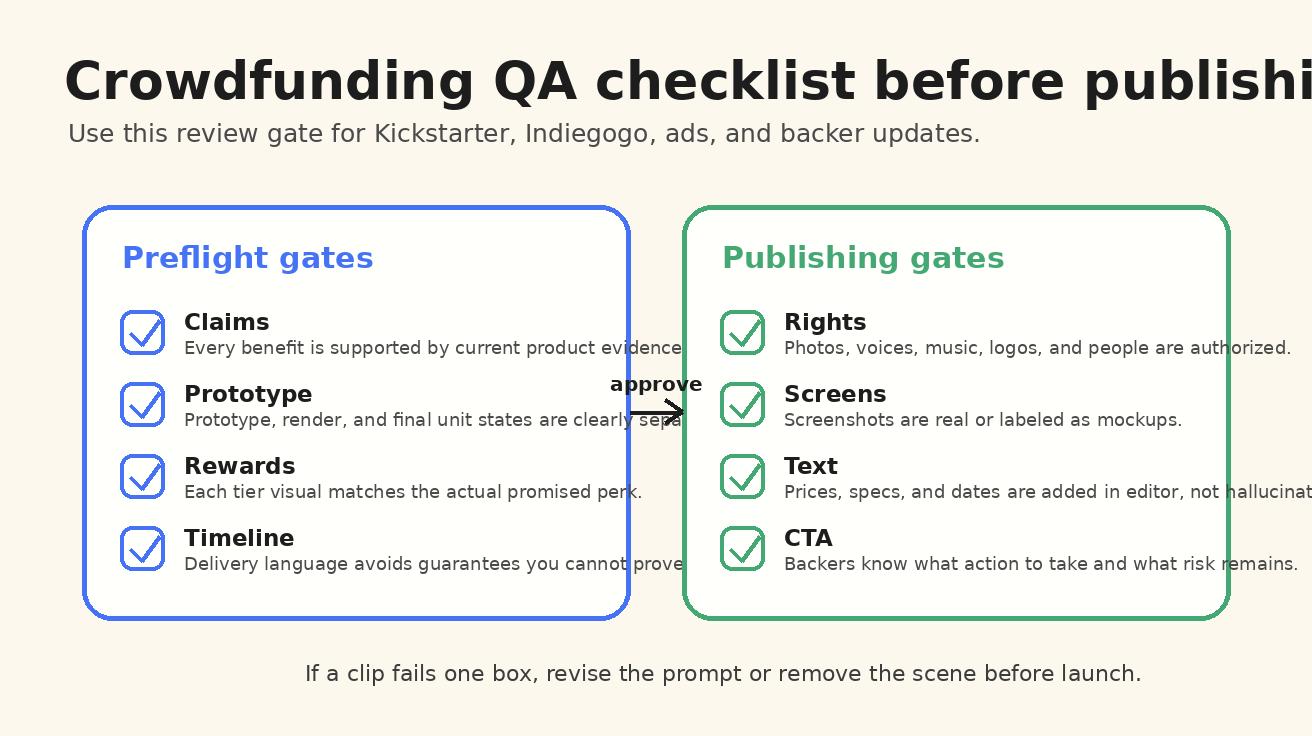
Use this checklist before the campaign video goes live. First, verify product state. Does every product shot match what exists today? Second, verify claims. Does every caption, voiceover line, and visual implication have evidence? Third, verify rewards. Does every tier scene show only items included in that tier? Fourth, verify timeline. Does the video avoid guaranteed dates unless those dates are supportable? Fifth, verify risks. Does the video align with the written risk disclosure?
Sixth, verify rights. Are all people, voices, music, product photos, screenshots, logos, and background assets authorized? Seventh, verify UI and text. Are important words added in editing instead of generated inside the image? Eighth, verify platform fit. Does the campaign page version differ from the ad version when necessary? Ninth, verify accessibility. Are captions readable, contrast strong, and pacing understandable without sound? Tenth, verify export. Does the final video load quickly, look sharp, and include a clean first frame for the campaign page?
If any item fails, do not publish the clip. Revise the prompt, replace the scene with real footage, or remove the visual claim. The cost of fixing a clip before launch is much lower than the cost of losing backer trust after launch.
Example production plan for one campaign
Imagine a founder launching a compact desk device on Kickstarter. The team has a working prototype, three product photos, one short real demo video, a shipping estimate, and three reward tiers. The team should not ask Veo 3 to create a finished commercial from scratch. Instead, it should create a controlled scene list.
Scene one shows the problem: a remote worker struggling with messy notes. Scene two shows the founder workspace and early sketches. Scene three uses the real prototype photo as a reference and adds subtle camera motion. Scene four shows the product action in a simplified setting. Scene five shows the three reward bundles as unlabeled arrangements, with real labels added later. Scene six shows the roadmap: prototype complete, tooling next, fulfillment planning. Scene seven shows the call to action with honest language: “Back the campaign and follow the build.”
This plan can produce one campaign page video, one reward-tier clip, two teasers, and one backer update template. The same source truth supports every asset. That is the main advantage of a structured Veo 3 crowdfunding workflow.
Common mistakes to avoid
The first mistake is asking for one perfect two-minute video. Long prompts create brittle outputs, and a single inaccurate scene can make the whole result unusable. Generate short clips instead.
The second mistake is over-polishing a prototype. Beautiful lighting is fine. Misleading production readiness is not. If the product is handmade, beta, pre-tooling, or software-only, show that honestly.
The third mistake is letting generated text carry important information. Campaign videos need exact wording. Add prices, tier names, dates, specs, and disclaimers in editing.
The fourth mistake is using fake social proof. Do not generate backer comments, star ratings, testimonials, press logos, award badges, or funding totals. If you have real proof, use the real asset. If not, leave it out.
The fifth mistake is ignoring the reward section. Many teams obsess over the hook and forget that backers need to choose a tier. A clear reward-tier video can reduce confusion and improve the campaign page experience.
Final workflow summary
A strong Veo 3 crowdfunding video generator workflow is built on truth first and creativity second. Start with the campaign truth pack. Break the launch story into modular scenes. Use product photos, screenshots, and prototype footage as anchors. Generate short clips with clear boundaries. Add important text in editing. Review every scene for claims, rewards, rights, and platform fit. Submit only the clips that make the campaign clearer and more trustworthy.
That process gives founders more than a single video. It creates a reusable launch asset system: Kickstarter video, Indiegogo video, product launch video, reward tier video, campaign teaser video, pre-launch social clips, and backer updates. The real win is not that AI makes the campaign look bigger. The real win is that the team can explain the product more clearly without losing honesty.
FAQ
Can Veo 3 make a Kickstarter campaign video by itself?
Veo 3 can help generate short story clips, product moments, founder scenes, reward-tier visuals, and campaign teaser shots, but a trustworthy Kickstarter video still needs real source material, accurate claims, human editing, platform review, and clear disclosure of prototype status and risks.
What should I prepare before using a Veo 3 crowdfunding video generator workflow?
Prepare the campaign promise, approved product photos or prototype footage, feature notes, reward tiers, delivery assumptions, risk disclosures, brand colors, founder talking points, and a shot list. The model should receive controlled creative direction, not be asked to invent the business case.
Should AI-generated clips show a finished product if I only have a prototype?
No. If the item is a prototype, the video should say or visually imply prototype status accurately. Avoid fake manufacturing footage, fake customers, exaggerated durability, unsupported delivery dates, or scenes that make a concept look like mass production.
How do I use product photos or screenshots in crowdfunding prompts?
Use product photos and screenshots as reference anchors. Ask for subtle motion, stable framing, realistic hands, simple environments, and no new labels or interface text. Put important captions, prices, dates, and specs in the video editor where they can be reviewed.
What clips should a Kickstarter or Indiegogo launch video include?
A strong sequence usually includes the problem, founder motivation, product proof, main use case, reward-tier explanation, campaign timeline, risk transparency, and call to action. Generate each scene separately so it can be checked and replaced without breaking the whole video.
Can I reuse the same Veo 3 clips for ads, updates, and social teasers?
Yes, if the source clips are accurate and rights-safe. Build modular scenes with clean edit handles, then create platform-specific versions for the campaign page, pre-launch email, Kickstarter updates, Indiegogo updates, short ads, and organic social posts.
<script type="application/ld+json"> { "@context": "https://schema.org", "@type": "FAQPage", "mainEntity": [ { "@type": "Question", "name": "Can Veo 3 make a Kickstarter campaign video by itself?", "acceptedAnswer": { "@type": "Answer", "text": "Veo 3 can help generate short story clips, product moments, founder scenes, reward-tier visuals, and campaign teaser shots, but a trustworthy Kickstarter video still needs real source material, accurate claims, human editing, platform review, and clear disclosure of prototype status and risks." } }, { "@type": "Question", "name": "What should I prepare before using a Veo 3 crowdfunding video generator workflow?", "acceptedAnswer": { "@type": "Answer", "text": "Prepare the campaign promise, approved product photos or prototype footage, feature notes, reward tiers, delivery assumptions, risk disclosures, brand colors, founder talking points, and a shot list. The model should receive controlled creative direction, not be asked to invent the business case." } }, { "@type": "Question", "name": "Should AI-generated clips show a finished product if I only have a prototype?", "acceptedAnswer": { "@type": "Answer", "text": "No. If the item is a prototype, the video should say or visually imply prototype status accurately. Avoid fake manufacturing footage, fake customers, exaggerated durability, unsupported delivery dates, or scenes that make a concept look like mass production." } }, { "@type": "Question", "name": "How do I use product photos or screenshots in crowdfunding prompts?", "acceptedAnswer": { "@type": "Answer", "text": "Use product photos and screenshots as reference anchors. Ask for subtle motion, stable framing, realistic hands, simple environments, and no new labels or interface text. Put important captions, prices, dates, and specs in the video editor where they can be reviewed." } }, { "@type": "Question", "name": "What clips should a Kickstarter or Indiegogo launch video include?", "acceptedAnswer": { "@type": "Answer", "text": "A strong sequence usually includes the problem, founder motivation, product proof, main use case, reward-tier explanation, campaign timeline, risk transparency, and call to action. Generate each scene separately so it can be checked and replaced without breaking the whole video." } }, { "@type": "Question", "name": "Can I reuse the same Veo 3 clips for ads, updates, and social teasers?", "acceptedAnswer": { "@type": "Answer", "text": "Yes, if the source clips are accurate and rights-safe. Build modular scenes with clean edit handles, then create platform-specific versions for the campaign page, pre-launch email, Kickstarter updates, Indiegogo updates, short ads, and organic social posts." } } ] } </script>
Related Articles
Continue with more blog posts in the same locale.
How to Make Sports Highlight Videos with Veo 3 AI (2026)
Create stunning sports highlight videos with Veo 3 AI. Generate dynamic action shots, slow-motion sequences, and dramatic replays using AI prompts.
Read article
How to Make a Short Film with Veo 3 AI (2026 Guide)
Learn how to create professional short films using Veo 3 AI. Step-by-step guide with prompts, workflow tips, and cinematic techniques.
Read article
How to Make Documentary Videos with Veo 3 AI (2026 Guide)
Create compelling documentary videos with Veo 3 AI. Learn prompting techniques, narrative structure, realistic footage generation, and post-production tips.
Read article